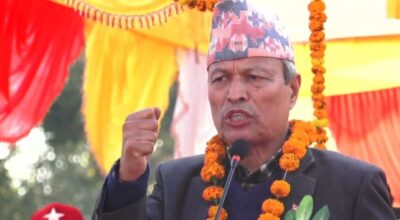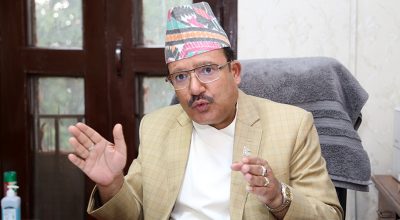



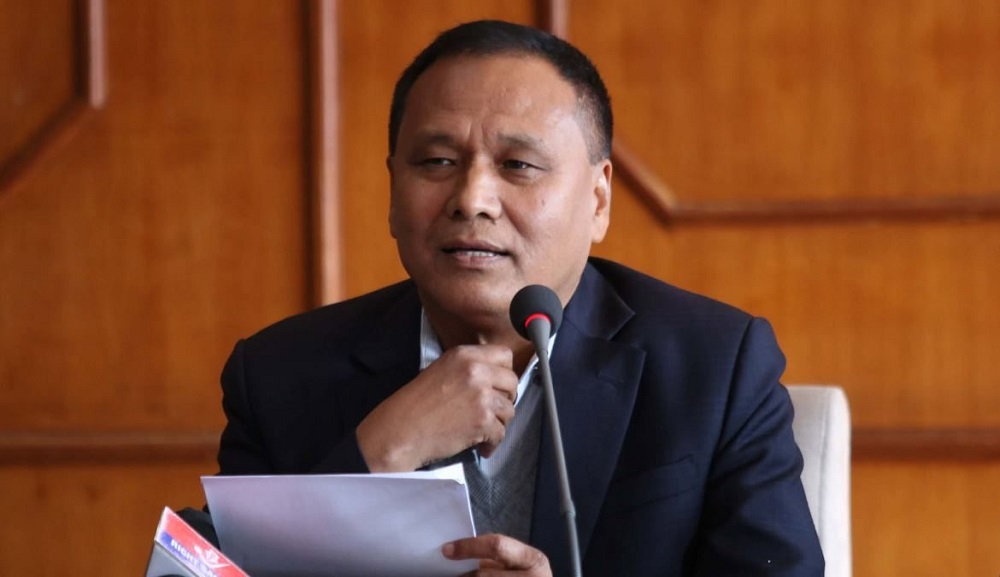
Kathmandu, Dec 24: Minister for Energy, Water Resources and Irrigation Kul Man Ghising has said that significant decisions and work implementation have taken place in the areas of energy production, transmission, investment management, and disaster risk reduction during his 100-day tenure at the ministry.
In a news conference organized at the Ministry today, Minister Ghising presented a list of 101 works carried out in the 100 days, stating that development projects have been expedited through direct inspection, proactive directives and administrative reforms.
He stated that domestic investment has been ensured for the Budhigandaki and Upper Arun hydropower projects while improving the electricity sector. An investment and financial modality has been prepared for construction through domestic investment and sent to the Ministry of Finance for these projects.
The Energy Minister mentioned that the ‘premium’ dues of ‘dedicated’ and ‘trunk’ lines, which could not be collected in the past, has started to be collected regularly.
“Due to clear instructions and strong decisions, all industries have started paying their outstanding revenues. Revenue collection has also begun from closed industries and those that had not paid a single instalment,” he said.
According to him, during this period, the management of ministry’s project contracts has been improved. Even though 60 percent of the contract duration has passed, only 10 percent of the work has been completed, and 22 problematic contracts under the Department of Water Resources and Irrigation, including the Rs 14 billion 220 million contract of the National Pride Sunkoshi Marine Multipurpose Project, have been terminated.
The project has been accelerated by understanding the problems of farmers whose fields have become barren due to lack of irrigation. A ‘Term Sheet’ has been signed with banks for the financial management of the Chainpur Seti project.
During this period, the Middle Bhotekoshi Hydropower Project was completed, the power generated from this project connected to the national transmission line, and the project began commercial production, Minister Ghising stated.
Similarly, electricity worth around Rs. 19 billion has been exported to India and Bangladesh. A framework under the “TBCB” model has been prepared for developing transmission lines.
An agreement has been finalized for constructing the Inaruwa–Purnia and Dododhara–Bareilly 400 kV cross-border lines under the Nepal–India venture, it was shared during the press meet.
At the 17th Nepal–India Joint Technical Team (JETT) meeting, Nepal’s export capacity was set at 1,500 MW, while India’s import capacity was set at 1,400 MW.
In a Nepal–Bangladesh meeting, Bangladesh agreed to import an additional 20 MW. To boost investment, the Ministry of Finance has proposed permitting the Nepal Electricity Authority to issue a 20 billion rupees energy bond and offer 20 percent of shares to the public.
Regarding irrigation, it has been decided to establish an irrigation management company to expand facilities to 22,500 hectares in Sarlahi and Rautahat with the help of 500 deep tubewells.
Work is in progress to terminate contracts for 22 of 33 stalled projects, and the Sunkoshi Marin Diversion Project contract has been ended due to delays. This follows the initiation of a new bidding process.
The Rasuwagadhi Hydropower Project has resumed 37 MW production after repairing its flood-damaged structures. Land is being acquired for a 132 kV substation at Singha Durbar, and seven of 13 grid substations have been automated. Minister Ghising added that the state’s disaster management capacity has been assessed within 100 days. #nepal #rss