


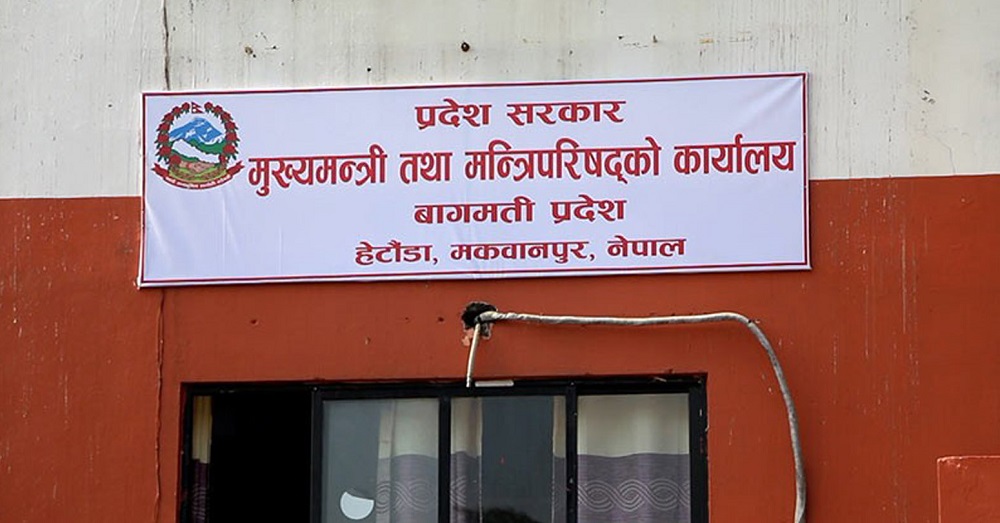
Hetauda, May 3: The Bagmati Province government has launched a new initiative to systematise the formulation of its annual budget and programmes, aiming to address long-standing issues in project selection and implementation.
The move comes in response to persistent concerns over irregularities in the annual project proposal process, including influence-based decision-making and the proliferation of fragmented projects.
According to the Ministry of Economic Affairs and Planning, the Annual Project Proposal and Selection Guidelines, 2083 has been introduced in line with a resolution endorsed by the Bagmati Provincial Assembly on July 27, 2025.
The guidelines aim to make the process time-bound and systematic by establishing objective criteria for selecting projects and programmes. The new framework also ensures that budget formulation aligns with constitutional provisions, including fundamental rights, directive principles, state policies, and provincial financial procedures.
Minister for Economic Affairs and Planning Prabhat Tamang said that all line ministries and central bodies are now required to submit programme proposals along with a medium-term expenditure framework, projecting costs for the next three years.
These proposals must be based on periodic plans and sectoral policies and presented in a sector-wise format covering departments, directorates, projects, and subordinate offices.
The guidelines prioritise projects that contribute to rapid economic growth, align with provincial priorities or comparative advantages, and can be completed within a short timeframe. Projects that have already completed preliminary preparations and support the objectives of the current provincial periodic plan will also receive preference.
Tamang, who also serves as the government spokesperson, added that ministries and central bodies must classify and present their annual budget and programme proposals sector-wise, covering their directorates, offices, projects, and subordinate entities.
Priority will also be given to projects that address regions lagging in geographical and human development indicators, contribute to social inclusion and gender mainstreaming, support the achievement of sustainable development goals, and promote cost-sharing in development and construction.
The guidelines further require provincial government offices at the district level to publish public notices inviting project proposals for the upcoming fiscal year. Additionally, Provincial Assembly members may propose projects they consider necessary within their constituencies.
A key feature of the new framework is the establishment of Project Selection Recommendation Committees at both district and constituency levels. These committees will review, discuss, and analyse proposals to ensure balanced distribution across geographical areas, districts, and local levels while avoiding duplication.
Each committee will be led by a directly elected Provincial Assembly member as coordinator, with a proportional representation member serving as co-coordinator. Other members will include the mayor or deputy mayor of the concerned local level—or a designated representative—and the head of the relevant sectoral office, who will serve as member-secretary.
According to Minister Tamang, the new system is expected to improve transparency, accountability, and efficiency in public spending, ultimately contributing to more effective development outcomes across the province. #Nepal