


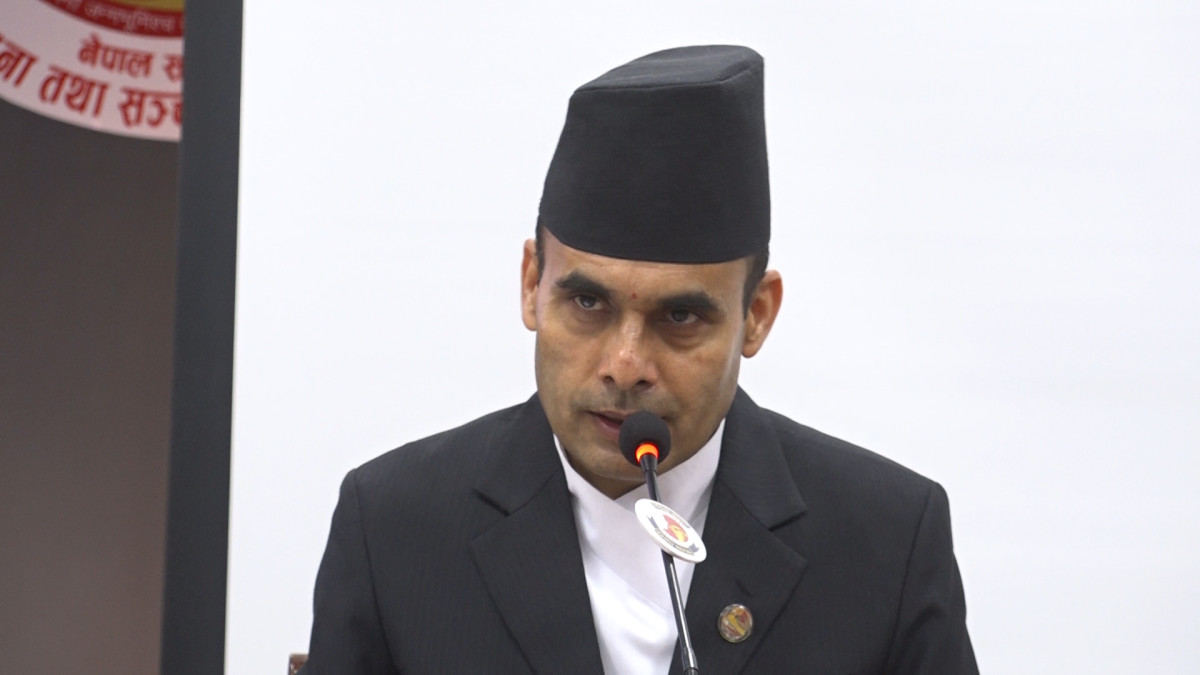
Kathmandu, June 4: Minister for Information and Communication Dr. Bikram Timilsina has announced a series of major reforms aimed at restructuring Nepal’s communication sector in line with the country’s federal governance framework.
Speaking at a meeting of the Ministry of Information and Communication’s thematic committee on Wednesday, Minister Timilsina said the government has taken significant policy decisions to improve coordination, clarify responsibilities and enhance service delivery across all three tiers of government.
The thematic committee, formed under Section 22 of the Intergovernmental Coordination and Interrelation Act, 2077, endorsed a range of reforms targeting legal, administrative and digital transformation within the communication sector.
One of the key decisions concerns the management of radio equipment licensing. The committee agreed that provincial governments will coordinate licensing processes in accordance with the Radio Act, 2014 and the Radio Communication (Licensing) Regulations, 2049. The meeting also decided to collect recommendations from all provinces to support broader reforms of existing communication laws.
In addition, the committee approved plans to amend the Printing and Publication Act, 2049, to address ongoing confusion regarding the registration and renewal of online media outlets. The proposed amendments are expected to simplify procedures and resolve challenges faced by online media registered under provincial legislation.
To strengthen transparency and governance, the committee endorsed the development of an integrated digital platform that will connect the Ministry, provincial governments, local governments and the Press Council Nepal. The unified system will manage the registration, renewal, monitoring and record-keeping of media institutions through a single database, reducing duplication and improving regulatory oversight.
The government has also announced plans to modernise and revitalise Nepal’s postal service by transforming it into a state-operated courier network. Under the proposed system, the postal network will be used to deliver essential public documents—including passports, driving licences, SIM cards and academic certificates—directly to citizens’ homes.
The committee called on provincial and local governments to coordinate closely in implementing the initiative. The meeting also discussed concerns over the encroachment of postal lands and assets and decided to work with local authorities to reclaim and protect government properties. All levels of government were urged to allocate adequate resources for the modernisation, diversification and digital transformation of postal services.
To address inconsistencies in the advertising sector, the committee approved the implementation of model guidelines prepared by the Advertising Board, along with model legislation for local governments. The objective is to establish a transparent, accountable and uniform advertising system nationwide.
The meeting further proposed recognising film, documentary, photography and digital content production as formal industries. It also pledged support for promoting Nepal as an international destination for film production by showcasing the country’s natural beauty and cultural heritage.
Among other decisions, the committee prioritised the effective utilisation of the Rural Telecommunications Development Fund to expand broadband internet access in rural and remote areas. The meeting also endorsed the standardisation of government gazette publication in line with federal formats and encouraged the production of news content in mother tongues as recommended by the Language Commission.
In response to growing concerns over misinformation, the committee stressed the need for public awareness programmes and initiatives promoting responsible journalism. The meeting also approved the ‘Work Procedure on Meetings and Decisions of Thematic Committee-2083’ and decided to establish a regular monitoring mechanism to ensure effective implementation of its decisions.
Minister Timilsina said the reforms are aimed at creating a more coordinated, modern and citizen-focused communication sector capable of meeting the demands of Nepal’s federal system and rapidly evolving digital landscape. #nepal