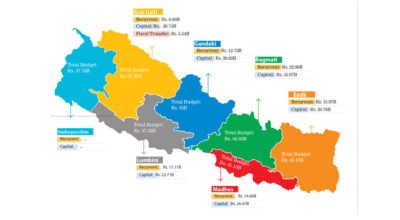



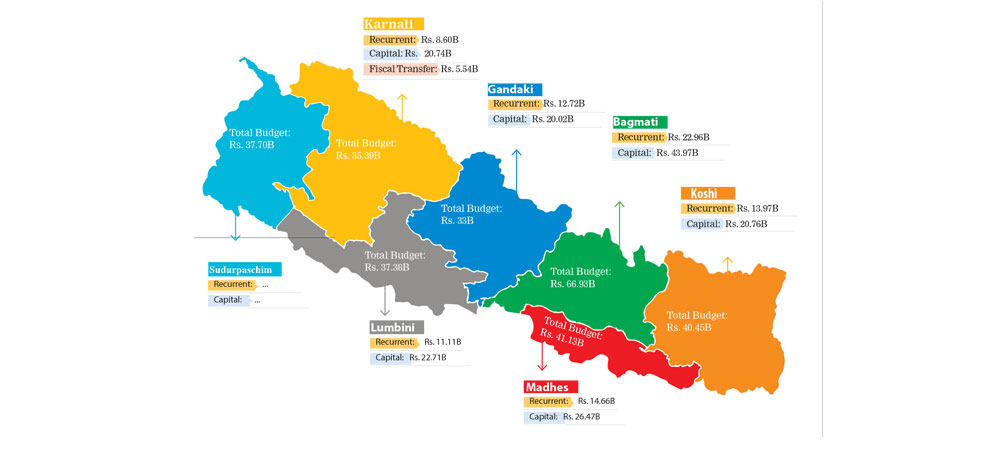
Kathmandu, June 16: All seven provincial governments have unveiled their annual budget totalling Rs. 291.98 billion for the upcoming fiscal year 2026/27, placing major emphasis on infrastructure development, agriculture modernisation, quality education, health services, employment generation and improved governance.
Bagmati Province has unveiled a budget of Rs. 66.93 billion, largest among the provinces, while Gandaki has announced the smallest budget of Rs. 33 billion for the next fiscal year.
The budgets also stress financial discipline, service delivery, improved implementation efficiency, austerity in recurrent spending and discouraging distribution-oriented programmes.
Koshi: Rs. 40.45 billion
The Koshi Province government has unveiled a budget of Rs. 40.45 billion for the next fiscal year 2026/27 aiming to ensure responsive, accountable, and transparent public service delivery, thereby strengthening the experience of good governance among citizens.
In a provincial assembly meeting held on Monday, Minister for Economic Affairs and Planning Bidur Kumar Lingthep presented the estimated income and expenditure for the next fiscal year.
Of the total budget, Rs. 13.976 billion has been allocated for recurrent expenditure, while Rs. 20.759 billion has been allocated for capital expenditure.
Similarly, Rs. 150 million has been set aside under the heading of financial management.
The recurrent expenditure accounts for 34.55 per cent of the total budget while capital expenditure accounts for 51.32 per cent and financial management accounts for 0.37 per cent.
The budget for the next fiscal year is 12.74 per cent higher compared to the current fiscal year.
The Koshi Province had unveiled a budget of Rs. 35.88 billion for the current fiscal year.
Regarding the sources of the budget, the government has estimated Rs. 5.50 billion from internal revenue, Rs. 12.87 billion from revenue sharing with the federal government, Rs. 9.12 billion from fiscal equalisation grants, Rs. 5.95 billion from conditional grants, and Rs. 550 million from supplementary grants. The government has estimated to meet the budget deficit of Rs. 5 billion from remaining cash balance of the current fiscal year.
The government has allocated the largest portion of Rs. 12.38 billion for infrastructure development, including Rs. 4 billion on the construction of roads and Rs. 6.28 billion for the drinking water, irrigation and energy sectors.
Similarly, Rs. 3.1 billion has been allocated for education and social sectors.
Madhes: Rs. 41.13 billion
The Madhes Province government has presented the budget of Rs. 41.13 billion for the upcoming fiscal year 2026/27.
Finance Minister Yubraj Bhattarai tabled the budget at the Provincial Assembly on Monday, giving emphasis to boosting production and expanding public services.
The government has allocated Rs. 14.66 billion for recurrent expenditure and Rs. 26.47 billion for capital expenditure.
The share of recurrent and capital budget is 35.64 per cent and 64.36 per cent respectively.
The budget for the coming year is about 13 per cent lower compared to the current fiscal year — Rs 46.58 billion.
Finance Minister Bhattarai said that despite limited resources and challenges in revenue growth, the budget has been introduced with a focus on production, employment generation, and infrastructure development.
For budget source management, it is estimated that Rs. 11.22 billion will be generated through internal revenue and other domestic sources. Likewise, Rs. 12.83 billion is expected to be received through revenue sharing from the federal government.
The fiscal grants to be received from the federal government will amount to Rs. 9.49 billion. In addition, Rs. 6.08 billion from the remaining cash balance of the current fiscal year will be mobilized for the next fiscal year.
The provincial government has also set a target of raising Rs. 1.50 billion in internal loans in the upcoming fiscal year.
Priority has been given to the modernisation of the agriculture sector, improvement of education, and expansion of access to health services.
The provincial government will revise the “Chief Minister’s Daughter Educate, Daughter Save Programme” into the “Chief Minister Women Self-Employment Programme,” aiming to enhance women’s skills, entrepreneurship, and economic empowerment.
Similarly, arrangements have been made to increase the salaries of government employees by 10 per cent and provide additional incentives based on performance.
The budget also includes a policy of not allocating funds to projects costing less than Rs 10 million and a ban on the purchase of new vehicles.
The government aims to focus investment on large and result-oriented projects rather than small and scattered projects.
Bagmati: Rs. 66.93 billion
The Bagmati Province government has presented the budget for the next fiscal year giving priority to infrastructure and agricultural development.
Minister for Economic Affairs and Planning Parbhat Gurung tabled the budget of Rs. 66.93 billion for the upcoming fiscal year 2026/26 at the Provincial Assembly on Monday.
This budget for the next fiscal year is Rs. 540 million lower compared to the current fiscal year.
Of the total budget, Rs. 22.96 billion (34.31 per cent) has been allocated for recurrent expenditure, and Rs. 43.97 billion (65.69 per cent) has been allocated as capital expenditure.
The estimated sources of financing for the next fiscal year include Rs. 30.15 billion from tax revenue, and Rs. 7.73 billion from other revenues.
It is estimated that Rs. 15.31 billion will be received from the federal financial transfer. Similarly, the government has estimated that Rs. 12.76 billion will be received from the projected savings in the consolidated fund of the current fiscal year and miscellaneous receipts, while Rs. 960 million is expected to be received from the repayment of loan investments from other institutions.
Under the Chief Minister’s “Poor Housing Programme,” Rs. 200 million has been allocated to construct and distribute safe housing to at least 1,000 extremely poor families within the coming fiscal year.
Rs. 565 million has been allocated for the construction of an integrated administrative building, Provincial Assembly building, and residential facilities of the Bagmati Province Government.
Infrastructure development projects in Hetauda—under the concept of a “Greater Hetauda”—include pedestrian-friendly roads with cycle lanes, river corridor development, and a provincial cultural village.
Gandaki: Rs. 33 billion
The Gandaki provincial government has presented a budget nearly Rs. 33 billion for the next fiscal year 2026/27.
Minister for Economic Affairs of Gandaki Province Jit Bahadur Sherchan presented the budget of Rs. 32.99 billion at the meeting of the Provincial Assembly.
The provincial government has allocated around Rs. 12.72 billion (38.56 per cent) under the heading of recurrent expenditure, and Rs. 20.02 billion (60.68 per cent) under the capital expenditure.
Likewise, around Rs. 250 million has been allocated for the financial management.
The sources for financing the budget include Rs. 7.84 billion from the federal government’s fiscal equalisation grant.
Likewise, Rs. 10.16 billion is expected from revenue sharing, and Rs. 514.8 million from royalty sharing.
It is estimated that Rs. 3.93 billion will be received from conditional grants, Rs. 554.6 million under supplementary grants and Rs. 395.4 million under special grants.
The provincial government has set a target of collecting Rs. 5.84 billion from internal revenue mobilisation.
After the implementation of the annual programmes of the current fiscal year, a cash balance of Rs. 2 billion is expected to remain, according to Minister Sherchan.
To cover the budget deficit of Rs. 1.75 billion, internal borrowing will be mobilised.The budget priorities include the development of sustainable and high-quality infrastructure along with the promotion of the tourism sector.
It also focuses on strengthening the economic sector, creating an investment-friendly environment, and improving revenue management.
For tourism promotion, programmes such as “First Home Country, Then Abroad” and “Lake to Lake” have been continued. This is expected to increase both domestic and international tourism, thereby linking local art, culture, traditions, and products with tourism and boosting income generation.
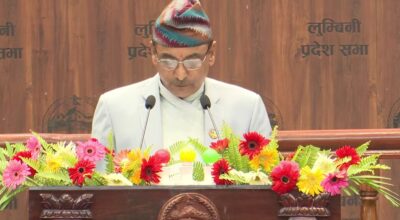
Lumbini: Rs. 37.38 billion
Lumbini Province government has unveiled a budget of Rs. 37.38 billion for the fiscal year 2026/27.
On Monday, Minister for Economic Affairs and Planning Dhanendra Karki presented the estimated income and expenditure statement of the provincial government at Provincial Assembly.
Out of the total budget, Rs. 22.71 billion has been allocated for capital expenditure, while Rs. 11.11 billion has been set aside for recurrent expenditure. The size of the budget for the province declined for the next fiscal year as compared to current fiscal year’s budget.
In the current fiscal year 2025/26, the government had introduced a budget of Rs. 38.91 billion.
For the development and expansion of irrigation, Rs. 864.1 million has been allocated, with priority given to the conservation of water sources.
Emphasis has also been placed on building sustainable and quality physical infrastructure, prioritising roads included in master plans and those connecting to national highways.
Under the province’s pride projects, Rs. 210 million has been allocated for the Rampur–Kapurkot road construction project. Additionally, Rs. 4 billion has been allocated to complete multi-year projects.
The budget also mentions programmes to connect youth with entrepreneurship, develop sports infrastructure, and implement plans focused on job creation.
Karnali: Rs. 35.39 billion
Meanwhile, the Karnali Province government has presented a budget of Rs. 35.39 billion for the upcoming fiscal year 2026/27.
Minister for Economic Affairs and Planning of Karnali Province, Rajib Bikram Shah, presented the budget at Karnali Provincial Assembly meeting on Monday.
Of the total budget, Rs. 8.60 billion (24.31 per cent) has been allocated for recurrent expenditure, while Rs. 20.74 billion (58.31 per cent) has been allocated for capital expenditure.
Likewise, Rs. 500 million (1.41 per cent) has been allocated for financial management and Rs. 5.54 billion (15.67 per cent) for financial transfer for local levels.
The budget for the next fiscal year is 7.28 per cent higher compared to the current fiscal year 2025/26.
For budget implementation, it is estimated to collect Rs. 855 million from internal sources and mobilise around Rs. 6.41 billion from the remaining unspent amount of the current fiscal year.
Similarly, it is expected to receive Rs. 10.66 billion through revenue sharing from the federal government, Rs. 10.63 billion as fiscal equalisation grants, and Rs. 5.67 billion as conditional grants.
In addition, Rs. 667.8 million will be obtained under supplementary grants and Rs. 485.6 million under special grants. To achieve employment and income growth through sustainable economic growth, quality and modern infrastructure, and to build skilled and productive human capital equipped with modern technology are the objective of the budget.
(Provincial reports prepared by Gokul Parajuli in Biratnagar, Ajaya Shah in Mahottari, Anil Parajuli in Hetauda, Liladhar Oli in Dang and Lalit Basel in Surkhet)
Sudurpaschim: Rs. 37.70 billion
The Sudurpaschim Province government has unveiled a budget of Rs. 37.70 billion for the next fiscal year 2026/27.
In the Provincial Assembly meeting held on late Monday evening, Minister for Economic Affairs Bikram Singh Dhami presented the estimated income and expenditure for the next fiscal year.
This is the largest budget ever introduced by the provincial government so far.
Minister Dhami said that the budget size was increased based on expected savings from the current fiscal year, higher internal revenue, and increased income from natural resources.
The budget has focused on service delivery, good governance, institutional strengthening, employment generation, and the overall economic development of the province. #nepal