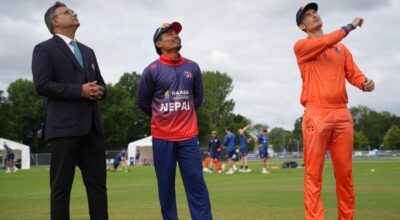




Kathmandu, July 1: Nepal defeated Bhutan by a huge margin of 298 runs in the final group match held today under ACC Men’s U-16 East Zone Cricket Cup.
Winning the toss, Nepal decided to bat first in today’s match held at Selangor Turf Club Ground in Malaysia and scored 358 runs at the loss of 5 wickets in the slated 50 overs.
For Nepal, Raunak Shrivastava scored highest 168 runs from 132 balls. Similarly, Joy Thapa collected 61 runs (not out), Shivans Bajgain 54 runs and Sugam Budhathoki 35 runs.
For the bowling side, Sangay Dorji of Bhutan took 3 wickets while Tenzin Loday one wicket.
Chasing the target of 359 posted by Nepal, Bhutan was able to muster 60 runs by losing nine wickets in 32.4 overs. The last batsman did not come to bat. For Bhutan, Tshezang Dawa made 14 runs and Ugyan Chophel 10 runs.
For Nepali bowling side, Captain Bipin Prasad Sharma took 4 wickets while Sachin Bhatta and Suyog Bhattarai 2 wickets each.
Nepal entered the semi-final remaining on the top of Group ‘A’ winning all four matches. Nepal will play semi-final match against host Malaysia on coming Thursday.
—
Fragmentation of development aid diluting its impact, says PM Oli
Kathmandu, July 1: Prime Minister KP Sharma Oli has said that the fragmentation of development aid spread across too many small projects, too many parallel channels, and too many competing priorities often dilutes its impact.
Equally troubling is the shift from grants to loans, even for countries already burdened with unsustainable debt, he said while making a statement during the Special Event convened by
President of the Government of Spain, Pedro Sanchez, on ‘Investing in Global Solidarity: A New Vision of Development Cooperation’ in Seville, Spain earlier today. The event was held in the margins of the Fourth International Conference on Financing for Development.
This event reaffirms the enduring value of development cooperation, especially in a time marked by resurgent nationalism, growing protectionism, and regional and global conflicts.
Stating that development cooperation is not a gesture of charity but a pledge to leave no one behind in our shared pursuit of progress, he said “It is about partnerships that empower communities, strengthen institutions, build capacity and that foster resilience.”
Development cooperation is solidarity in action for lasting peace, for shared prosperity, for climate justice and for the foundations of a just, fair, and equitable world. However, despite its proven relevance development assistance is declining even as the wealth and income of many advanced economies continue to rise. “And this decline comes when the need is greatest, when countries in special situations face rising pressures and widening gaps. They need enhanced and sustained global support to overcome mounting challenges and accelerate inclusive growth.”
Prime Minister Oli said the Sevilla Commitment, adopted on Monday, gives us new hope, as it is about turning principle into progress through global solidarity.
Welcoming the clear emphasis on the need to strengthen international development cooperation as a driver of sustainable development, Oli said this is the moment to translate our words into action. We must now deliver—on both our commitments and our principles of effectiveness. We must find innovative ways to mobilise resources and make development cooperation truly meaningful for the lives of people on the ground.
Today, he said, developing countries face mounting financial stress, including rising debt. In this context, concessional finance is not optional but it is essential.
—
LDCs trapped in a shrinking fiscal space, says Prime Minister Oli
Kathmandu, July 1: Prime Minister KP Sharma Oli has said that the Least Developed Countries are trapped in a shrinking fiscal space, as debt is mounting unsustainably. And tragically, “we spend more on debt repayments than on healthcare or education.”
In his statement as the Leader of the Nepali Delegation to the Fourth International Conference on Financing for Development (FfD4) at the High-Level Event on LDCs in Seville, Spain earlier today, Prime Minister Oli said this is not only a fiscal crisis but a human one. “Climate injustice strikes hardest in our regions as we spend more on recovery than we receive for prevention. Is this the climate justice we were promised?” he said.
Prime Minister Oli also said that it is well known that the world doesn’t lack money but lacks political will. “Crisis after crisis has shaken our economies. Conflicts and climate shocks have reversed years of progress. Our hard-earned gains towards the SDGs are stalling or slipping away. Aid is drying up and the support we once relied upon is fading just when we need it most.”
At this critical juncture, the Fourth International Conference on Financing for Development offers hope, he said and described the Compromiso de Sevilla adopted on Monday marks a turning point. “It reaffirms our shared commitment to put people—especially the most vulnerable—at the heart of global development efforts. It offers a clear message— the financing gap must be closed, and fast.”
He also expressed happiness over the fact that the Doha Programme of Action has been recognised—and its full implementation emphasised. As co-facilitators from LDCs, both Nepal and Zambia have worked with deep conviction to bring LDC issues to the forefront, and “We are pleased that the outcome document reflects this, especially in addressing both pre- and post-graduation needs of LDCs.”
The Prime Minister said the responsibility lies with us—to translate this commitment into real action. “Let us use the momentum from Sevilla to advance the Doha Programme of Action,and to realise the 2030 Agenda.”
Oli also urged development partners to honour the Sevilla Commitment—fully and faithfully, while noting that this is essential to strengthen domestic resource mobilization, boost private investment and blended finance, channel more grants and ODA into national programs, and expand LDCs’ productive capacity to unlock their trading potential.
Prime Minister OIi said the Sevilla Commitment gives us more than hope— it gives us a path and expressed the belief that with collective resolve and a renewed spirit of multilateralism, the unmet promises of Addis and beyond can still be fulfilled.
This is a chance to build a fairer, prosperous yet sustainable future for all, while with the right financing, we can invest in people, we can fight poverty, build capacity, and create lasting opportunity. We can harness the power of science, technology, and innovation—by investing in infrastructure, expanding access, and strengthening systems.
—
Security agencies delivering with limited resources: Home Minister Lekhak
Kathmandu, July 1: Minister for Home Affairs Ramesh Lekhak stated that the security agencies in the country are functioning with limited resources and means.
Minister Lekhak highlighted the acute resources constraints facing the security agencies such as Nepal Police and Armed Police Force (APF) during the deliberations on the Ministry of Home Affairs’ budget for the upcoming fiscal year under the Appropriation Bill-2082 BS at the National Assembly (NA) meeting here today.
Responding to the queries posed by NA members during the discussion, Minister Lekhak stated that Rs 400 million has been set aside for the development of infrastructures for the security agencies under the investment partnership modality involving all three levels of government.
Stating that there were demands to establish temporary police posts, upgrade the temporary police posts to permanent ones and upscale the existing ones, the Minister said that his Ministry has acknowledged these issues as its priority and thus pledged to address these demands gradually in spite of the budgetary constraints.
Furthermore, he appraised the Upper House that the Bills relating to transfer and promotion in security agencies as well as to make the security agencies more professional were currently under deliberation in the State Affairs and Good-Governance Committee under the House of Representatives.
As for post-disaster response efforts in the wake of recent earthquakes in Doti, Bajhang and Jajarkot, he shared that the relief and rehabilitation operation has been accelerated in those affected areas.
According to him, details of a total of 77,528 quake-affected households have been collected so far and around Rs 3.95 billion is already allocated for reconstruction of quake-damaged houses across the affected districts.
He added that the government was also working towards building warehouses in every local level with the support of local and provincial government to store essential materials for disaster response and relief operations.
Furthermore, the government is also increasing facilities in the prisons across the country to protect the basic human rights of the prisoners, he said.
Additionally, the Minister mentioned that funds have been allocated to transform prisons into reform centres, offering vocational and skill-oriented trainings, psychosocial counseling and engaging inmates in small-scale enterprises.
—
PM Oli urges development partners to continue supports in WASH
Kathmandu, July 1: Prime Minister KP Sharma Oli has said that waterborne diseases remain a major public health crisis in many countries and to meet the goal of universal WASH coverage by 2030, we must accelerate progress—by as much as six-fold. “This demands not only commitment, but collective action. We must work together to build a world where clean water, safe sanitation, and hygiene are guaranteed rights—not distant dreams.”
The Prime Minister was speaking at a side event organized in the margins of the Fourth International Conference on Financing for Development (FfD4) jointly organized by the Governments of Nepal and Burundi in collaboration with Sanitation and Water for All (SWA) in Seville, Spain, on Tuesday.
On the occasion, he stated that Nepal remains deeply committed to ensuring access to WASH for all. Our constitution recognises access to clean water and sanitation as a fundamental right of every citizen and Nepal is determined to realise the national aspiration of “Prosperous Nepal, Happy Nepali”—where every household enjoys essential services, including WASH. “As of 2024, Nepal has achieved 96 per cent basic water supply coverage. Yet challenges remain—especially in delivering quality and sustainable WASH services to all,” Oli shared.
The tireless advocacy of SWA has brought WASH—water, sanitation, and hygiene—to the heart of the global policy discourse, Oli added.
Prime Minister Oli was of the view that WASH is not just another development goal. It is about life, health, and human dignity. “It prevents deadly outbreaks. It keeps children in school. It empowers women and girls. And it breaks the vicious cycle of poverty and disease,” PM Oli stated.
Announcing that Nepal has joined the Heads of State Initiative (HoSI) on WASH on Tuesday, Oli described that this manifests our strong political will to make WASH a national success story.
He urged all the development partners to continue supporting Nepal in this endeavor adding that Nepal can build the infrastructure and strengthen the institutions needed to achieve our shared goals with their help.
The Prime Minister said that despite being one of the most fundamental human needs, billions still live without access to water, sanitation, and hygiene and added that over 2 billion people lack safe drinking water and 3.5 billion do not have access to safely managed sanitation.
“Waterborne diseases are on the rise. Poor sanitation continues to spread deadly pathogens. Children still die from preventable illnesses like diarrhoea—simply because they lack clean water and safe toilets,” Oli added.
Likewise, Prime Minister Oli praised the SWA for its strong collaboration in organising this event which he said reflects the organization’s unwavering commitment to ensuring these basic human rights.
—
‘Bill to Amend Some Nepal Acts, 2080, endorsed by NA
Kathmandu, July 1: The National Assembly has unanimously passed a proposal seeking endorsement of ‘Bill designed to Amend Some Nepal Acts, 2080, received with a message from the House of Representatives.
Minister for Law, Justice and Parliamentary Affairs Ajay Kumar Chaurasia presented the proposal in today’s meeting of the Assembly.
Also in today’s meeting, Chairperson of the Legislative Management Committee Tulsa Kumari Dahal presented the Report of the Committee on ‘Customs Bill, 2080,’ received with message from the House of Representatives’.
The bill aims to make the customs process systematic, transparent, and accountable, thereby facilitating and securing international trade and increasing the effectiveness of revenue collection.
—
Digital agriculture and precision technology priority of govt., says Foreign Minister Rana
Kathmandu, July 1: Minister for Foreign Affairs Dr Arzu Rana Deuba has said embracing digital agriculture and precision technology and supporting climate-smart and integrated farming system through increased investment in agriculture research and advisory services is in the Nepal Government’s priority.
These measures integrate climate resilience, gender equity, and digital agriculture to build a sustainable, inclusive and resilient food system that ensures food security, nutrition, and livelihoods for all, she said.
Participating as a panelist in the Round Table on Four Betters for Innovation and Agrifood System Transformation held at the sidelines of the 44th Session of the General Conference of Food and Agriculture Organization (FAO) in Rome, Italy on Tuesday, she said Nepal has adopted various policy and institutional measures, such as Nepal’s Agriculture Development Strategy, Food and Nutrition Security Plan of Action and Nepal’s Food Systems Transformation Strategic Plan (2022-2030), according to the Ministry of Foreign Affairs.
Also on Tuesday morning, Foreign Minister Rana also held a meeting with Director General of FAO Dr Qu Dongyu at its headquarters and discussed the partnership between Nepal and FAO for agriculture development, ensuring food security and forest development and other related matters.
Nepal has been an active and committed member of FAO ever since it joined the organization in 1951.
—
NC’s CC meeting continues, 35 members express their views
Kathmandu, July 1: The ruling Nepali Congress (NC)’s Central Committee (CC) meeting, which kicked off on last Monday, continued for the second day.
So far, 35 CC members have voiced their opinions on various agenda in both meetings presided over by the Party President Sher Bahadur Deuba, according to NC central office’s Chief Secretary Krishna Prasad Poudel
In the second day of the meeting, CC members Ramesh Rijal, Uma Regmi, Ramesh Lekhak, Laxmi Pariyar and Sita Kumari Rana among others presented their views on agendas such as report of the party’s 100-day campaign, report of the Central Policy, Research and Training Academy, the report of the Discipline Committee and the progress report on the renewable of the active membership among others.
The attendees also deliberated on various topics such as decisions of the Directorate Committee regarding sister organizations and management and expansion of Nepali Public Relations Committee and the like.
Furthermore, they dwelt on issues as endorsement of the decisions of the NC’s Central Working Committee and directives on the performances of the people’s representatives as well as effectiveness of the party’s role in parliament and government.
Invitee member Pushparaj Parajuli who also discussed the agendas presented in the meeting, it was shared.
As the CC members continue discussing various agendas and sharing their opinions, the CC meeting shall convene again on Wednesday, said Chief Secretary Krishna Prasad Poudel.
—
GCF grants Rs 5 billion to prevent glacial lake outburst floods
Kathmandu, July 1: Nepal is set to receive a grant assistance of around Rs five billion to reduce the level of water in four glacial lakes at risk in the country.
The 42nd board meeting of the Green Climate Fund (GCF) held in Port Moresby, the capital of Papua New Guinea, on Tuesday approved the project titled ‘Protecting livelihood and assets at risk from glacial lake outburst floods (GLOFs) and climate change-induced flooding in glacial river basins of Nepal’.
Dr Sindhu Prasad Dhungana, an alternate board member of the GCF on behalf of the Least Developed Countries (LDCs), confirmed that the project will receive a grant of US $ 36.2 million, or around 5 billion rupees, from the Green Climate Fund.
Similarly, the Government of Nepal, the United Nations Development Programme (UNDP), and the Independent Power Producers Association of Nepal have committed to co-investing 13.8 million US dollars in this project. This project was submitted by UNDP as an accredited body of the Fund on behalf of the Government of Nepal.
UNDP Country Representative in Nepal Kyoko Yokosuka said the seven-year project will be implemented in partnership with the United Nations Development Programme under the leadership of the Department of Hydrology and Meteorology. “It will directly benefit about 2.2 million people living in the Koshi and Gandaki river basins systems, as it will help reduce the level of water in four high-risk glacial lakes, expand early warning systems, conserve more than 150 hectares of riverbanks through natural means, including afforestation, and enhance disaster preparedness and climate resilience,” she said.
It may be noted in a similar joint initiative, Nepal had previously successfully averted a potential disaster by reducing the water level of Imja Lake in Solukhumbu by 3.4 meters in a controlled manner.
Kamal Ram Joshi, Director General of the Department of Hydrology and Meteorology, said that the GCF grant will help in risk management as reports says that 21 glacial lakes in Nepal could burst at any time and cause major damaged.
—
Photo exhibition on Nepal in Cairo
Kathmandu, July 1: A three-day photo exhibition titled ‘Faces from Nepal’ began at the Opera House in Cairo, Egypt, in coordination with the Nepali Embassy.
Nepali Ambassador to Egypt Sushil Kumar Lamsal inaugurated the exhibition on Tuesday. A total of 30 photographs taken by Egyptian photojournalist Yasser Ala Mubarak on the occasion of Mahashivaratri 2024 in the Pashupatinath premises in Kathmandu are also display at the exhibition.
According to the Nepali Embassy in Cairo, on the occasion, Ambassador Lamsal described the importance of the Pashupatinath Temple area, which is on the World Heritage List, and expressed the view that the photo exhibition gives the audience a glimpse of Nepal’s indigenous and ancient cultural heritage.
Journalist Mubarak, while sharing his experience of taking photos in Nepal, said that Nepal is a center of great attraction for photographers due to its immense and diverse cultural heritage. He expressed confidence that activities such as the photo exhibition would further strengthen the foundation of Nepal-Egypt cultural exchange.
The embassy has stated that around 100 people including photographers and journalists, artists, representatives of diplomatic missions and students participated in the inaugural session and observed the photo exhibition.
—
Process advanced to purchase aircrafts in transparent measures, Minister says
Kathmandu, July 1: Minister of Culture, Tourism and Civil Aviation Badri Prasad Pandey has said that process to purchase aircraft for Nepal Airlines Corporation (NAC) have been advanced with priority.
Responding to the concerns raised by the National Assembly (NA) members in today’s NA meeting, Minister Pandey shared that management reforms of the NAC are forwarded with top priority for the transformation of the NAC while making it competitive and professional organization.
He said that required steps have been advanced in a transparent and open process to add more aircrafts for domestic and international flights on the basis of international leasing and provinces’ partnership.
Likewise, Minister Pandey said that the number of international flights to Gautam Buddha International Airport have gradually increased while the number of domestic flights there have sharply increased.
Similarly, Minister Pandey shared the government plan to upgrade different airports and finalize the construction and operation modality of the proposed Nijgadh International Airport.
—
SEJON declines govt. grant worth Rs 10 million
Kathmandu, July 1: The Society of Economic Journalists of Nepal (SEJON) has decided not to accept Rs 10 million in grant allocated to it by the government for the upcoming fiscal year 2025/26.
The grant was outlined in the subtitle 21 of the Ministry of Communications and Information Technology’s annual development programme. However, the SEJON’s executive committee convened here on Tuesday unanimously agreed to reject the grant, according to SEJON’s President Sujan Oli.
Chairperson Oli further clarified that the SEJON neither requested for the grant with the Ministry nor has accepted any unconditional grant from the Ministry.
The organization that has been championing the cause of promoting fiscal and budget discipline and effective use of public funds explained that accepting such grant would contradict with its institutional legacy and long-standing values.
Issuing a press statement, the SEJON said at the time when the government is grappling with fiscal resources constraints, the government ought to heavily invest in addressing citizens’ basic needs thereby improving their livelihoods.
“We, as an umbrella organization of responsible journalists, deem accepting the tax payers’ money against our professional ethics and dignity that should be utilized for the greater good of the citizens instead,” read the statement.
—