


Kathmandu, Sept 6: Minister for Education, Science, and Technology Raghuji Pant has emphasized the government’s commitment to promoting non-formal education in Nepal, aligning it with the National Qualifications Framework to better connect indigenous knowledge, skills, and arts with daily life.
Speaking at the National Non-Formal Education Conference held in Kathmandu on Friday to mark International Literacy Day 2025, Minister Pant stressed the need to revive and scientifically interpret traditional knowledge. “We possess a wealth of ancestral knowledge, but the challenge lies in linking it with modern life and skills. Much of it is being lost to modernity,” he said.
Government initiatives for non-formal education
The Ministry of Education has already prepared the National Curriculum Framework of Non-Formal Education, which currently addresses Levels 1–4, with preparations underway for Level 5. The Minister highlighted that non-formal education is essential for lifelong learning, preservation of ancestral practices, and adaptation to climate change.
He also urged the younger, tech-savvy generation to blend digital literacy with traditional skills. “Formal education alone cannot ensure lifelong learning. We must also embrace non-formal education to preserve our heritage, food culture, and nature,” he added.
Inclusive education and national plans
Geeta Kumari Paudyal, Member of the National Planning Commission, underlined that non-formal education is crucial for achieving the vision of the 16th National Periodic Plan and for promoting inclusive education in Nepal. She called for special programs targeting the illiterate youth population (aged 15–35) and stressed that skills-based training, such as in garment factories, could help them secure jobs.
Expert perspectives
Delivering the keynote speech on “Strengthening Non-Formal Education for the Promotion of Lifelong Learning in Nepal,” education expert Dr. Bimal Kumar Phuyal urged the adoption of separate legislation and an autonomous institution for non-formal education. He argued that traditional approaches used for formal education are ineffective for non-formal systems.
Similarly, Krishna Kapri, Director-General of CEHRD, informed that a national framework on non-formal education has been prepared and will soon be endorsed. He praised Community Learning Centres (CLCs) for their critical role in expanding literacy and linking education with income generation.
UNESCO’s call for equity in education
Jaco du Toit, UNESCO Representative to Nepal, commended Nepal’s progress in literacy but noted challenges for marginalized groups such as women, people with disabilities, indigenous communities, and the poor. He stressed that literacy is a human right and central to Sustainable Development Goal 4 (SDG4). “In today’s digital world, advancing literacy requires equity and inclusion. No one should be left behind,” he remarked.
Digital literacy in focus
CEHRD Director Dinesh Ghimire revealed that only one-third of Nepal’s population is in formal education, while two-thirds rely on non-formal education. He stressed that digital literacy is now a necessity.
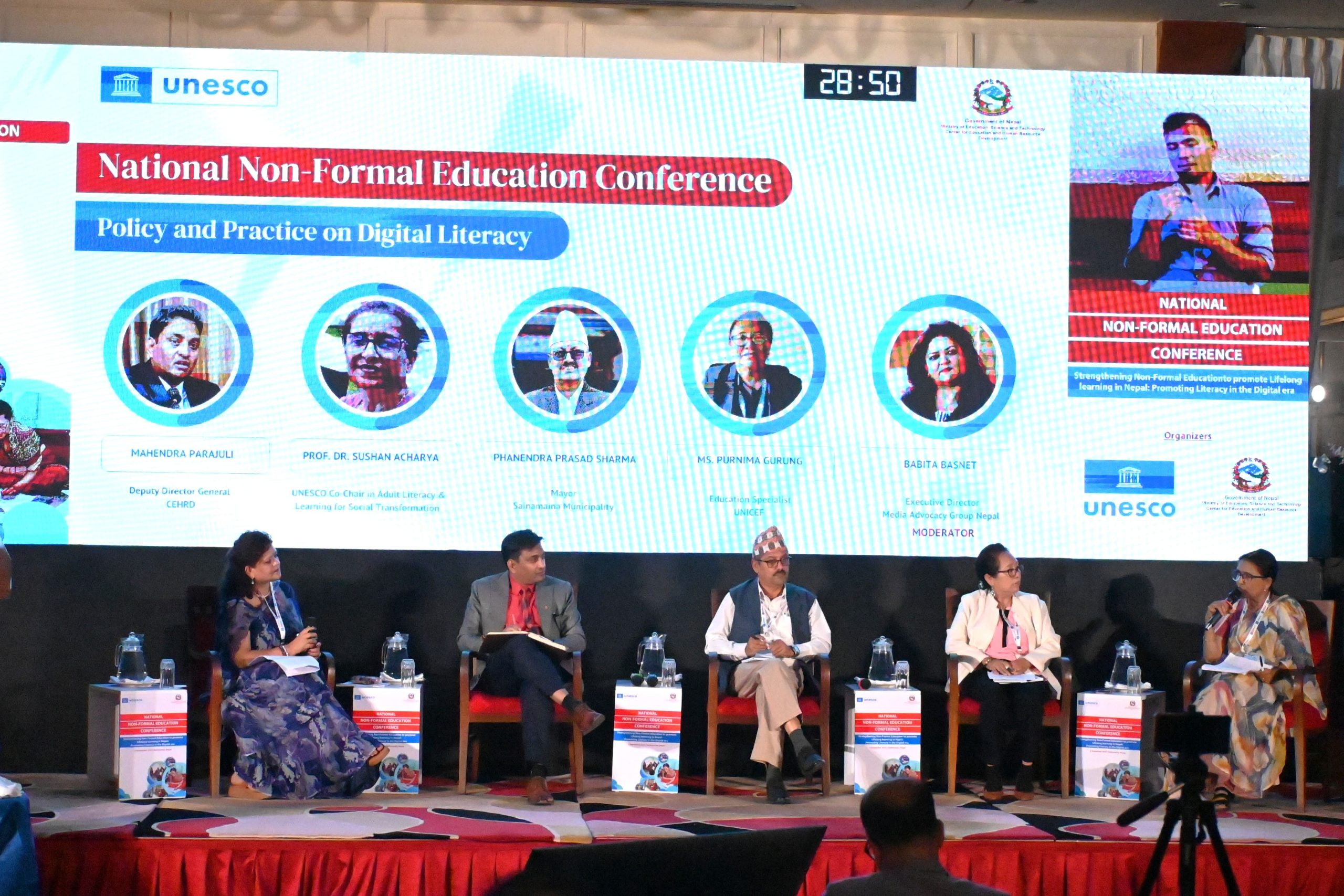
The conference also featured group discussions on:
-
Digital Literacy Policy and Practice, with insights from Mahendra Parajuli (CEHRD), Professor Dr. Sushma Acharya, Mayor Phanindra Prasad Sharma (Sainamaina Municipality), and UNICEF’s Purnima Gurung.
-
Youth and Adult Learning in the Digital Age, featuring contributions from Bagmati UNESCO Club, youth scientist Nishchal Baniya, Netra Ghimire (Pithuwa CLC Ratnanagar), Jalamati Chaudhary (Baragadhi Rural Municipality), Rima Gurung (Devithan CLC Parbat), and Madhav Chaudhary (Laxmi CLC Saptari). #nepal #education