


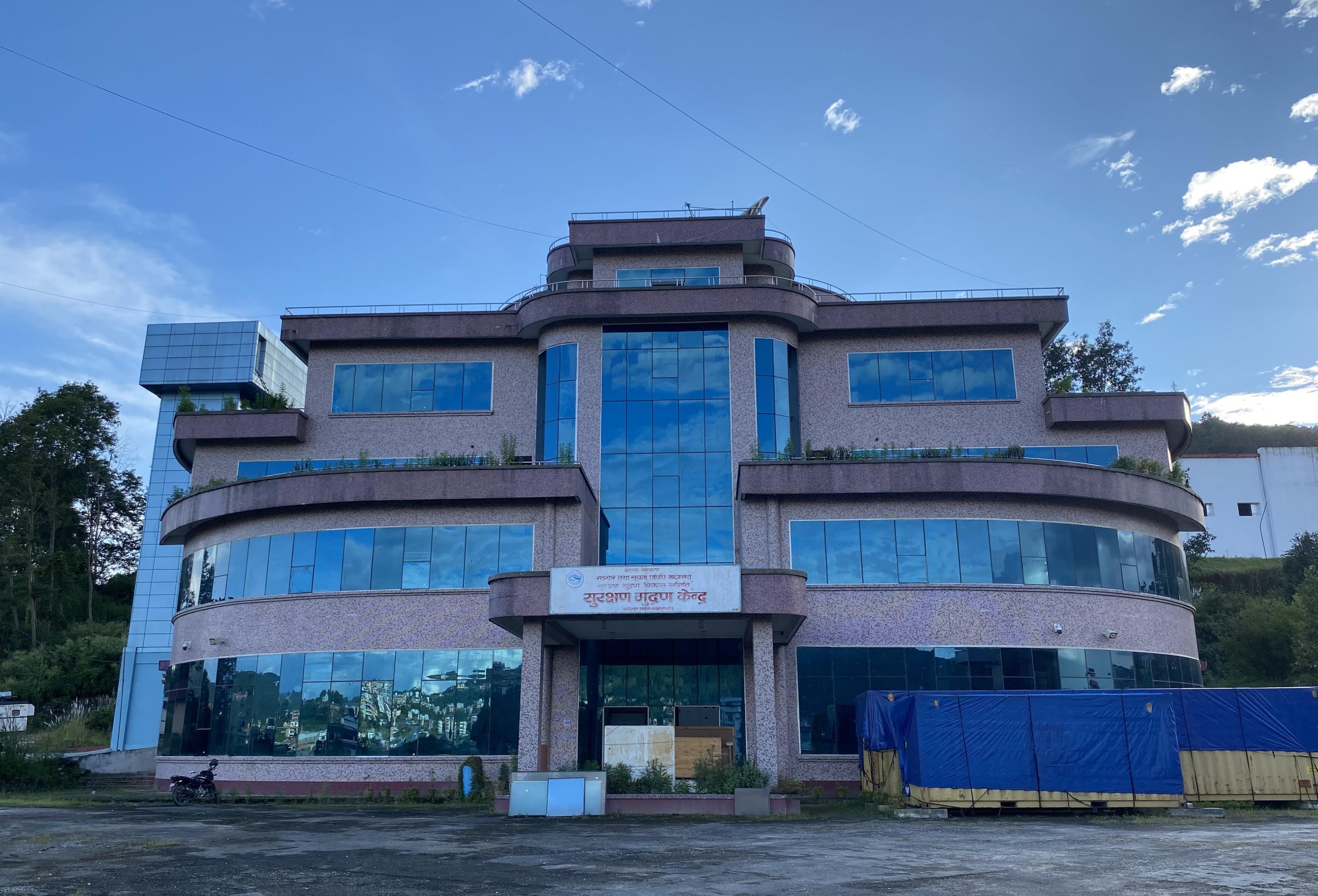
Banepa, Nov 9: The Security Printing Center (SPC) located in Panauti Municipality–5, Kavrepalanchok, is expected to come into full operation within the next six months, marking a major milestone in Nepal’s effort to reduce dependency on quality foreign printing services.
According to Executive Director Devraj Dhungana, the center will be able to provide nine types of paper-based security printing services — including citizenship certificates, excise stickers, land ownership certificates (Lalpurja), postal stamps, and visa stickers — once the machines are fully functional.
Dhungana said some specialized technicians from abroad would be brought in to operate advanced machines. “If we can ensure proper human resources and equipment management, the center can handle up to 11 different types of secure printing services,” he added.
Domestic printing to save billions
Over Rs. 3 billion has already been invested in infrastructure and equipment at the SPC, including Rs. 500 million worth of high-security machines. The project, initially designed as a Rs. 33 billion mega-plan, has now been scaled down to Rs. 8 billion.
Once fully operational, the center is expected to save up to Rs. 10 billion annually that currently goes abroad for printing passports, national ID cards, driving licenses, and other security documents. Within five years, the center aims to deliver a 23.74% annual return on investment to the government.
Driving license printing begins
On Friday, Minister for Communication and Information Technology Jagadish Kharel officially launched the printing of driving licenses from the center’s new facility. Nepal currently has a backlog of 2.8 million driving licenses awaiting printing.
“Despite legal and logistical hurdles, we have begun local printing with available resources,” said Minister Kharel. “For years, these printing contracts went to foreign companies, but now we are printing domestically with our own machines.”
Initially, the SPC will print 500 licenses per day, gradually increasing capacity under a contract to print 1.2 million cards in the first phase.
The SPC’s infrastructure includes a 50-meter-long, 25-meter-wide warehouse built to safely store printing paper, inks, and raw materials, with fire-resistant and earthquake-proof design standards.
Earlier, two high-security digital printing machines imported from Iraq were tested for excise sticker production, capable of printing up to 600 million stickers annually.
The center requires around 1,000 personnel, including 200 technical experts, to operate at full capacity.
Long-term vision
Nepal’s Security Printing Center Act 2081 BS provides the legal foundation for the SPC’s operations. The government’s master plan aims to make Nepal self-reliant in secure printing within five years, export security products to SAARC and Southeast Asian nations within ten years, and reach global markets within fifteen years.
The center is located on the site of the former IT Park, built in 2001 on 257 ropanis of land with multiple administrative and residential buildings. The repurposing of the unused IT Park into the SPC has given new life to one of Nepal’s most ambitious tech infrastructures. #nepal #SecurityPrinting #stickers