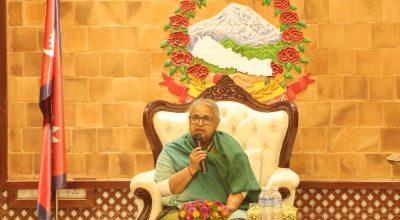



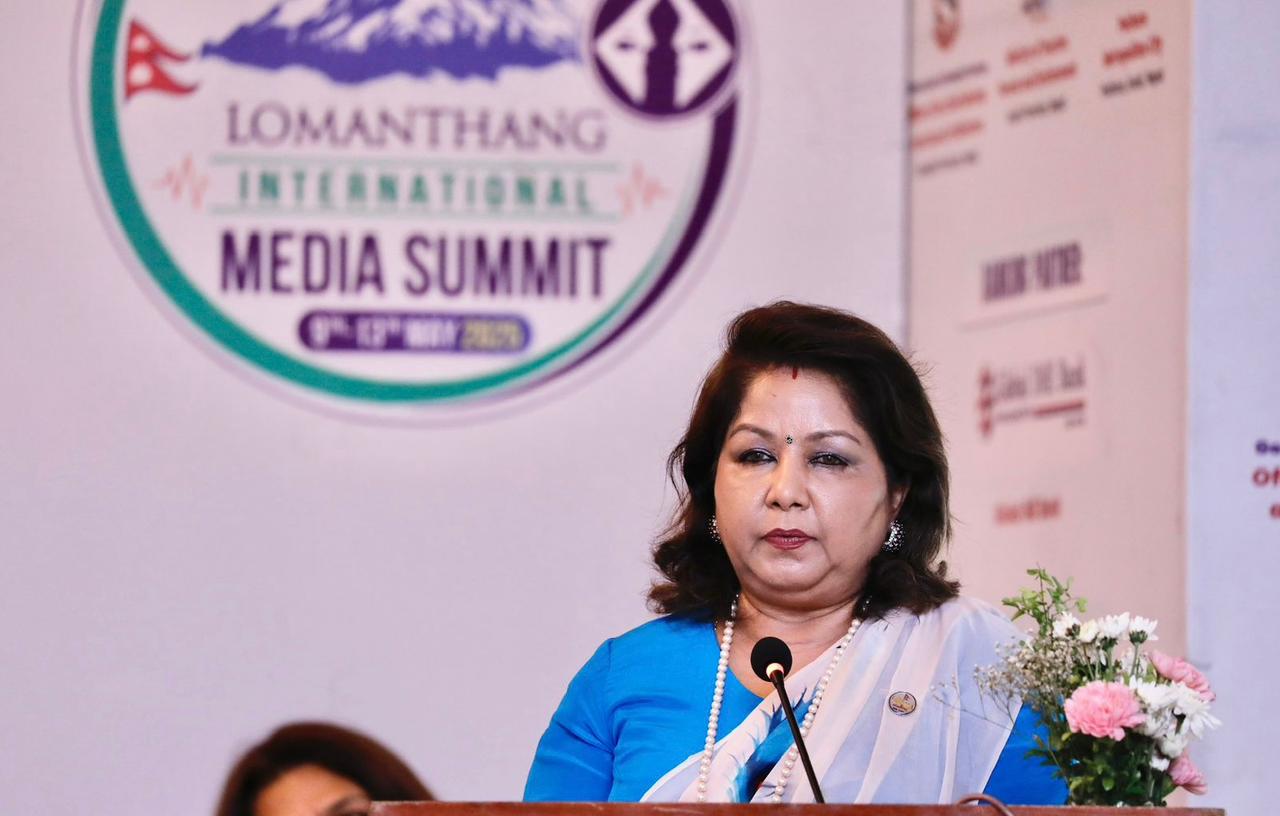
Patan, May 10: It is a great pleasure for me to address this distinguished gathering at Lomanthang International Media Summit.
At the outset, I wish to express my sincere congratulations to Nepal Press Union for bringing together mediapersons, professionals and policymakers from various countries for dialogue and deliberations on critical issues facing society today through this important initiative.
Dialogue platforms such as this Summit help foster the exchange of ideas among stakeholders and the general public, while also promoting trust, cooperation and mutual understanding among professionals and policymakers from around the world.
This Summit is even more special as it brings together experts and practitioners to discuss issues of vital global significance, including climate change, just ahead of Sagarmatha Sambaad, a global dialogue forum being held in Kathmandu from May 16-18 on the theme of “climate change, mountains and the future of humanity.”
I hope that the outcomes and insights of this Media Summit will serve as an excellent precursor to the global dialogue that Sagarmatha Sambaad aims to foster.
Excellencies, Ladies and Gentlemen:
The major themes of the Media Summit are strengthening democracy, combating climate change and advancing press freedoms and the freedom of expression.
These issues are of great import and relevance today more than ever before, but we should be mindful of the fact that they require constant public engagement and vigilance from society.
We are all aware that democracy is under increasing strain and facing multiple challenges today.
The disruptive nature of technological change and abrupt shifts in traditional modes of communications have triggered political and social polarization, and enabled a reckless and rampant spread of misinformation and disinformation.
The wildfire of misinformation and disinformation, in turn, creates incalculable negative impacts on the exercise of individual rights and freedoms, and negates the very fabric and foundation of society. This harmful trend should not be allowed to proliferate any further.
It is important to understand how the distortion of information – through misinformation and disinformation – undermines a democratic system deeply from within, and why curbing such corrosive trends should be an urgent priority in the pursuit of strengthening democracy.
I earnestly believe that more than others, the primary responsibility of confronting and correcting this alarming development rests with the media itself.
There can be no better referee of the press than the press itself. The best antidote to darkness can be nothing but light.
Free speech and the freedom of expression are the light that we need in even greater measure today – that is how we can hope to build a democratic, progressive and inclusive society for all, and that is how we should be moving forward as a democratic society.
Sadly, democracy faces subtle but corrosive challenges with a declining trust in institutions, which is both a cause and a symptom of democracy flailing from within.
Democracy requires its adherents to embrace the ability to understand and respect opposing points of view. Yet, we are living in an age where the foundational value of appreciating dissenting perspectives is eroding more precipitously than ever before.
Here lies the critical role of the press – as a custodian of truth, a platform for diverse voices and a bridge across ideological divides. The role of the press is critical in the pursuit of achieving a deeper and more meaningful democratic system.
The freedom of expression nourishes the flowering of diverse perspectives and creates the space for a range of political, social and cultural viewpoints. Press freedom nurtures pluralism and questions the veracity of echo chambers.
Freedom of speech bridges the gaps in public debates by bringing multiple perspectives into play, and helps build an organic, inclusive and holistic public marketplace of ideas.
It also helps the cause of seeking transparency in governance, and connecting people across political divides reduces hostility and promotes civic engagement.
This is how a free press promotes democracy. Democracy, in turn, creates the right conditions for advancing the cause of economic growth, social development and cultural progress, the vision of our future.
We firmly believe that the freedom of expression is critical in strengthening democracy.
This is why the state’s commitment to full freedom of the press is enshrined in the preamble itself of the Constitution of Nepal, apart from the guarantee of the freedom of speech as a fundamental constitutional right.
It reflects Nepal’s commitment to safeguarding freedom of expression and free speech as a basic, unalterable feature of the Nepali society.
Excellencies, Ladies and Gentlemen:
Allow me now to dwell on the issue of climate change.
In recent years, Nepal has suffered devastating consequences of global warming and climate change.
Climate-related disasters like glacial lake outbursts, floods and extreme weather events have taken a huge toll of life and property across the country and come as a wake-up call to take urgent and concerted action in combating climate change.
The impacts of climate change are everywhere, but in mountainous and developing countries like Nepal, they are particularly egregious.
The fact remains, though, that Nepal’s carbon emission on the global scale is negligible. It is grave injustice as we are affected by a crisis not of our making.
It is essential that the world acknowledges the vulnerabilities of countries like Nepal and supports targeted mitigation and adaptation strategies.
Nepal believes that there should be a remedial program and strategy especially tailored for the needs of climate-vulnerable developing countries like Nepal.
We have, therefore, been consistently at the forefront of advocating for climate justice in international forums and multilateral institutions.
I urge the press and media fraternity — especially representatives from various countries present here – to amplify coverage of the issues and impacts of climate change faced by countries like Nepal, and support our call for climate justice in international forums.
The role of a free press will be critical in the pursuit of concerted and meaningful action against climate change.
In the absence of a free press, crucial facts and data will be at risk of being set aside, downplayed or misrepresented.
A free press and its corollary – quality journalism – alone is capable of translating dense and complex data relating to climate change into accessible language.
As people become aware of the dangers of climate change, they will begin to take action at their ends and effect meaningful changes in a bottom-up approach to social progress.
A free press will hold the government and the corporate world accountable for their policies and actions regarding climate change, and give voice to the poor, downtrodden and vulnerable people impacted by global warming.
A free press will help raise global awareness about the perils created by climate change in climate-vulnerable countries like Nepal, and promote international cooperation and mutual collaboration among states to mitigate the adverse impacts of climate change while at the same time adapting to its irreversible consequences.
Excellencies, Ladies and Gentlemen:
Let me reiterate that a free press and the freedom of expression are not only unalterable elements of our constitutional guarantees, but constitute the very essence and foundations of the Nepali society.
We hold press freedom dear to our hearts as it advances the cause of democracy, progress and a harmonious society. It has beneficial impacts on society and advances the overall wellbeing of the people at large.
I am therefore very pleased that the Media Summit will be deliberating on these important matters in the various seminars and workshops over the next few days, and I hope that the discussions of the Summit will bring valuable insights into our understanding of key issues intersecting the realms of democracy, climate change and freedom of the press.
Before I conclude, I wish to commend the organisers for the choice of venue. I see that some of the Media Summit events will take place in Pokhara and Upper Mustang – the choice of these places resonates strongly with the theme of the Summit, especially on climate change, and I do hope that the Summit’s participants will, along with fresh air, gain fresh perspectives on matters of vital significance for humanity in the pristine serenity of the Himalayas for the benefit of us all.
I wish the Lomanthang International Media Summit all success!
Thank you.
(Full text Speech of minister for foreign affairs Dr. Arzu Rana Deuba in a Lomanthang International Media Summit organized in Lalitpur today).