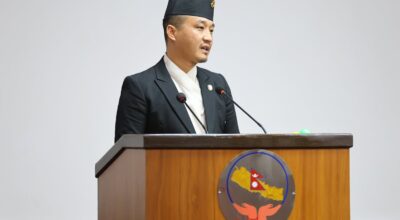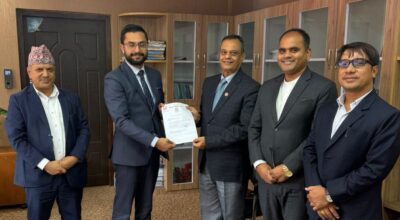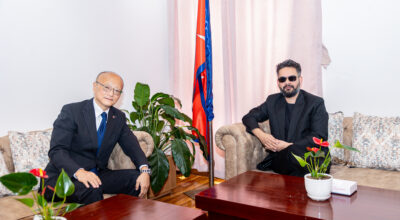



Nepal and China have reaffirmed their commitment to advancing strategic cooperation and expanding development-oriented partnership as Foreign Minister Shishir Khanal held high-level talks with senior Chinese leaders in Beijing, marking a broad-based diplomatic engagement covering state, party and institutional levels.
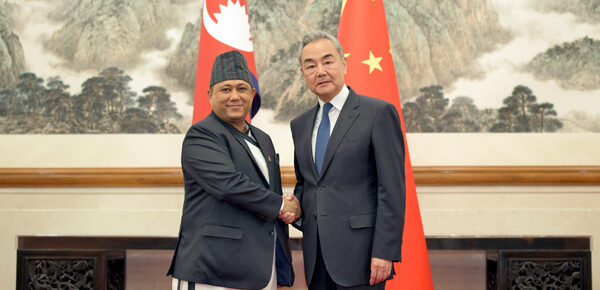
Chinese Foreign Minister Wang Yi held talks with Foreign Minister Khanal on June 15, focusing on connectivity, trade, investment, border management, technology transfer, tourism, political exchanges and multilateral cooperation.
According to Chinese Foreign Ministry spokesperson Guo Jiakun, Foreign Minister Wang Yi said China has always placed its relations with Nepal in an important position in its neighborhood diplomacy and pursues a friendly policy toward all Nepali people.
Foreign Minister Wang Yi reiterated China’s support for Nepal in safeguarding its national sovereignty, independence and territorial integrity, while pursuing a development path suited to its own national conditions.
He said China stands ready to work with Nepal to carry forward traditional friendship, enhance mutual political trust, keep pace with the times and achieve new outcomes in China–Nepal strategic cooperation.
“China will always be a trustworthy and reliable good neighbor and good partner for Nepal in its development, revitalization and modernization,” Foreign Minister Wang Yi said.
He also expressed China’s readiness to advance high-quality Belt and Road cooperation and support Nepal’s transition from a landlocked to a land-linked economy through enhanced connectivity and infrastructure development.
Foreign Minister Khanal, according to multiple social media posts shared by him, held comprehensive discussions with Wang Yi on the full spectrum of bilateral relations, including connectivity, border management, trade, technology transfer and multilateral cooperation. Both sides also exchanged views on expanding people-to-people ties and reaffirmed commitment to further strengthening bilateral relations for mutual benefit.
Beyond the bilateral dialogue, Foreign Minister Khanal met Wang Huning, Chairman of the National Committee of the Chinese People’s Political Consultative Conference (CPPCC), where discussions focused on development cooperation, trade, investment, tourism, political exchanges and people-to-people relations.
He also held talks with Liu Haixing, Minister of the International Department of the Communist Party of China (CPC) Central Committee, on strengthening party-to-party exchanges and deepening institutional and people-to-people engagement.
Taken together, the engagements underline an increasingly layered relationship—extending beyond government-to-government diplomacy into party and institutional channels, reflecting China’s structured approach to external relations and Nepal’s growing multi-level engagement with Beijing.
At a broader level, the trajectory of Nepal–China relations continues to be shaped by China’s rapid economic transformation and its expanding role as a global development partner. Its experience in infrastructure building, industrial expansion and technological advancement is increasingly viewed in developing countries as a reference point for modernization strategies.
For Nepal, which is seeking to accelerate economic growth and strengthen its productive base, the emphasis on connectivity, technology transfer and investment cooperation carries potential developmental implications. If effectively translated into implementation, such cooperation could generate broader economic opportunities, including in infrastructure, energy, agriculture and industrial development.
Analysts note that political engagement with Chinese party institutions, including interactions with bodies such as the CPC International Department, also provides emerging Nepali political forces—including newer parties like the Rastriya Swatantra Party—a wider platform for understanding China’s governance experience and institutional evolution. Such exchanges, however, remain primarily exploratory and relationship-building in nature.
As Nepal and China move forward, the challenge will lie less in political affirmation and more in converting high-level assurances into measurable outcomes that support Nepal’s development priorities.
The Beijing engagements, therefore, signal not only continuity in diplomatic goodwill but also an evolving attempt to align political trust with development delivery—an area that will ultimately define the next phase of Nepal–China relations. #nepal