


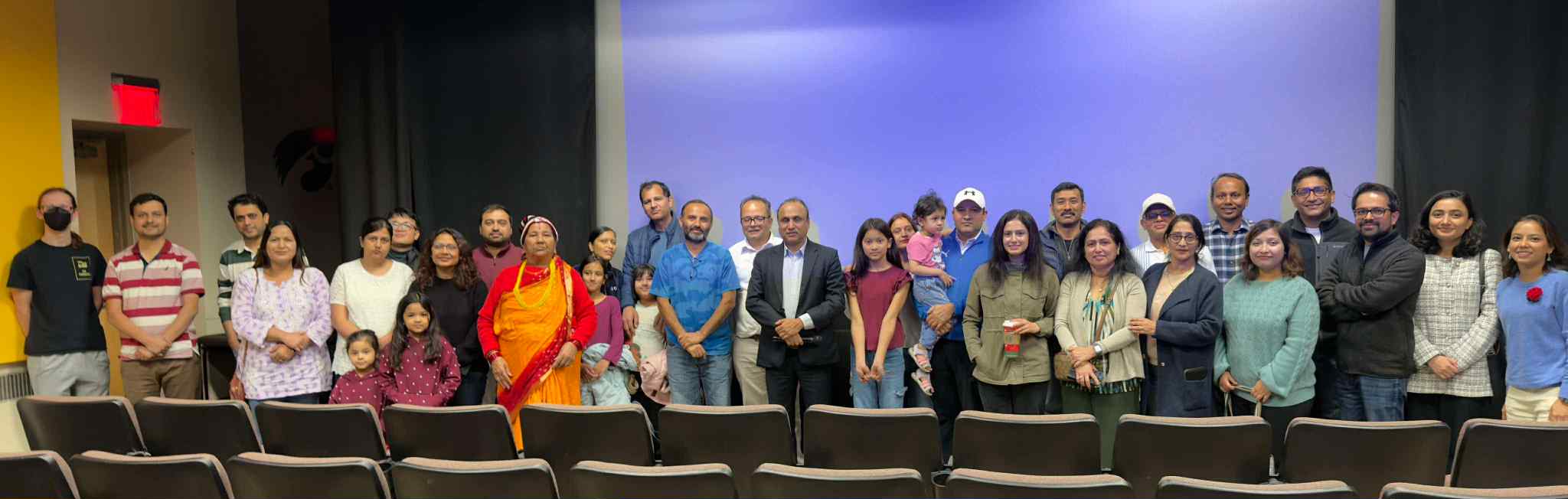
Iowa, USA, Nov 20: Three decades after the disappearance of Dor Bahadur Bista, I found myself sitting among members of the Nepali community and anthropology enthusiasts at the University of Iowa, USA, watching a documentary about his extraordinary life and work.
The film is interspersed with archival footage of an older Nepal—scenes that feel foreign yet intimately familiar.
Through the testimony of fellow anthropologists, friends, and family, the documentary allows us to understand the man who gave Nepalis the vocabulary to articulate the social forces shaping their lives. He illuminated structural issues that continue to define Nepal today. His ideas provoked discomfort precisely because he verbalized what many had long understood in silence.
From Nepal’s first anthropology student to becoming the Father of Nepali Anthropology, Bista walked an unorthodox path—right up to his mysterious disappearance.
Ma Alap Huna Chahanchu (I Want to Disappear) – Into The Mist, directed by Dr. Sachin Ghimire and Gaurab KC, is a powerful tribute to Bista’s legacy. I am grateful to have watched it.
Who was Dor Bahadur Bista?
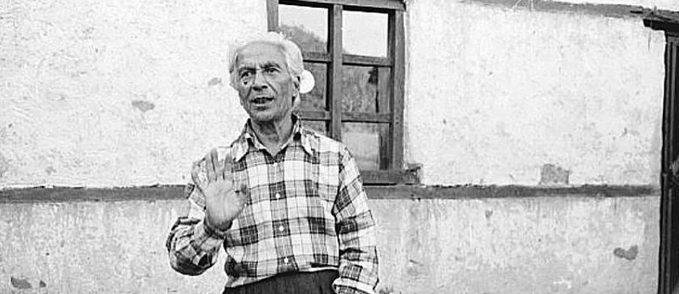
To anyone connected with anthropology in Nepal, Dor Bahadur Bista is a towering figure. Known widely as the Father of Nepali Anthropology, Bista often left for remote destinations without warning and returned only after completing his research. Nearly 30 years have passed since he vanished—leaving behind a legacy that has only grown in his absence.
In honor of this lost legend, The Dor Foundation, in collaboration with The Movie Lovers Nepal, has presented Ma Alap Huna Chahanchu – Into the Mist, a documentary capturing the tumultuous journey of Bista’s life.
Bista is a name deeply embedded in Nepal’s intellectual history—a man who reshaped how Nepalis see themselves and their society, and then disappeared under circumstances as enigmatic as his personality. He had long written and spoken about wanting to disappear, and in the last week of Poush 2052 BS, he actually did.
Born 97 years ago on April 15, 1928, in Jharuwarasi, Lalitpur, Bista’s whereabouts remain a mystery to this day.
A legacy that refuses to fade
His disappearance and the ongoing search for answers kept him at the center of public discussion at home and abroad. His works never lost relevance. Fatalism and Development remains perhaps the most reviewed English-language book ever written by a Nepali anthropologist.
Published in 1991, it disrupted the intellectual complacency of Nepal’s scholars. Yet it sparked hope among Indigenous nationalities, Madhesis, Dalits, women, Muslims, and other marginalized communities by explaining systems they had always felt but could not name.
Long before this, his 1967 book People of Nepal had already cemented his global stature. His other work, Sabai Jatko Phoolbari (Garden of All Castes), became transformative literature for many marginalized groups across Nepal.
Institutionally and methodologically, Bista shaped the foundations of anthropology in Nepal more than anyone else. He argued that Brahmanism, fatalism, patronage networks, and sycophancy were the root causes of Nepal’s backwardness—ideas that remain strikingly relevant today.
Proudly identifying as a Matwali Khas, Bista claimed that Nepal’s kings were descendants of the Magar community. His critique of entrenched systems made him both widely admired and widely criticized.
The man behind the scholar
Those who knew him describe a simple, approachable, and charismatic figure—neatly dressed, well-combed hair, and always smiling. His classes at Tribhuvan University were lively and inspiring, and he played a central role in establishing TU’s anthropology and sociology departments.
Both the state and insurgent forces viewed him with suspicion. Such pressures may have played a part in his disappearance—or it may have stemmed from personal struggles.
Despite receiving lucrative academic offers from France, the U.S., the U.K., Japan, and beyond, and despite Kathmandu’s comforts, he chose Karnali. Bista believed societal transformation begins with changes in thought, systems, and lifestyle. This conviction led him to the remote regions of Jumla.
He founded the Karnali Institute in Chaudhabisa, then the largest educational institution in the region. He established small hydropower systems across four VDCs, bringing light to villages that had known only darkness.
More than 30 years ago, he mobilized JTAs, health workers, ANMs, and technical staff throughout Karnali, envisioning a self-reliant region in agriculture, health, and education. He encouraged Marshi rice cultivation, studied apple potential, and promoted climate-suitable crops—initiatives that could have reshaped Karnali’s development trajectory.
A disappearance that still haunts Nepal
Bista’s ideas angered as many as they inspired. Both the state and rebels viewed him with unease. These tensions may have contributed to his disappearance—or perhaps it was something more personal.
Whatever the reason, he vanished—but left Nepal with intellectual and philosophical contributions that remain impossible to forget.
Director Profiles (Ma Alap Huna Chahanchhu – I want to disappear)
Sachin Ghimire
An anthropologist and filmmaker with a PhD from Jawaharlal Nehru University, Ghimire has directed Maatemurali (2006), Punte Ko Pangro (2013), Dealing with Disasters (2015), co-directed Diyalee (2012), and Ma Alap Huna Chahanchu (2019). He has also served as associate director for Cellphone (2012) and Neerphool (2019). His documentaries and short films have won numerous national and international awards.
Gaurab KC
An anthropologist by training, KC has spent the last decade teaching and researching. He currently serves as an assistant professor at Kathmandu School of Law and is affiliated with Martin Chautari, one of Nepal’s leading research institutions. #nepal #dorbista #anthropology
[Aayushma Aryal is a student and anthropology enthusiast in the Iowa University in the USA.]