



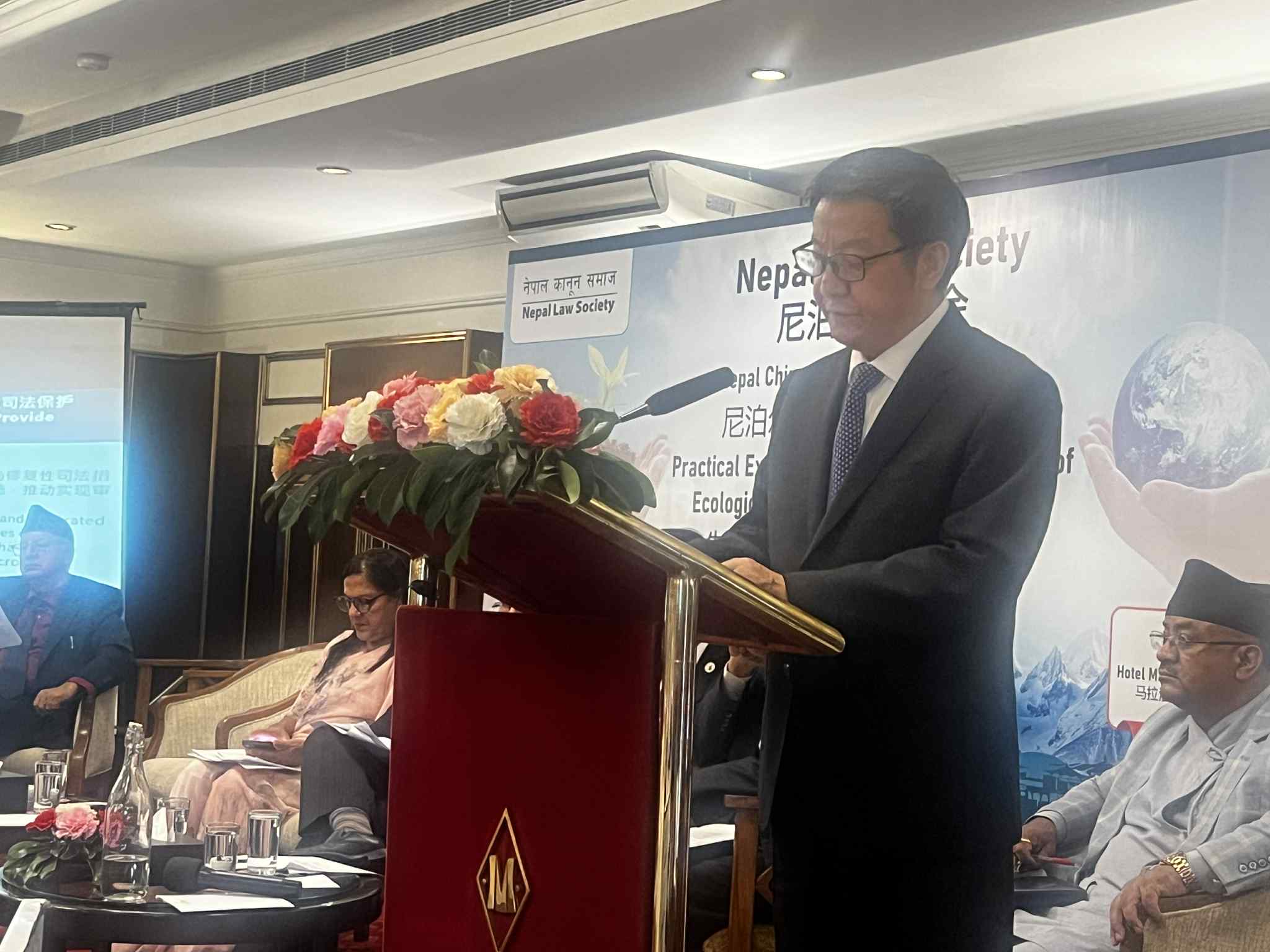
Greetings to all esteemed colleagues! I am delighted to join this seminar and exchange insights with colleagues from the judiciary in Nepal on the practice of judicial protection of ecological environments and resources.
Nepal has actively collaborated with international organizations to promote projects aimed at adapting to climate and natural changes, setting clear targets for emission reduction and ecological restoration, and providing valuable references for developing countries to balance resource utilization with ecological protection.
I hope today’s meeting will facilitate the exchange of valuable experiences and yield fruitful results in international judicial collaboration and regional co-governance on ecological matters.
In line with the theme of this seminar, I would like to share some practical experiences from the Shanghai courts in the judicial protection of environmental resources.
In recent years, Shanghai courts have consistently upheld the principle of preventive jurisprudence, proactively advancing adjudication of environmental and resource cases.
Implementing preventive principles under international conventions and domestic law. As a Contracting State to multiple environmental conventions including the Rio Declaration and the Convention on Biological Diversity (CBD), China integrates the Preventive Principle articulated in Principle 15 of the Rio Declaration:”States shall widely apply precautionary measures according to their capabilities to protect the environment.”
Further, the 2021 World Environmental Justice Conference in Kunming adopted the Kunming Declaration, explicitly endorsing “preventive judicial measures” such as injunctions and pre-litigation preservation to prevent or mitigate ecological damage.
As a staunch defender of international rule of law, China has consistently upheld the spirit of international conventions.
Article 5 of the Environmental Protection Law establishes the precautionary principle as fundamental one, mandating that “environmental protection adheres to the principles of prioritizing protection, giving priority to precautionary approaches, comprehensive management, public participation, and the polluter-pays principle.”
The precautionary principle, as codified herein, now permeates the entirety of China’s environmental legal regime and stands as a cornerstone of its environmental adjudication.
Second, courts have institutionalized judicially-mandated source control through landmark rulings. Post-remediation is fundamentally distinct from preemptive prevention.
Traditional environmental litigation predominantly focuses on post-damage compensation—a reactive model that, while serving punitive purposes, fails to curb systemic ecological collapse.
Crucially, many environmental damages (e.g., groundwater contamination and biodiversity erosion) exhibit scientifically latent and irreversible traits, rendering “restitutio in integrum” often technically or economically unfeasible.
Therefore, embedding the precautionary principle into environmental adjudication better ensures on-site preservation of ecological status quo ante.
For instance, in a land lease dispute between a coastal management authority and a construction company in Shanghai, the company leased nearly 30,000 square meters of tidal flats at the Yangtze Estuary as a sand and gravel storage yard but refused to vacate upon contract expiration.
Through court mediation, the company voluntarily vacated approximately three-quarters of the leased area; for the remaining portion it refused to relinquish, the court issued a timely ruling to ensure ecological restoration of the tidal flats, thereby protecting the Yangtze River’s coastal ecosystem through proactive prevention at the source.
Chinese environmental law underscores “prevention primacy and integrated governance,” where preventive and restorative justice measures operate synergistically.
Through functionally-targeted restorative mechanisms, Shanghai courts have advanced multi-stakeholder synergies across adjudication, ecological restoration, and social governance.
Multi-pronged measures ensure tangible ecological restoration: To strengthen judicial protection of prime farmland, courts now mandate perpetrators to concurrently conduct soil reclamation and other ecological remediation, while coordinating with regulatory agencies for remediation efficacy evaluations—thereby ensuring tangible ecological restoration.
Pioneering novel mechanisms, courts innovatively implement labor-based compensation in eco-damage cases by executing memorandum of cooperation with relevant departments.
These instruments specify operational parameters, designated sites, and work cycles for in-kind remediation services, while clarifying post-implementation accountability—thus guaranteeing verifiable restoration outcomes.
Where restoration to the original state is feasible, courts adhere to the judicial tenet of “mandatory restoration where possible.” For cases where restitution in integrum is unattainable or in situ remediation is unsuitable, courts proactively pursue alternative remediation measures.
In the case of Shanghai Municipal People’s Procuratorate, Second Branch v. A Surveying Company concerning ecological damage civil public interest litigation, the court affirmed the defendant’s liability for ecological environmental damages through purchasing carbon inclusive emission reductions.
This mechanism achieves restoration and compensation for carbon sequestration functionality, thereby providing a replicable “Shanghai Paradigm” to propel society-wide green low-carbon development.
The case was subsequently incorporated into the Supreme People’s Court’s China Environmental Resources Trial (2024) and recognized by the Shanghai High People’s Court as both a “2025 Top Ten Livelihood-Related Case” and a “World Environment Day Model Case”.
Second, extending judicial functions to ensure the comprehensive implementation of restorative judicial measures.
Leveraging specialized Environmental Resources Tribunals, Shanghai courts proactively establish transnational exchange platforms, including flagship symposia such as the Chongming World-Class Ecological Island Judicial Symposium and Yangtze River Delta Regional Judicial Consistency Symposium on Environmental Resources Adjudication.
These initiatives foster interdisciplinary dialogue between jurists and environmental scientists, thereby catalyzing legal consistency and jurisprudential alignment in eco-case adjudication across regional courts.
lCourts have established a multi-sector coordination mechanism with administrative authorities to strengthen solid waste management, hazardous waste supervision, and specialized rectification of third-party environmental agencies,forging a pluralistic co-governance framework for ecological protection.
Concurrently, we advance the construction of ecological remediation bases, having established six multifunctional facilities integrating ecological restoration, legal education, and deterrence-driven awareness campaigns. These initiatives continuously expand the reach of environmental rule-of-law advocacy and amplify judicial influence.
lConcurrently, Shanghai courts advance digital court construction by proactively developing application scenarios for environmental adjudication. This enables intelligent adjudication assistance in eco-cases, thereby enhancing trial quality and efficiency.
A prime example is the “Application Scenario for Legal Consistency in Monetary Penalties for Environmental Pollution Crimes,” which benchmarks historical adjudicated cases to calculate penalty benchmarks.
By providing pre-judgment prompts on fine assessment, this system standardizes penalty application criteria and elevates judicial consistency.
The green and low-carbon development model is imperative for building a Beautiful China and realizing the Chinese path to modernization characterized by harmonious coexistence between humanity and nature.
In July 2024, the CPC Central Committee and State Council issued the Opinions on Accelerating Comprehensive Green Transformation of Economic and Social Development, further emphasizing the need to “refine green low-carbon development mechanisms and accelerate society-wide green transition”.
At the local level, the Shanghai Regulations on Promoting Green Transformation of the Development Model came into effect in 2024, accompanied by specific action plans. These plans outlined key priorities in five areas: energy, industry, transportation, construction, and the circular economy.
To further serve and safeguard the green transformation of economic and social development: On one hand, courts integrate green development principles into adjudicating corporate, financial, bankruptcy reorganization, and other disputes.
Through jurisprudential guidance, they propel enterprises toward green low-carbon transition from high-pollution, high-energy-consumption models. Illustratively, in a Shanghai case involving the bankruptcy reorganization of a port operator, the court:
Recognized environmental remediation costs as administration expenses repayable at any time for pollution caused by deficient facility maintenance; Incorporated binding eco-operational plans into the reorganization scheme;
Ultimately achieved dual victories in economic revitalization and ecological conservation through corporate green transformation.
On the other hand, courts advance legislative and judicial rule refinement to establish granular standards for green development.
China’s Environmental Protection Law and Judicial Interpretation on Environmental Civil Public Interest Litigation recognize “acts posing significant risks of impairing public interests” as actionable grounds for litigation- constituting the statutory basis for preventive justice.
To clarify legal application, it is imperative to refine standards at both legislative and technical levels. Currently, the Eco-Environment Code (Draft) is open for public consultation. China will further accelerate:
Codification progress of the Code; Issuance of specialized judicial interpretations; Explicit criteria for initiation thresholds, burden-of-proof allocation, and remedial measures across distinct categories of environmental preventive litigation.
Environmental challenges transcend national borders. The core value of trans-boundary environmental adjudication lies in breaking through geographical and administrative boundaries to address basin-wide and transnational ecological risks through judicial coordination.
We aspire to expand multilateral cooperation channels via broader international exchanges, strengthening cross-border ecological synergy.
Joint prevention of pollution and ecological restoration projects shall be advanced based on actual conditions, while promoting the implementation and advocacy of environmental public-interest initiatives—from biodiversity conservation to climate change response, thus continuously enhancing the rule of law in global environmental governance.
Esteemed judicial colleagues from both nations, This beautiful planet is our shared homeland, demanding our collective guardianship. We anticipate this symposium will catalyze deeper Sino-Nepalese collaboration in environmental justice, safeguarding our blue skies and green mountains for generations to come!
Mr.Justic JIA YU- President, Shanghai High People’s Court, presented the thoughts in a program Nepal China Legal Cooperation Forum organized by Nepal Law Society in Kathmandu on 11 Aug, 2025.