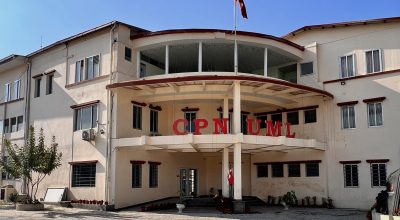


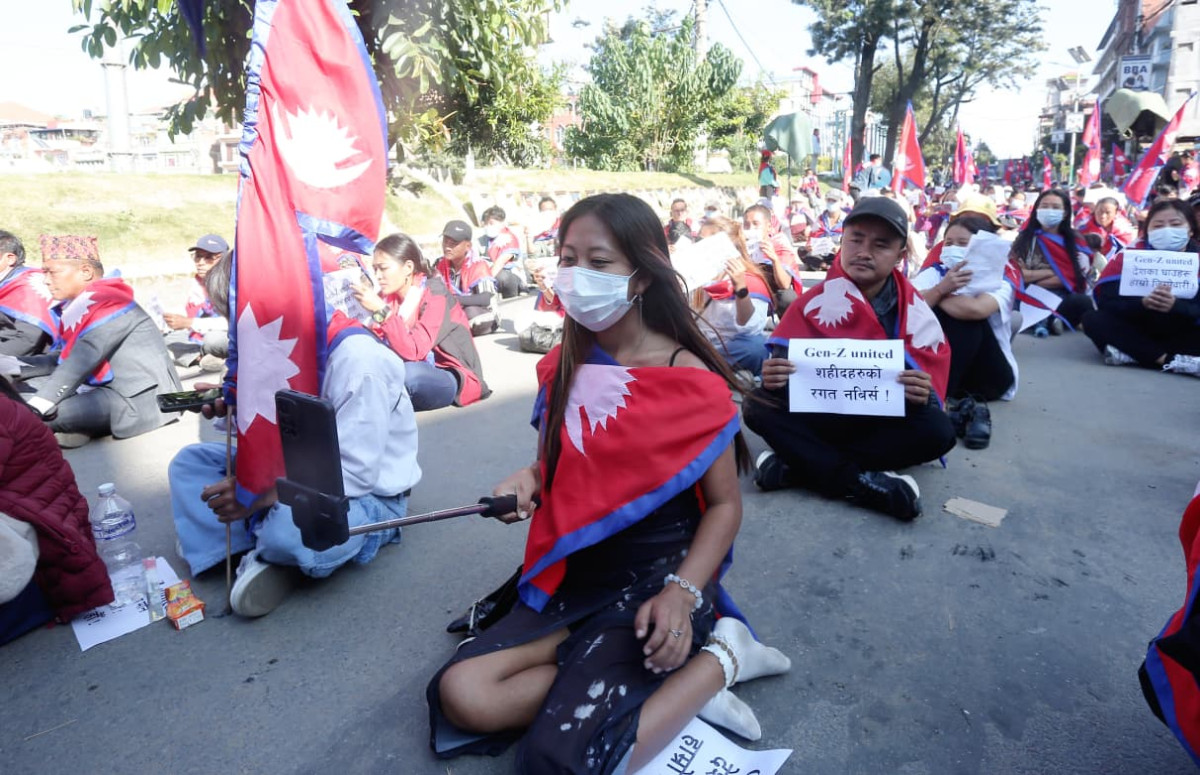
During the September 8–9, 2025 uprising, groups of Generation Zed (Gen Z) youths—along with infiltrators—unleashed a wave of destruction across Nepal. A total of 688 government offices, 259 private residences, 128 businesses, 198 political party offices, and 307 police stations were reduced to ashes. The coordinated attacks erupted simultaneously in 484 locations nationwide, as per the Nepal Army. Among the torched institutions were the Parliament, Supreme Court, President’s Office, and Prime Minister’s Residence, resulting in the loss of invaluable state documents.
Amid the chaos, leaders of the Rastriya Swatantra Party (RSP)—most notably its president, Rabi Lamichhane—reportedly facilitated the release of 15,588 inmates from various prisons on September 9. Of these, 6,789 remain at large and 392 firearms are still missing. Many of the fugitives have resumed terrorizing former victims, and spreading fear and lawlessness. Even more disturbing, several individuals claiming to represent Gen Z have been implicated in serious criminal acts, blurring the line between protest and anarchy.
Amid this atmosphere of fear, the lacklustre performance of the Sushila Karki-led government has only deepened uncertainty. The political course remains shrouded in a smokescreen of internal rivalries and external influences, each seeking an opportunity to fish in troubled waters. From the very beginning, the government formation process invited suspicion when the army chief reportedly initiated dialogue and advised including the RSP, pro-monarchist Durga Prasai, and Dharan Sub-metropolis Mayor Harka Sampang — figures later exposed for their infiltration in the Gen Z movement. By that measure, the early choices of this administration raise troubling questions.
The uprising toppled the KP Sharma Oli-led government on September 9, and a new administration emerged three days later. Ironically, the change merely replaced a seventy-four-year-old man with a seventy-three-year-old woman — a shift symbolic rather than substantive. This outcome stood in stark contrast to the spirit of the Gen Z movement, which demanded generational renewal and paid a steep price: 76 lives lost, including 22 on the first day alone. Forty-three days into her tenure Karki has yet to include the movement’s real stakeholders — the youth — in her cabinet. The promise of change, it seems, has been consumed by continuity.
Nearly all cabinet members are above 50, many being retired bureaucrats who bear little resemblance to the Gen Z protesters that propelled the movement. The poor performance of ministers such as Om Prakash Aryal and Kulman Ghising — marked by immaturity and retaliatory behavior — has deepened the rift between the government and Gen Z activists. Their conduct has also alienated the leadership of major political parties. The PM now appears trapped between the restless energy of Gen Z groups, whose demands are often conflicting, and the invisible influence of her own political patrons. The alienation of youth risks igniting new rounds of unrest.
Over time, the hidden architects of the movement — and the shadowy connections of some cabinet ministers to corruption cases — have begun to surface. These revelations may explain the PM’s growing irritability in public fora, particularly when journalists question her about cabinet expansion or the inclusion of Gen Z representatives. The government’s defensive posture and evident lack of transparency have drawn widespread criticism. In the eyes of many, it has squandered the moral mandate born of a generation’s sacrifice.
The government’s inability to address the pressing demands of Gen Z has further eroded public trust. Their core demands include inclusion in governance, the introduction of a system for directly electing the chief executive, legal action against former PM KP Sharma Oli and former Home Minister Ramesh Lekhak for ordering excessive force during the September 8 crackdown that claimed 22 lives, the arrest of those responsible for arson and looting, and the timely conduct of national elections on March 5, 2026. Each unfulfilled commitment has become a symbol of broken promises and deepening disillusionment.
The situation worsened when Home Minister Aryal, reportedly acting under the influence of his political mentor and Kathmandu Mayor Balendra Shah, ordered Nepal Police to immediately arrest Oli and Lekhak. The directive, seen as politically motivated and legally questionable, starkly violated established procedures. It also revealed the minister’s lack of prudence and his failure to anticipate the chaos such a move could unleash. Despite being a legal expert, Aryal now finds himself caught between Scylla and Charybdis. Aryal’s actions have turned a constitutional crisis into a moral one.
Kul Man Ghising, Minister for Energy, Water Resources & Irrigation, reissued a decree to recover a total outstanding electricity tariffs amount of Rs 6.6 billion (excluding penalties) from 61 industries based on bills issued by mid-2024. This move triggered a confrontation between Ghising and the industrialists, who have unitedly defied the order. The episode has also undermined Ghising’s credibility, especially given that a corruption case against him remains pending at the Commission for the Investigation of Abuse of Authority.
The government further compounded its missteps by selectively recalling 11 ambassadors, most of whom had been appointed by the Oli-led administration, drawing widespread criticism. A caretaker government has no mandate to take such actions. Nepal’s long-standing political instability—having witnessed 29 governments in 35 years since 1990—has earned it international censure, particularly for the frequent recalling of ambassadors by short-lived administrations. This recent action may well represent one of the shortest intervals in which ambassadors have been recalled.
Nepal has also suffered a loss of credibility in the international arena, particularly in the employment sector. The calculated release of inmates, many of whom soon resorted to violent activities, has generated fear not only domestically but also abroad. Consequently, three major labor-importing countries—UAE, Saudi Arabia, and Malaysia—have, though not officially declared, effectively halted the issuance of visas to Nepalis, affecting a large population of low- and semi-skilled workers. The government’s leniency in taking action against the leaders of the RSP has further tarnished the nation’s reputation, undermining confidence in both its people and institutions.
Minister Aryal, reportedly influenced by his mentor Balendra Shah, has been publicly urging Gen Z youths to file a corruption case against former PM Oli over his alleged involvement in the Giribandhu Tea Estate scam. This seems aimed at pressuring the government into acting against Oli, as Aryal appears impatient to ensure his arrest by any means. While Oli should indeed be investigated if evidence warrants, due legal process must be followed; otherwise, any case risks being overturned by the courts, potentially backfiring on a fragile government whose authority rests on the movement that brought it to power.
Meanwhile, the Nepal Police has done a commendable job by nabbing 132 people from the Kathmandu Valley, mostly infiltrators above 30 years who were directly involded in ransacking and arsoning government institutions and private residences. The courage of conviction of Nepal Police primarily of Chandra Kuber Khapung, Inspector General of Police, commands respect for arresting those who committed crimes against the nation, despite Home Minister Aryal’s pressure to relase those arrested earlier and not arrest the remaining criminals.
It seems the ministers of the Karki-led government remain starkly oblivious to the fact that the primary cause of the revolt was the ban on 26 social media sites, a move that ultimately changed the regime. Yet now, Jagdish Kharel, Minister for Information and Communications, is advocating for social media regulation. One must ask: what, then, was the bloodshed for? Kharel further sparked ridicule by suggesting that the cremation site at Pashupatinath Temple should offer free Wi-Fi so that bereaved family members abroad could watch the funeral live and ‘be happy.’
It appears that the ministers, the so-called Gen Z leaders, foreign agents operating through social media, external forces, and opportunists seeking to advance their vested interests are collectively engaged in schemes to further destabilize the country. Meanwhile, Sudan Gurung—who does not represent Gen Z—has emerged as a kingmaker and has restarted protests. Do we still need more evidence to show that he is being mobilized by external forces?
It is undeniable that life holds greater value than property. Yet, why has he been openly inciting people by claiming that ‘thousands of Singha Durbars can be built and rebuilt’? Meanwhile, the Durga Prasai-led pro-monarchy group is also preparing a series of protests. If the government fails to contain such mobilizations, it could trigger a disaster of far greater magnitude—sweeping away the administration, plunging the country into political upheaval, economic disarray, and threatening the sovereignty of the nation and its people.
The self-proclaimed Gen Z leaders are increasingly being exposed. Those who took the law into their own hands, intimidating and terrorizing high-level government officials into quitting their posts, have been found guilty in multiple criminal cases, and a few have already been arrested. Some of these so-called leaders have acquired substantial shares in a hydropower project in Sindhupalchowk without paying a single rupee, merely by threatening project staff. Others have been found guilty of looting personal property, further highlighting the dangers of unchecked political opportunism.
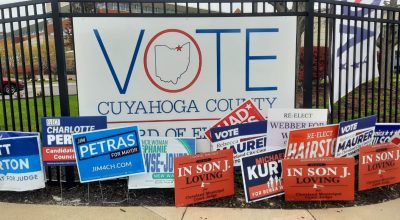
Balendra Shah, the anti-hero behind the curtain, continues to provoke the leaders of major political parties through his late-night, often contemptuous social media posts. He has been adding fuel to the fire, widening the rift between major political parties and the government, particularly as the House of Representatives (HoR) elections approach on March 5, 2026. It appears that the ochaestrators, apologists, fake Gen Z representatives, and even some ministers are engaged in a cut-throat competition to spoil the political environment, potentially derailing the elections.
Meanwhile, the Communist Party of Nepal Unified Marxist-Leninist, though ousted from the coalition government, remains a formidable political force. The party has argued—largely unanimously—that the present government and the dissolution of the HoR are unconstitutional, and it has filed a case at the Supreme Court demanding the reinstatement of parliament. If the court resists street pressure, it is likely to reinstate the legislature, as it has done twice in the past. Such a move could trigger yet another confrontation, further destabilizing the fragile political landscape.
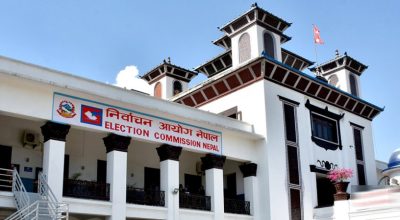
With less than 4.5 months remaining, elections can only be conducted if traditional political parties and voters are assured of safety and a free, fair ballot. Yet, with 6,789 criminals still at large, 392 firearms unaccounted for, the morale of security forces—particularly the Nepal Police—diminished, unabated protests, interest groups seeking to further destabilize law and order, and no action taken against RSP leaders who orchestrated jailbreaks and directly contributed to terror, the feasibility of holding elections appears highly questionable.
The movement was initially leaderless, which is natural for a spontaneous uprising. But mere criticism of the government will not resolve the underlying issues. Unless protesters unite—or at least establish a common agenda to realize the movement’s objectives—the momentum is likely to fizzle out. Such an outcome would leave an indelible scar on the protesters, the government, political parties, the people, and the nation. Moreover, if consensus cannot be forged among stakeholders and the cycle of mutual obstruction continues, the country faces the real risk of a political catastrophe.