


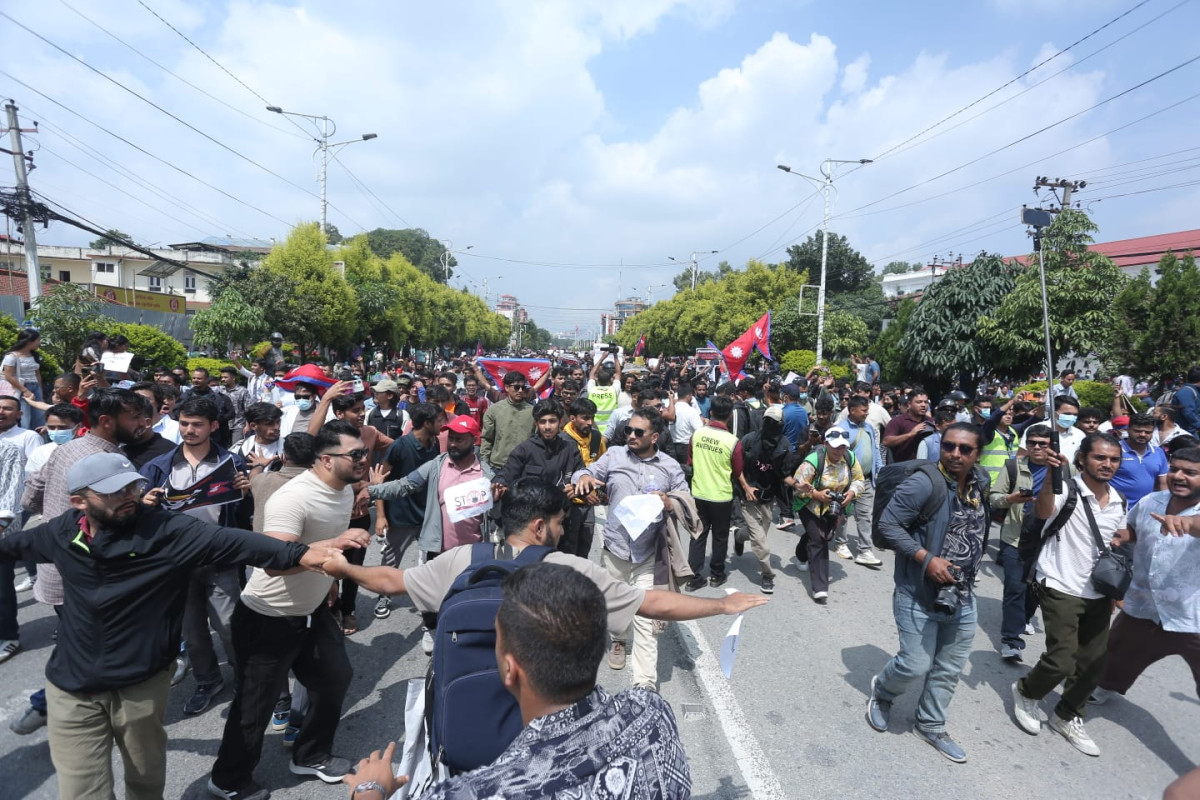
In the aftermath of the September 8-9, 2025 demonstrations–a movement initially spearheaded by Gen Z youths but later infiltrated by various interest groups–two contrasting interpretations have emerged regarding the role and responsibility of the Nepal Police. There is also a widespread fallacy regarding the exact number of protesters killed.
One segment of the public argues that the police used excessive force against peaceful demonstrators, largely composed of students from schools and colleges who had taken to the streets with what they believed were legitimate concerns. On the other hand, another group—either knowingly or under the guise of ignorance—has sought to place undue blame on the police, disregarding the complexity of the situation.
It is, however, as clear as daylight that the Nepal Police’s primary objective was to prevent the crowd from breaching the restricted area. Their actions–deploying barricades and water cannons–were part of standard crowd-control measures, not an intent to resort to lethal force. In fact, the police showed restraint until the protesters reached the Parliament building in New Baneshwor, where the situation had already begun to spiral out of control.
The police resorted to using arms only as a last measure, when infiltrators within the crowd forced open the main gate, set fire to the guardrooms, and broke down the concrete fence of the Birendra International Convention Center, which houses the Federal Parliament.
To be clear, this is not to suggest that the use of live ammunition, which tragically resulted in the death of 22 individuals on September 8 and 9, was justified. The agents of interest groups and the infiltrators have been making a mountail out of a mol hill by inciting the public by spreading misinformation regarding the death of individuals.
According to the Nepal Army, only 22 out of 76 died on September 8 and 9 were protesters. The remaining included 3 police officers, 10 inmates, and 41 individuals classified as ‘others.’ Many ransackers and arsonists also lost their lives as 7 people were found charred to death beyond recognition at Bhatbhateni Department stores. And the store has said none of its staff were killed.
Yet, it must be recognized that the police had a constitutional duty to protect the Parliament building, and their presence there was for that sole purpose. In such extreme circumstances, their decision reflected a desperate, last-ditch effort to safeguard a vital state institution from imminent threat.
In the immediate aftermath, Nepal’s media space became saturated with self-proclaimed ‘experts’ who distributed half-baked ideas and hastily concluded that Prime Minister KP Sharma Oli and Home Minister Ramesh Lekhak had ordered the police to open fire. This claim, however, is a baseless fallacy, propagated through rumor and conjecture rather than verified fact.
It is important to dispel a widespread misconception: neither the Prime Minister, the Home Minister, nor even the Inspector General of Police (IGP) or the Commanding Officer on site are legally authorized to issue an order to open fire in such situations. The authority to make that decision rests solely with the District Security Council (DSC), the statutory body responsible for maintaining law and order within a district.
In the case of the September 8 incident, which occurred in Kathmandu, the Chief District Officer–as the head of the DSC–was the only official legally empowered to authorize the use of force, including opening fire. Therefore, no other government institution, minister, or senior official possesses such authority under existing legal provisions.
Given this, the demand to arrest former Prime Minister KP Sharma Oli and former Home Minister Ramesh Lekhak appears to be politically motivated rather than grounded in law. This does not, however, imply that they are beyond scrutiny. A free, impartial, and transparent investigation must be carried out, and anyone found culpable should be held accountable in accordance with the law.
On the other hand, the Sushila Karki-led government appears to be moving in a troubling direction. The administration–particularly the Home Minister, seemingly influenced by Kathmandu Mayor Balendra Shah–reportedly ordered the arrest of KP Sharma Oli and Ramesh Lekhak, even as investigations concerning the September 8–9 incident remain ongoing.
At the same time, the government has ordered the release of individuals detained on charges of ransacking and setting fire to public property, including the Federal Parliament building, Singha Durbar, other government offices and private houses of senior political leaders all of whom were not corrupt, and residences businesspeople and business enterprises.
The Nepal Police have already collected substantial evidence implicating these infiltrators in serious criminal acts–including the killing of unarmed police personnel, destruction of critical government documents (notably those related to criminal cases), arson and looting of private property, and terrorizing local communities. Under the existing laws, the police are legally empowered to arrest and prosecute those responsible for such offences.
The release of these detainees has not only demoralized a police force already traumatized by the loss of colleagues and destruction of facilities, but also shaken public confidence in the rule of law. Reports that some of these released offenders–allegedly aided by the Rastriya Swatantra Party–have since committed further crimes, including murder and attempted rape, have only deepened public fear and resentment.
According to the Nepal Army’s data made public on Friday (17 October 2025) at a press meet held in Kathmandu, the protests occurred at 484 locations across the country. During the unrest, widespread arson and vandalism were reported, affecting 688 government offices, 259 private residences, 128 businesses, 198 political party offices, and 307 police stations.
The army said out of 15,588 inmates escaped during the protests, 6,789 criminals remain at large, and 392 firearms are still unaccounted for. These absconding criminals have begun threatening the victims, and those who assisted in filing cases against the culprits, creating a pervasive state of fear. Alarmingly, individuals who claim to represent Gen Z have been implicated in multiple serious offenses.
Despite the severity of the situation, the government, under the pretext of boosting morale and rehabilitating the Nepal Police, has neither allocated a dedicated budget nor taken measures to encourage officers to return to duty following an unexpected uprising hijacked by infiltrators.
According to Nepal Police, a total of 465 police offices were damaged during the two-day event. Without government support, the police have managed to reconstruct 405 of these offices–a feat made possible by the resilience and unwavering leadership of IGP Chandra Kuber Khapung and senior police officials, who have consistently motivated the rank and file to rise from the ashes.
The Nepal Police have expressed heartfelt gratitude to community members, businesspersons, non-resident Nepalis, and others who supported the reconstruction of police offices within a month of this unprecedented disaster–a calamity from which the police have yet to fully recover.
According to the Nepal Police, the public has increasingly recognized the importance of the police, developed understanding that officers do not act independently to cause harm, but rather execute orders issued by legitimate authorities.
The police take satisfaction in knowing that ordinary citizens, without any vested interests, genuinely appreciate the essential role of law enforcement in protecting lives and property during crises and maintaining law and order in normal circumstances. The restraint exercised by the police during the demonstrations prevented casualties far greater than anyone could have imagined.
With the emergence of new Gen Z groups, the increasing influence of interest groups claiming to represent Gen Z, political parties still attempting to exploit turbulent situations, as well as internal and external actors, coupled with the government’s incompetence and retaliatory mindset, political unrest is likely to resume soon after festivals such as Deepawali and Chhath.
Therefore, the government should move beyond mere lip service about ‘boosting the morale of the police’ and take sincere action to rehabilitate law enforcement. It must refrain from issuing whimsical orders that violate existing laws, avoid fueling growing animosity between the government and major political parties, and recognize that failing to do so will make it increasingly difficult for the police to protect lives and property should similar movements erupt in the future. #nepal #police