


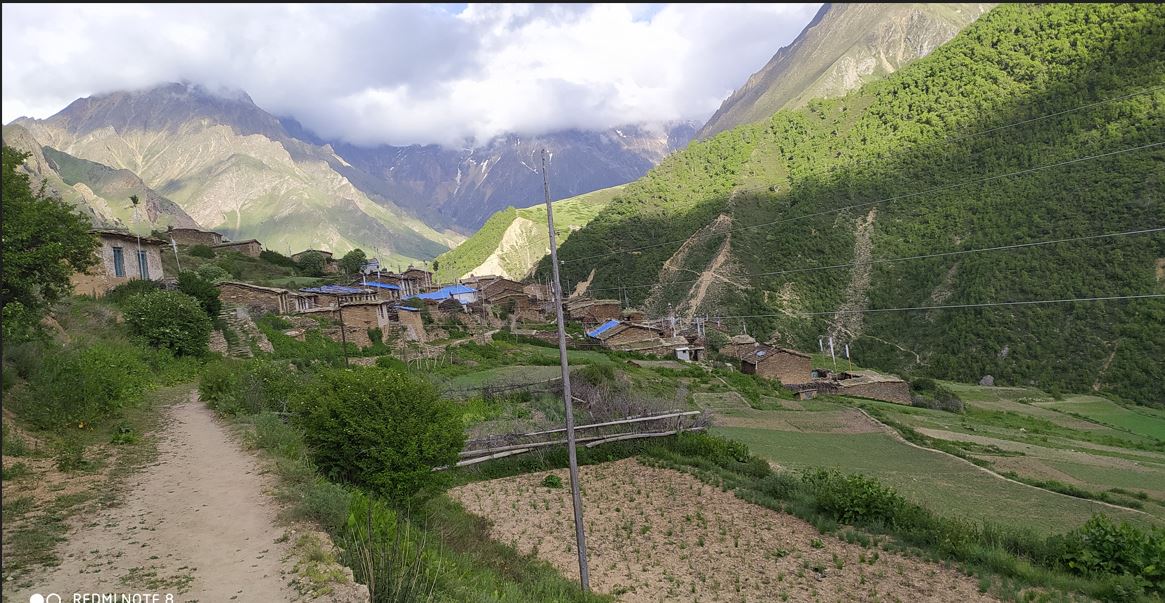
Darchula, May 10: After spending six months away due to extreme winter cold, residents of Tinkar village in northern Darchula district have returned home. Around 70 families had migrated to Khalanga in mid-November to escape the harsh weather and have now returned at the end of the April.
According to local Jaspal Tinkari, “The doors of our houses remained just as we had left them, locked and untouched, as if under the guardianship of the gods.” As the villagers arrived after a six-day journey, activity in the otherwise deserted village has resumed.
There is no direct Nepali trail to reach Tinkar; villagers must travel via Indian territory. Ward No. 1 member Hitesh Budhathoki expressed frustration, saying, “It feels humiliating to get Indian permission to access our own land.” Residents blame government delays in infrastructure development for this ongoing struggle.
Although the government allocated Rs 55 million for a road project under a special grant this fiscal year, delays in the awarding of the contract by the local rural municipality meant no progress was made. The construction company has only just been selected this week.
Despite dreams of accessing Tinkar via Nepal’s own land, residents were again forced to return through India. “Sometimes it makes us feel inferior about our own government,” Budhathoki shared. Locals were thrilled in 2020 when the Nepal government released a new map asserting sovereignty over this region, but they now feel those hopes are fading as infrastructure remains lacking.
In one brief period, the government airlifted food supplies to Tinkar, providing temporary relief and hope, but that momentum has since faded. Most of the village’s youth are away for work or studies, and elderly residents face hardships during emergencies due to the lack of basic services like healthcare and transportation.
Seasonal migration and life in Tinkar
Due to heavy snowfall (over 6 feet) and its high altitude (3,300 meters), villagers temporarily migrate to Khalanga every year, a process known locally in the Sauka community’s Rang language as “Kunchha.” The village remains abandoned during the winter months, yet remarkably, no thefts have ever been reported. Locals believe their deep faith and spiritual practices keep their homes and supplies protected.
The main sources of livelihood are agriculture, trade, and medicinal herb collection. Crops like buckwheat, barley, potatoes, and wheat are cultivated. Villagers also raise animals such as cows, yaks, mules, and goats.
Trade with Tibet was common in the past, but imports from China have recently stopped. Tinkar is home only to the Sauka ethnic group, who speak the “Rang” language. The village is renowned for its natural beauty, traditional homes, blooming alpine flowers, wild animals like the blue sheep (Naur), and views of Api Himal and surrounding Himalayan ranges.
Lack of Basic Services
Residents live in Tinkar for only about six months a year. During this time, they lack access to basic health services. For minor ailments, they either rely on medication carried from Khalanga or seek help from Indian border security. Elderly patients often face life-threatening risks due to the absence of local medical care.
The nearest health post is in Chhangru, which is over five hours away on foot. Construction of a health facility in Tinkar began 3–4 years ago but remains incomplete due to inconsistent budgeting. Even security personnel have to carry their own medical supplies.
Dependency on Indian route for access
During the Panchayat era, Tinkar was accessible via a Nepali trail, but after the transition to multiparty democracy, that path fell into disrepair. Without proper maintenance, locals have had to rely on Indian roads and permission for access to their own village. Attempts to build roads within Nepal have repeatedly been hampered by poor implementation, even when budgeted.
In some areas, Indian road projects along the Mahakali River have caused landslides and blocked access to Nepalese trails. Riverbank erosion in regions like Tambaku has entirely cut off some routes.
Due to Nepal’s infrastructure failure, not only villagers but also officials from the Armed Police Force (APF), Nepal Police, and border posts (BOP) stationed in Tinkar must use Indian roads for movement.
Limited deployment of security forces
Security personnel, like villagers, are only stationed in Tinkar for about six months due to the extreme cold. According to DSP Lili Bahadur Chand of APF, the latest APF team under Inspector Anil Shahi reached Tinkar’s Chhayalek BOP via India. Nepal has stationed armed police in the area since 2020, after publishing the updated national map.
Meanwhile, Nepal Police are preparing to ascend to Tinkar within a few days. Coordination is underway to obtain travel permits from both the Nepal and Indian sides. #nepal #tinker