


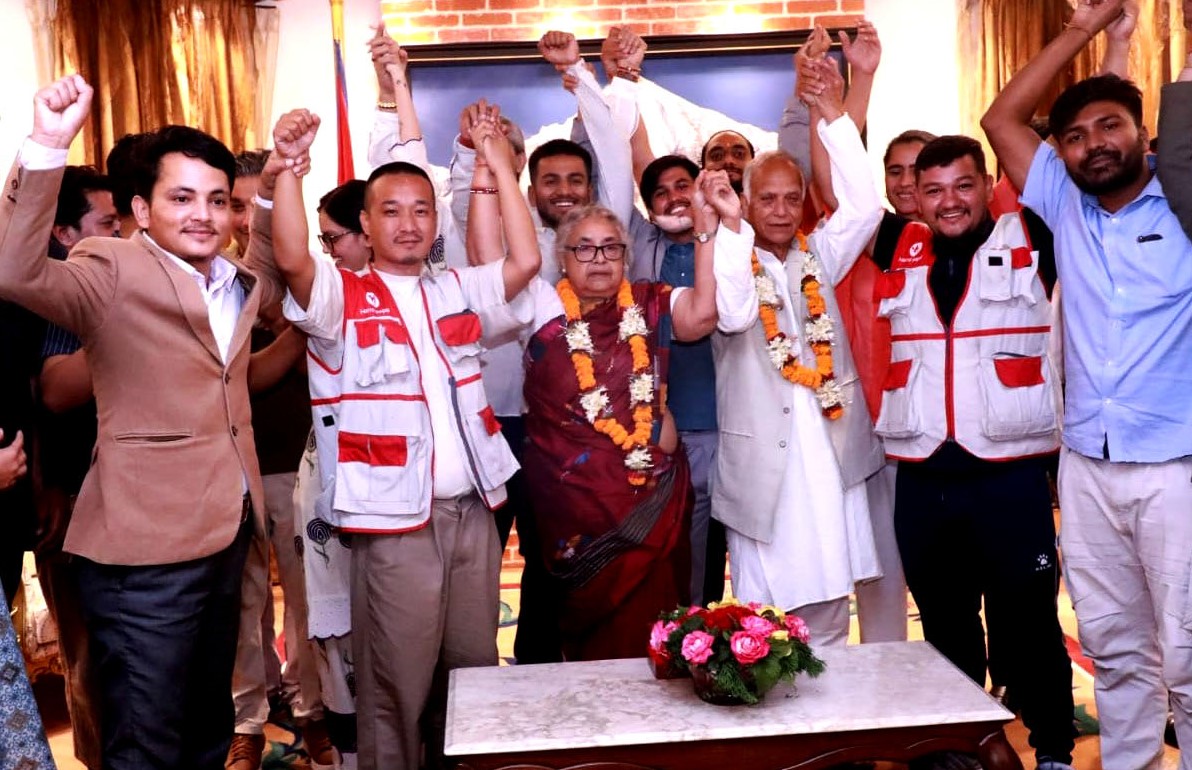
Kathmandu, Oct 3: Had the state not brutally opened fire on the peaceful demonstrations of September 8-9, 2025, the trajectory of the Gen-Z movement would likely have been very different. The social media influence of independent mayor Balendra Shah (Balen) played a decisive role in escalating the crisis to the point of parliamentary dissolution.
With his chemistry with the military and the proposal to install former Chief Justice Sushila Karki as interim Prime Minister, Balen Shah has emerged as the de facto leader of the Gen-Z atmosphere, issuing directives directly from Facebook. At the same time, members of the “Hami Nepali” group, who originally appeared at the protests merely to serve water to Gen-Z demonstrators, are now attempting to intervene in the country’s highest political decision-making.
Fate of Lucifer and the hijacker
Analyst Saurabh Rishal has likened Balen to a “Lucifer,” confined largely to the world of Facebook. By contrast, the statements of Sudan Gurung from Hami Nepali have raised eyebrows. Today, he has rebranded himself as a decisive figure shaping Nepal’s political future, acting out the role of someone who can “dictate” the state. Media outlets have questioned how Sudan so quickly became the “hijacker” of the Gen-Z uprising.
This article is not centered solely on Sudan, but on how his performance as a self-styled leader threatens to distort the legitimacy of a Sushila Karki-led interim government and prolong the cycle of transition.
Just days ago, in an interview with a foreign outlet, Sudan Gurung declared: “We will not allow old political parties to contest elections instead we (the government) will intensify investigations.” He went further, calling for investigations into corruption and violence by senior leaders from old political parties, bans on traditional parties, and even jail terms for their chiefs. While genuine Gen-Z members have listed electoral reform and good governance as priorities, Sudan’s rhetoric aims to infect the interim government with a different, more authoritarian flavor.
Miraaj Dhungana and his peers have shown passionate activism, yet their statements have not carried the same criminal undertone. By contrast, Sudan’s ambition—born abruptly from Hami Nepali’s “schooling”—appears driven by a desire to seize leadership. Perhaps it was toward such figures that KP Oli directed his barbed remark: “Will we entrust this ‘hullabaloo government’ with the nation and simply leave?”
Investigations and pushback
The three member Commission of Inquiry led by former justice Gauri Karki has restricted the passports of several high-profile figures including former Prime Minister KP Sharma Oli, former Home Minister Ramesh Lekhak, linked to moral responsibility for the tragic incident of the Gen-Z protests. Both the Nepali Congress and the CPN UML have accused the Sushila-led government of seeking revenge, filing formal protests.
The question now remains: is the Gen-Z mandate still with its genuine grassroots, or has it been hijacked by new actors with ambitions that risk dragging Nepal deeper into uncertainty?
Road to Bangladesh path: Nepal’s interim government
In the eyes of Nepal’s political leaders, commissions like the one led by former Supreme Court Justice Girish Chandra Lal—whose report remains unpublished—carry little weight. But for the new political forces germinating in Kathmandu, their intent is clear: to tap into public anger against old leaders by adopting “liberal interpretations” of the law and spotlighting past wrongs.
Though branded an “election-focused” administration, the interim government increasingly appears compelled to walk in step with Sudan Gurung’s political line. Meanwhile, Kathmandu Metropolitan City continues to wield the “miraculous staff of development” on Facebook as long as its broader ambitions remain unfulfilled.
Doubts are now openly voiced over whether the Sushila Karki-led government can deliver elections within the prescribed timeframe. The real Gen-Z bloc and Sudan’s faction are expected to push for new preconditions before polls. Traditional political parties, alternating between defensive and protective postures, find themselves caught off balance. Apart from KP Oli—who continues to speak in his own unfiltered style—other senior leaders have maintained restraint, seeking traces of constitutionalism within this “Madam’s government.” By March 5, Nepal’s transitional cycle seems set to drag further, with layers of latent conflict between old parties and rebellious forces shaping the narrative.
Compared to Bangladesh, Nepal’s shift in power was swifter. Yet in Dhaka, Nobel laureate Muhammad Yunus has already served more than a year as the Chief Adviser (equivalent to prime minister) of its interim government following regime change, with elections scheduled for mid-February next year.
In a recent interview with journalist Mehdi Hasan, Yunus was asked: Nepal is holding elections within six months under an interim government, so why is Bangladesh’s timeline extended so much?
Yunus replied: “Some even say this government should last not just five or ten years, but fifty! Those who believe in democracy want elections on time. But in Bangladesh, the issue is not democracy alone—it is governance. We want a corruption-free country. This is an interim government. No one can say how long it will last, because that decision lies with us. Our agenda is reform, trial, and election. If we hold elections without reforms, the old system will only continue.”
In Bangladesh, Yunus has advanced with the dual goals of “reform” and “trial”: reforming the legacy of Sheikh Mujibur Rahman while putting members of the Awami League party under scrutiny.
For Nepal, the comparison is inevitable: will its interim government become a short-lived caretaker focused on elections, or will it, like Bangladesh, prioritize structural reforms before facing the ballot box?
Sushila and Gauri Bahadur Karki’s mission
In Nepal, the decision of the incumbent Home Minister not to immediately bring to justice those who allegedly set fire to constitutional bodies and private property during the September 8–9 uprising—citing the jurisdiction of a judicial inquiry committee—reflects the deep political fractures of the moment. Constitutional experts have described the government’s stance as an “authoritarian farce.”
For victims whose property was looted or burned, the response they will receive remains tied to the findings of the high-level inquiry commission. The Home Minister has already made clear where the government stands. Notably, even before assuming leadership of the commission, Chair Gauri Bahadur Karki had named senior leaders and outlined the scope of investigations publicly on social media.
At the height of the violence in Kathmandu, Karki wrote on X (formerly Twitter): “Former prime ministers KP Oli, Sher Bahadur Deuba, Pushpa Kamal Dahal ‘Prachanda,’ along with ex-officials, ministers, and MPs must not be allowed to leave the country. They should be detained and investigated…”
The impression left is that while Sushila Karki was on the streets through the interim government, Gauri Bahadur Karki was waging the battle on social media. The government, it seems, is moving forward according to the script of transition. Yet, formal and open dialogue between the interim government and the political parties remains absent.
State vigilantism and the killing of security forces
Until the Home Ministry regains control over looted weapons and absconding criminals, it will be difficult to restore public trust in the security apparatus. Yet, political figures already discredited in the eyes of ordinary citizens—and their supporters—are being pushed into reactionary postures. Sudan seeks to form an organization modeled on the one in Bangladesh that, he claims, sustained Muhammad Yunus’s interim government for five decades. Similarly, in Nepal, Sudan’s group appears intent on propping up the Sushila government, even if through authoritarian means throughout the transitional period.
Every sector of the state is plagued by disorder. Sudan Gurung, with a camera in hand, has been storming into government offices across Kathmandu “to reform them,” as if he himself were the Home Minister. This trend signals a dangerous slide into state vigilantism. It also sets a precedent suggesting that a few thousand enraged people can cause a complete “security collapse” whenever they wish. To avoid such a collapse, the Sushila government must exercise sound judgment. Whoever was responsible for turning the Gen-Z movement into a scene of brutality must face punishment. At the same time, the government must act as mediator between Gen-Z activists and political parties, ensuring that dialogue does not break down. #nepal #genz #sushilakarki