


Surkhet, May 6: The implementation of free and compulsory education in Karnali Province has become increasingly difficult due to a shortage of teachers and weak management relative to student numbers.
Although national standards require one teacher for every 45 students, many community schools have failed to meet this ratio, forcing them to charge fees despite the constitutional provision for free education.
At a time when school enrolment campaigns are ongoing, several community schools have reportedly been collecting money from parents to manage additional teaching staff.
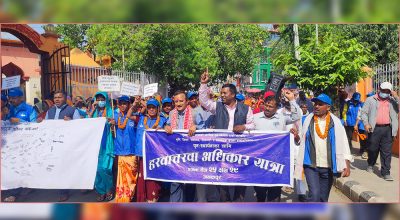
Stakeholders highlighted these concerns during a programme on the status of compulsory and free education organised in Surkhet by the Environment Agriculture and Development Centre.
Dhirendra Prasad Sharma, Education Chief at Birendranagar Municipality, said that while the Constitution guarantees free education, its practical implementation remains challenging.
“Some schools are compelled to charge fees due to insufficient teachers,” he said, adding that proper teacher management could make free education feasible. He also urged all three levels of government—local, provincial, and federal—to prioritise teacher allocation based on student density.
Sharma noted that Birendranagar, as the provincial capital, attracts nearly half of its students from other districts, placing additional pressure on local schools.
Acting Secretary Devi Prasad Paudel of the Ministry of Social Development stressed the need for coordination among all tiers of government, stating that the province alone cannot formulate comprehensive policy solutions.
Meanwhile, Khadka BK, Chairperson of Chaukune Rural Municipality, said local governments often hesitate to spend on teacher management due to concerns over audit objections from the Office of the Auditor General. However, he noted that schools in his municipality have not been charging fees.
Deepa Hamal, Director at the Education Development Directorate, said around five percent of children in Karnali are still out of school, although the number is gradually declining.
She pointed out that children of migrant workers—especially those whose parents work in India—are more likely to miss out on schooling. Increasing the education budget and improving teacher management, she said, would help ease implementation challenges.
According to Balbir Sunar, Education Officer at the Ministry, about seven percent of Karnali’s total budget of Rs. 32.99 billion—equivalent to Rs. 2.35 billion—has been allocated to education. Of this, Rs. 8.4 million is specifically earmarked for compulsory and free education.
Anup Nepali of KED pointed out a contradiction between policy and practice, noting that schools continue to charge fees despite the free education mandate.
He suggested that all levels of government must increase funding and improve coordination to address structural challenges in the education sector. #Nepal