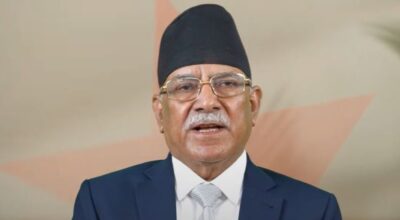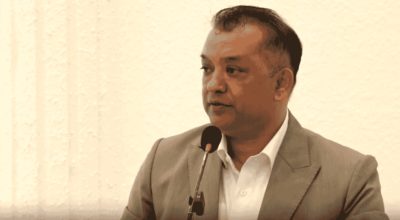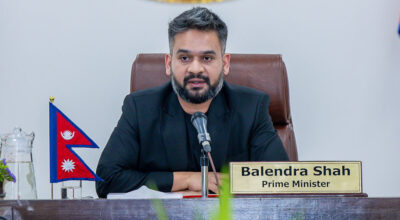




Kathmandu, May 31: The Ministry of Foreign Affairs has clarified that Prime Minister Balendra Shah’s remarks in the House of Representatives on Nepal-India border issues were related to encroachment in the no-man’s-land (Dasgaja) area and the issue of “cross-border occupation” of land.
In a statement issued on Saturday evening, the ministry said the prime minister’s comments while responding to lawmakers’ questions on the Nepal-India border and the Lipulekh issue were made in that context.
“The matter referred to by the Prime Minister in Parliament primarily concerns encroachment of the Dasgaja area and ‘cross-border occupation,’ where citizens of one country cultivate or reside on land that technically falls within the territory of the other country,” the statement said.
According to the ministry, this situation exists because the Nepal-India boundary in river-border areas was determined under the “fixed boundary principle,” resulting in some instances of cross-border land use and occupation.
The statement noted that bilateral border mechanisms and technical teams from both countries are actively engaged in constructing and repairing boundary pillars, addressing encroachment in the Dasgaja area, and compiling records of cross-border occupation along the extensively mapped Nepal-India border.
The ministry further said that the work of the technical committee, which had remained stalled for a long period, has resumed and joint data collection is currently underway in border areas.
Studies conducted by the technical committee have shown that, in some locations, land presently used and occupied by Nepal may technically fall on the Indian side of the border, while land currently used by India may fall on the Nepali side. The ministry said the prime minister’s statement that “some Indian land may be on Nepal’s side” should be understood in this technical context of cross-border occupation.
Regarding India’s operation of the Kailash Mansarovar pilgrimage route through the Lipulekh area, which Nepal claims as its territory, the ministry reiterated that the Government of Nepal had already made its official position clear on May 3, 2026. It added that India had also responded to Nepal’s diplomatic note through diplomatic channels.
According to the statement, both countries have expressed their commitment to resolving border-related disputes through diplomatic means and mutual dialogue.
“The centuries-old, long and open border between Nepal and India is well known. Nepal’s current international boundary was established and defined by the 1816 Treaty of Sugauli,” the ministry said.
It added that boundary mapping remains pending in the areas of Susta, Limpiyadhura, Lipulekh, and Kalapani, while issues related to cross-border occupation and encroachment of the Dasgaja area persist in some other locations along the border.
After the Prime Minister’s controversial address in the House, a large section of Nepal’s political community and border experts criticized his remarks as irresponsible, arguing that they overlooked the sensitivity of border issues and demanding further clarification from the government. #nepal