


The presentations shared by speakers were professional and inspiring. From both Chinese and Nepali judicial perspectives, they showed how the judiciary can contribute to protecting the environment and serving national development. Such in-depth and useful exchanges help deepen mutual understanding between our legal systems and give us inspiring ideas on how judicial services can better serve green and sustainable development.
The ecological environment is the basic condition for human survival and development. Around twenty years ago, Chinese President Xi Jinping proposed the concept of “lucid waters and lush mountains are invaluable assets” when he was the head of Zhejiang Province. The idea was developed into Xi Jinping Thought on Ecological Civilization after he became the President of the People’s Republic of China and has been translated into the practice of the building of an ecological civilization as part of the country’s development strategy.
Xi Jinping Thought on Ecological Civilization systematically explains the relationship between humans and nature, protection and development, the environment and people’s livelihoods, and domestic and international relations.
-On ecology as invaluable assets, President Xi said, “Lucid waters and lush mountains are not only natural wealth, ecological wealth, but also social wealth and economic wealth.”
-On the relationship between nature and humans, President Xi said, “Sound ecological environment is the most inclusive benefits to people’s wellbeing. Civilization prospers when ecology prospers.”
-On strict rule of law, President Xi said, “Protecting the environment requires the best institutional arrangements and the strictest rule of law. Institutional innovations must be accelerated and enforcement of laws and regulations must be strengthened.”
-On global cooperation, President Xi said, “The construction of ecological civilization is related to the future of mankind, and building a green home is the common dream of mankind. Protecting the ecological environment and tackling climate change requires all countries in the world to help each other and make joint efforts.”
China has set its ecology goal as building A beautiful China, celebrating ecological civilization, enabling the country’s great rejuvenation by mid-century. To that end, China has adopted the following ecology strategies:
1-Promote sustainable development with green technologies, especially clean, renewable energy.
2-Systematic, integrated, modernized management of landscapes, forests, farmlands, rivers, lakes, grass, sand, and biodiversity.
3-Reduce pollution by multi-disciplinary scientific research, innovative practices, cross-regional system governance, and system improvement.
4-Maintain strictest rule of law in controlling, preventing and punishing pollution.
5-Involve all the people in building a beautiful China, by advocating a simple, moderate, green and low-carbon lifestyle, with minimum wastes.
6-Engage the international community to build global ecological civilization.
Over the past two decades, guided by this philosophy, China has achieved historic progress in building an ecological civilization.
In 2020, addressing the United Nations General Assembly, President Xi surprised the world by pledging very publicly that China’s carbon dioxide emissions will peak before 2030 and carbon neutrality will be achieved before 2060.
China is among the countries with the fastest growth in forest resources. In 2024, the share of days with good air quality in district-level and main cities reached 87.2%, and biodiversity protection has achieved notable results.
In the past 10 years, China has deployed more solar and wind capacity than any other country. More than 50 percent of electric vehicles in the world are sold in China. China also makes and operates over 90 percent of the world’s electric buses.
It is worth highlighting China’s rapid development of new energy vehicles has not only supported China’s green transition, but also created new green opportunities globally. According to statistics for Nepal’s 2024/25 fiscal year, electric vehicles made up 73% of imported four-wheel passenger cars, and Chinese models accounted for 83% of the import value. This is a concrete example of China–Nepal green cooperation and shows the broad space for future collaboration between us on ecological civilization.
building an ecological civilization requires judicial support. In recent years, China’s judicial system has steadily applied Xi Jinping Thought on Ecological Civilization and continuously strengthened its ability to handle environment-related cases. Courts across the country have established specialized tribunals for environment and resource cases, promoting an ecological damage compensation system, and innovating with public-interest litigation and restorative justice measures.
These more systematic, professional, and effective approaches have met the public’s expectations for a quality ecological environment. Throughout this process, Xi Jinping Thought on the Ecological Civilization has offered solid guidance. This thought stresses using legal thinking and legal methods to address ecological challenges, promoting sound laws and good governance, and ensuring fairness and justice. China’s judicial practice is a vivid example of these principles and continues to enrich global experience in ecological rule-of-law.
Ecological civilization is a systemic undertaking and a deep transformation. It needs both visionary guidance and legal protection. Although China and Nepal have different national conditions, we are close neighbors and are both exploring how judicial services can respond to environmental challenges and support national development. Today’s forum is an important platform for building consensus and seeking cooperation. China stands ready to continue working with Nepal to strengthen the exchange of ideas, share practical experience, align mechanisms, and advance practical and deeper cooperation on green rule-of-law.
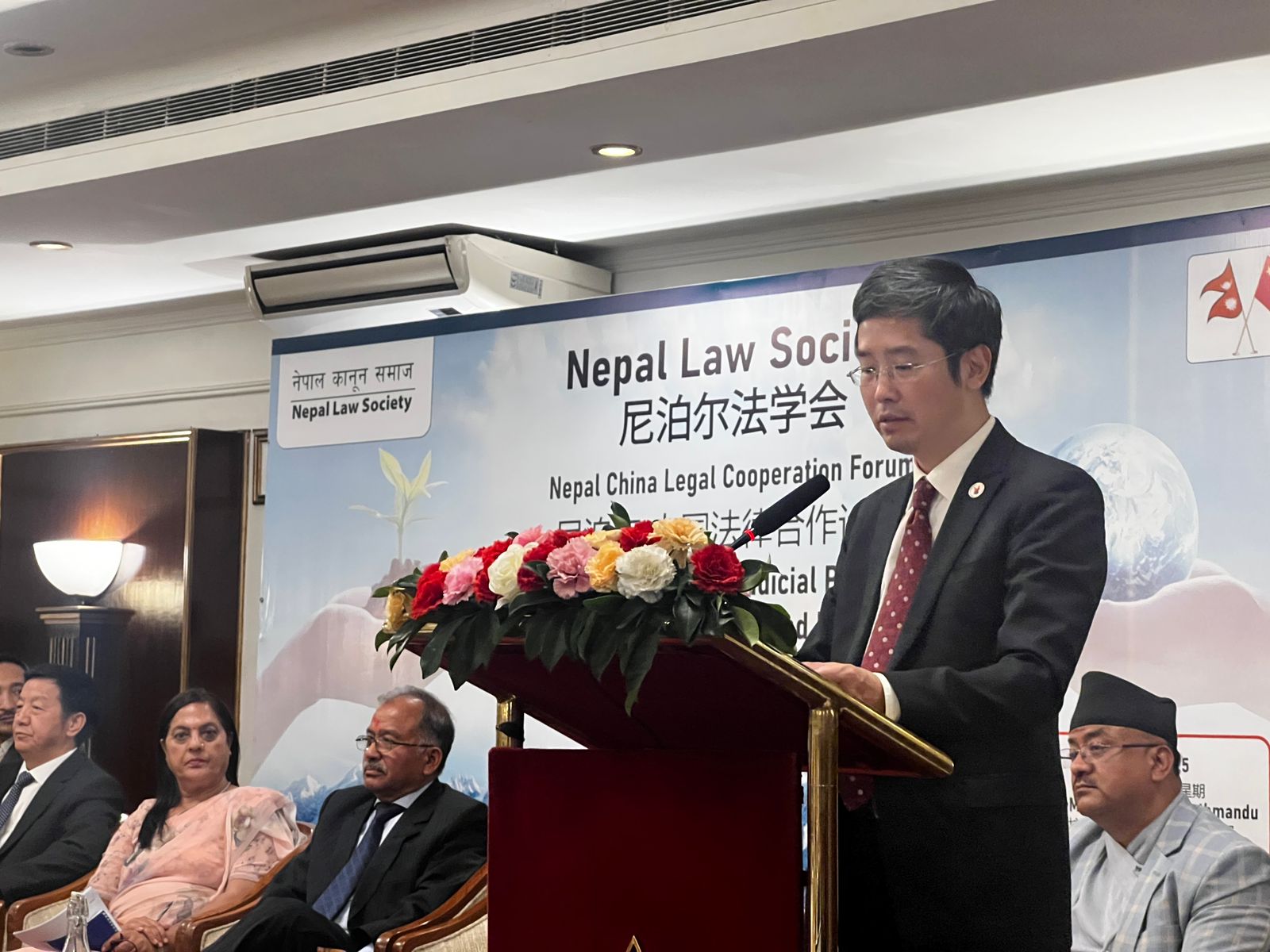
Mr. Wang Xin, DCM of the Chinese Embassy in Nepal, presented the thoughts in a program Nepal China Legal Cooperation Forum organized by Nepal Law Society in Kathmandu on 11 Aug, 2025.