

Kathmandu, Sept 3: Mount Everest, the world’s highest peak, has long been a symbol of Nepal’s global identity. Beyond its religious and cultural value, Everest significantly contributes to Nepal’s tourism and economy.
However, in recent years, the growing number of climbers and trekkers has led to an alarming rise in waste accumulation, creating serious threats to the Himalayan ecosystem and environmental balance.
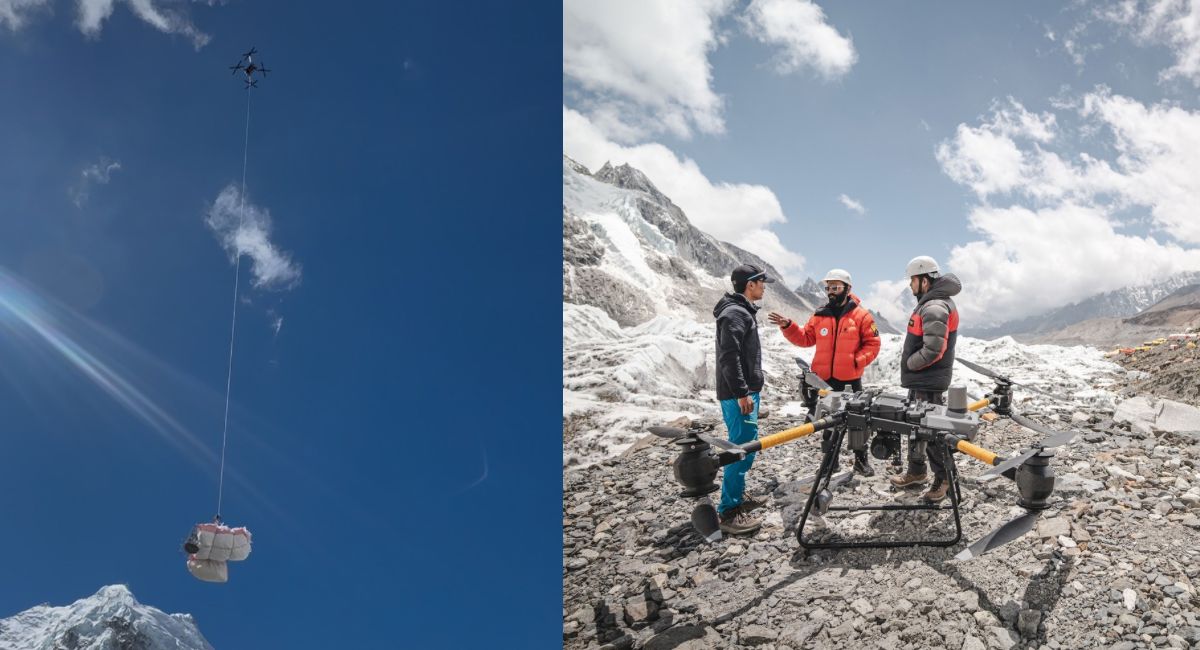
To address this challenge and support climate change mitigation, drones are now being deployed for waste collection in the Everest region. Cimex Inc., the official distributor of BYD electric vehicles in Nepal, has partnered with Nepali drone company Airlift Technologies to carry out waste transportation using drone technology.
According to Cimex Inc., the company aims to collect 1,000 kg of waste from the Everest region. The initiative is part of BYD’s global campaign “Cool the Earth by 1°C”, which promotes clean energy, zero carbon emissions, and climate action worldwide. Cimex CEO Sahil Shrestha stated that the campaign reflects the company’s corporate social responsibility (CSR) and commitment to sustainability.
“Everest is our national pride. By using technology, we want to protect it from climate threats while promoting sustainable development and a cleaner environment,” Shrestha said.
Drones Speeding Up Waste Transport
According to Milan Pandey, Director of Airlift Technologies, the drones used in Everest can fly at 15 meters per second and operate in temperatures as low as -15°C. Previously, transporting waste from higher camps took 6–7 hours, but with drones, the task can be completed in just 1–2 minutes.
He explained that in past years, waste piling up in Khumbu Icefall posed risks during rope fixing and load carrying, leading to fatalities. With drone use, both waste transport and climber safety have significantly improved. Currently, drones are transporting waste from 6,130 meters altitude down to the Everest Base Camp.
The campaign is being carried out in collaboration with the Sagarmatha Pollution Control Committee (SPCC) and Khumbu Pasang Lhamu Rural Municipality.
Pandey added:
-
In 2024, Airlift collected 234 kg of waste from Camp-1 of Everest and 641 kg from Mount Ama Dablam.
-
This season, 286 kg of waste has already been collected from Everest with Cimex’s support.
-
Future plans include expanding waste collection to Ama Dablam and Manaslu, and eventually to other Himalayan regions and national parks.
Expanding the Campaign
Cimex’s Marketing Head Samir Shrestha confirmed that waste collection efforts are ongoing, with the new goal of reaching 1,000 kg of waste cleanup. He highlighted that drones had already proven effective in rope fixing operations, which encouraged their use in large-scale waste collection.
Mountaineers Call for Stronger Regulations
Mingma David Sherpa, First Vice-President of the Nepal Mountaineering Association, noted that many climbers still leave waste on Everest despite deposit fees collected by the government. Although these deposits are later refunded, the waste problem persists.
“Collecting waste from Everest is costly and risky. Drone technology has made it much easier, but stricter policies are needed. The government should enforce non-refundable waste management fees to ensure climbers take responsibility,” Sherpa said.