


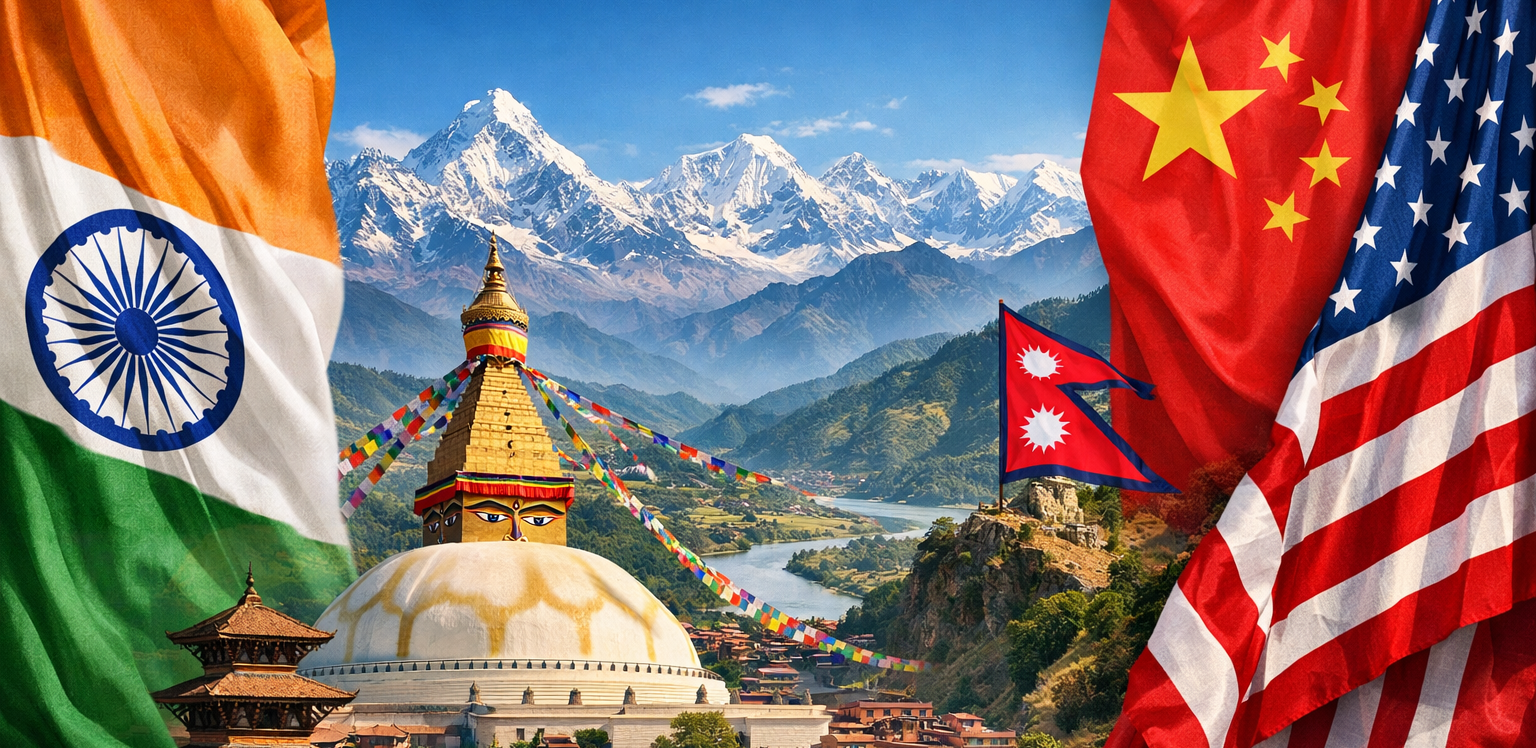
Nepal stands at a defining moment in its contemporary political and diplomatic history. Situated between two rising and rival powers—India to the south and China to the north—the country’s foreign policy has long been shaped by geography, history, and the imperative of survival as a small state in a competitive regional environment.
As Nepal prepares for parliamentary elections this March under the interim administration led by Sushila Kari, the choices made by the post-election government will significantly influence not only the country’s sovereignty and security, but also its development trajectory and standing in South Asia.
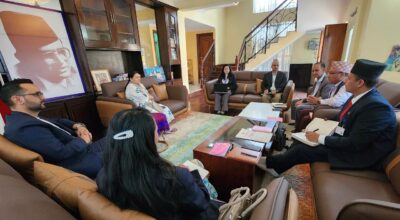
The Sushila Karki administration has been mandated by the President to conduct elections and ensure a smooth transition of power. While the interim government is responsible for day-to-day governance, it is the duty of the post-election government to formulate and implement a coherent foreign policy that safeguards Nepal’s independence, development interests, and strategic autonomy.
Past weaknesses—most notably corruption, mismanagement of resources, and persistent political instability—have created openings for external influence, at times reducing Nepal to a strategic playground for competing powers. Preventing a recurrence of such vulnerabilities must therefore be a central priority of the incoming leadership.
Nepal’s geopolitics has traditionally been captured by the famous metaphor of a “yam between two boulders,” attributed to King Prithvi Narayan Shah, the founder of modern Nepal. This imagery reflects the country’s enduring need to pursue a cautious, non-aligned foreign policy that balances the interests of its powerful neighbors while preserving national independence. Historically viewed as a buffer state, Nepal has avoided overt alignment with any single power, instead emphasizing balanced relations with both India and China. In today’s context, however, this balancing act has become more complex due to intensifying Sino–Indian rivalry, growing involvement of extra-regional actors such as the United States, and Nepal’s own domestic governance challenges.
While geographically distant, the United States has maintained a relationship with Nepal for over seven decades. Initially centered on humanitarian and development assistance during the Cold War, U.S. engagement expanded to support democratic governance, human rights, and institutional capacity. Following the 1990 People’s Movement, which restored parliamentary democracy in Nepal, Washington played a supportive role in consolidating democratic institutions.
During the post-2006 peace process, U.S. assistance helped stabilize the country after a decade-long civil war, providing both financial and technical support for governance and reconstruction. The 2015 earthquake further highlighted U.S. developmental support, with aid for disaster relief, rehabilitation, and reconstruction projects across affected districts. These historical engagements underscore that U.S. involvement in Nepal has consistently been civilian and developmental in character, rather than coercive or militarized.
Competition between India and China remains the most decisive external factor shaping Nepal’s strategic environment. For India, Nepal is deeply interconnected through open borders, cultural and civilizational ties, economic interdependence, and security considerations. For China, Nepal’s importance lies in its proximity to Tibet and its potential role as a gateway to South Asia through trade and infrastructure connectivity.
The United States, while distant geographically, has increasingly sought to engage Nepal as part of its broader Indo-Pacific strategy. Washington’s approach, however, emphasizes development, governance, and soft power projection rather than military or strategic control. Development projects, foreign assistance, and diplomatic engagement in Nepal are frequently interpreted through a geopolitical lens. U.S. aid and infrastructure support, such as the Millennium Challenge Corporation (MCC) compact, focus on electricity transmission and road connectivity. This allows Nepal to strengthen infrastructure and economic governance without entering defense alliances or compromising sovereignty. At the same time, Chinese Belt and Road projects and Indian trade and energy initiatives create multiple pathways for economic development, giving Nepal leverage to pursue a diversified, non-aligned strategy.
Non-alignment and strategic balancing must continue to underpin Nepal’s foreign policy. This does not imply rigid neutrality, but rather diversified and pragmatic engagement. Nepal must pursue mutually beneficial relations with all major powers while resisting pressure to take sides. Relations with India remain indispensable for trade, employment, energy exchange, and people-to-people connectivity.
Engagement with China should be carefully calibrated, particularly in areas such as infrastructure development, tourism, and investment, including projects under the Belt and Road Initiative. At the same time, partnerships with middle powers and the United States can provide additional development avenues and diplomatic support, enhancing Nepal’s strategic autonomy.
A key challenge for the new government will be to ensure that cooperation with one partner does not erode trust with another. This requires careful management of perceptions and transparency in agreements, such as those under the MCC compact, which was ratified by Nepal’s Parliament and remains strictly developmental in scope.
A notable evolution in Nepal’s geopolitical thinking is the effort to transform geography from a constraint into an opportunity. Moving beyond the narrative of being merely landlocked, Nepal has increasingly promoted the concept of becoming a land-linked or bridge state connecting South and East Asia. Improved road, rail, and energy connectivity could enable Nepal to integrate more deeply into regional supply chains, reduce dependence on a single transit route, and strengthen its bargaining position. U.S.-funded infrastructure projects and development assistance can complement Chinese and Indian investments, helping Nepal pursue a diversified connectivity strategy and reducing overreliance on any single external partner.
Endowed with vast hydropower potential, Nepal is increasingly viewed as a future energy supplier for South Asia. India remains the principal market and development partner, while China and Western actors—including the United States—have expressed interest in investment and technology transfer.
Hydropower presents both economic opportunity and diplomatic leverage, but realizing this potential requires transparent governance, long-term planning, and safeguards to ensure national control over critical resources. Projects such as Upper Karnali and Budhi Gandaki illustrate both promise and peril, demonstrating how political interference, delayed decisions, and cost overruns can undermine investor confidence and national credibility.
Internal challenges continue to constrain Nepal’s geopolitical effectiveness. Chronic political instability, weak institutional capacity, and policy inconsistency have limited the country’s ability to pursue coherent and proactive diplomacy. Leadership failures and poor governance have repeatedly exposed Nepal to external pressure. In this context, national security is inseparable from economic resilience, political stability, and institutional strength. Building capable institutions, enforcing accountability, and forging broad national consensus on core foreign policy priorities are essential tasks for the post-election government. U.S. engagement—through programs supporting governance, transparency, and institutional capacity—provides tools that Nepal can utilize to strengthen autonomy and decision-making. By combining domestic reform with international partnership, Nepal can better manage complex regional dynamics without compromising sovereignty.
Looking ahead, Nepal’s foreign policy must evolve from a largely reactive posture to a more confident and proactive diplomacy. This transition demands scenario-based strategic thinking, as shifts in regional and global dynamics—including U.S.-China strategic competition—could have immediate and profound consequences for Nepal. Escalation of Sino–Indian tensions into open conflict, particularly along contested borders, would place Nepal under intense pressure. Strategic leverage over trans-boundary rivers—such as China’s upstream position on the Brahmaputra—could heighten regional tension. Nepal would face pressure to align with one side, risking long-term costs to sovereignty. Maintaining principled neutrality, supported by civilian partnerships with countries like the United States, could allow Nepal to play a constructive role as a peace broker, leveraging its peace-oriented identity and UN peacekeeping record.
A more optimistic scenario envisions India and China managing their rivalry through dialogue, preserving regional stability and shifting attention toward economic competition. Regional institutions regain relevance, cooperation on growth and climate action deepens, and development assistance—including from the United States, Japan, Germany, and EU members—expands. Nepal can leverage this to attract infrastructure financing, deepen connectivity, and diversify investment sources, enhancing its strategic autonomy. Even in less favorable conditions, strategic use of U.S. and other development programs can mitigate risks from structural economic constraints and weak governance, while domestic reforms remain critical to ensure tangible benefits from foreign engagement.
Major global crises, such as conflicts in the South China Sea or Taiwan, could indirectly reshape South Asian geopolitics, narrowing Nepal’s strategic space. In such a scenario, humanitarian and developmental assistance from the United States and other partners can help Nepal sustain economic and political stability while preserving neutrality. Nepal can also leverage partnerships—including with the United States—to strengthen its global identity. Peacekeeping contributions, climate diplomacy, cultural heritage promotion, and education exchanges enhance Nepal’s soft power. By integrating U.S. development assistance and governance programs into a broader multi-alignment strategy, Nepal reinforces its role as a bridge state rather than a pawn in regional rivalries.
Nepal’s geopolitics reflects a dynamic interaction between geography, the ambitions of powerful neighbors, extra-regional actors like the United States, domestic governance quality, and the country’s own aspirations for sovereignty, stability, and development.
The post-election government will have a critical opportunity to recalibrate foreign policy toward a development-first, non-aligned, and strategically balanced approach. By strengthening institutions, curbing corruption, leveraging soft power, diversifying partnerships, investing in human capital, and transforming geography into an asset, Nepal can move from being a passive buffer to an active bridge in an increasingly multipolar world—no longer a playground for external powers, but a confident and constructive regional actor. U.S. engagement, focused on infrastructure, governance, and people-to-people ties, can be an enabler of Nepal’s sovereignty and development goals without compromising its non-aligned posture.
Combined with prudent management of relations with India, China, and other global partners, Nepal can translate its unique geographic and strategic position into a sustainable advantage, achieving stability, prosperity, and recognition as a proactive regional actor.