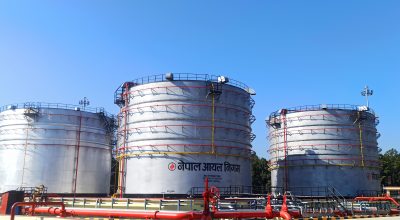



Kathmandu, June 27: The country imported petroleum products worth nearly Rs. 300 billion during the first 11 months of the current fiscal year 2025/26, with rising international fuel prices pushing up the country’s import bill despite a decline in the volume of some major fuel imports.
According to trade statistics released by the Department of Customs, the country imported petroleum products, including liquefied petroleum gas (LPG), worth Rs. 297.77 billion between mid-July 2025 and mid-June 2026.
The fuel import bill increased by about 20 per cent compared to the corresponding period of the previous fiscal year, when petroleum products worth Rs. 250 billion were imported.
Diesel accounts for largest share
Diesel remained the largest imported petroleum product, with imports valued at Rs. 152.67 billion during the review period.
Petrol imports stood at Rs. 68.18 billion, aviation turbine fuel (ATF) at Rs. 24.06 billion, and kerosene at Rs. 655 million.
In the same period of fiscal year 2024/25, the country had imported diesel worth Rs. 115.55 billion, petrol worth Rs. 58.88 billion, ATF worth Rs. 17.50 billion, and kerosene worth Rs. 1.07 billion.
As a result, expenditure on diesel imports rose by 32.12 per cent, while spending on petrol and ATF increased by 16.38 per cent and 37.5 per cent, respectively. However, spending on kerosene imports declined by 38 per cent. Similarly, the country imported LPG worth Rs. 52.21 billion during the first 11 months of the current fiscal year, down from Rs. 57.36 billion in the same period last year.
The value of LPG imports fell by around 9 per cent.
In terms of value, fuel imports surged during the review period due to rising petroleum prices in the international market, which directly increased Nepal’s import bill.
As a result of the rise in international fuel prices, the retail price of petrol in Nepal reached as high as Rs. 219 per litre, while diesel climbed to Rs. 237 per litre.
However, international crude oil prices have begun to decline, and domestic fuel prices are expected to decrease accordingly.
In terms of volume, the import of diesel—the most widely consumed petroleum product in the country—declined during the review period, while imports of petrol and aviation fuel increased marginally.
However, the consumption of kerosene declined during the review period.
During the review period, the country imported around 1,264,878 kilolitres (KL) of diesel, 685,127 KL of petrol and 197,387 KL of aviation fuel.
Similarly, 6,796 KL of kerosene and 475,980 tonnes of LPG were imported.
In the first 11 months of the previous fiscal year, the country had imported around 1,312,900 KL of diesel, 681,484 KL of petrol, 194,500 KL of aviation fuel and 506,679 tonnes of LPG.
The import volume of diesel declined by 3.65 per cent and that of LPG by 6 per cent during the review period compared to the corresponding period of the previous fiscal year.
However, petrol imports increased marginally by 0.5 per cent, while aviation fuel imports rose by 1.5 per cent during the review period compared to the same period last fiscal year.
Revenue collection slightly down
The government revenue from petroleum imports declined slightly during the review period despite the higher import bill. The government collected Rs. 103.92 billion in revenue from petroleum imports, including Rs. 52.82 billion from diesel, Rs. 37.60 billion from petrol, Rs. 3.6 billion from ATF and Rs. 9.73 billion from LPG.
During the same period last fiscal year, revenue collection from petroleum imports stood at Rs. 104.63 billion, comprising Rs. 52.33 billion from diesel, Rs. 38.58 billion from petrol, Rs. 2.73 billion from ATF, Rs. 302 million from kerosene and Rs. 10.69 billion from LPG.
The decline in revenue collection has been attributed to tax reductions introduced by the government to cushion consumers from the impact of rising international fuel prices.
On April 7, the government had decided to provide a 50 per cent waiver on customs duties and infrastructure development tax on the import of petrol, diesel and kerosene. This policy measures were adopted to address the worsening fuel supply crisis and rising economic burden. #nepal