


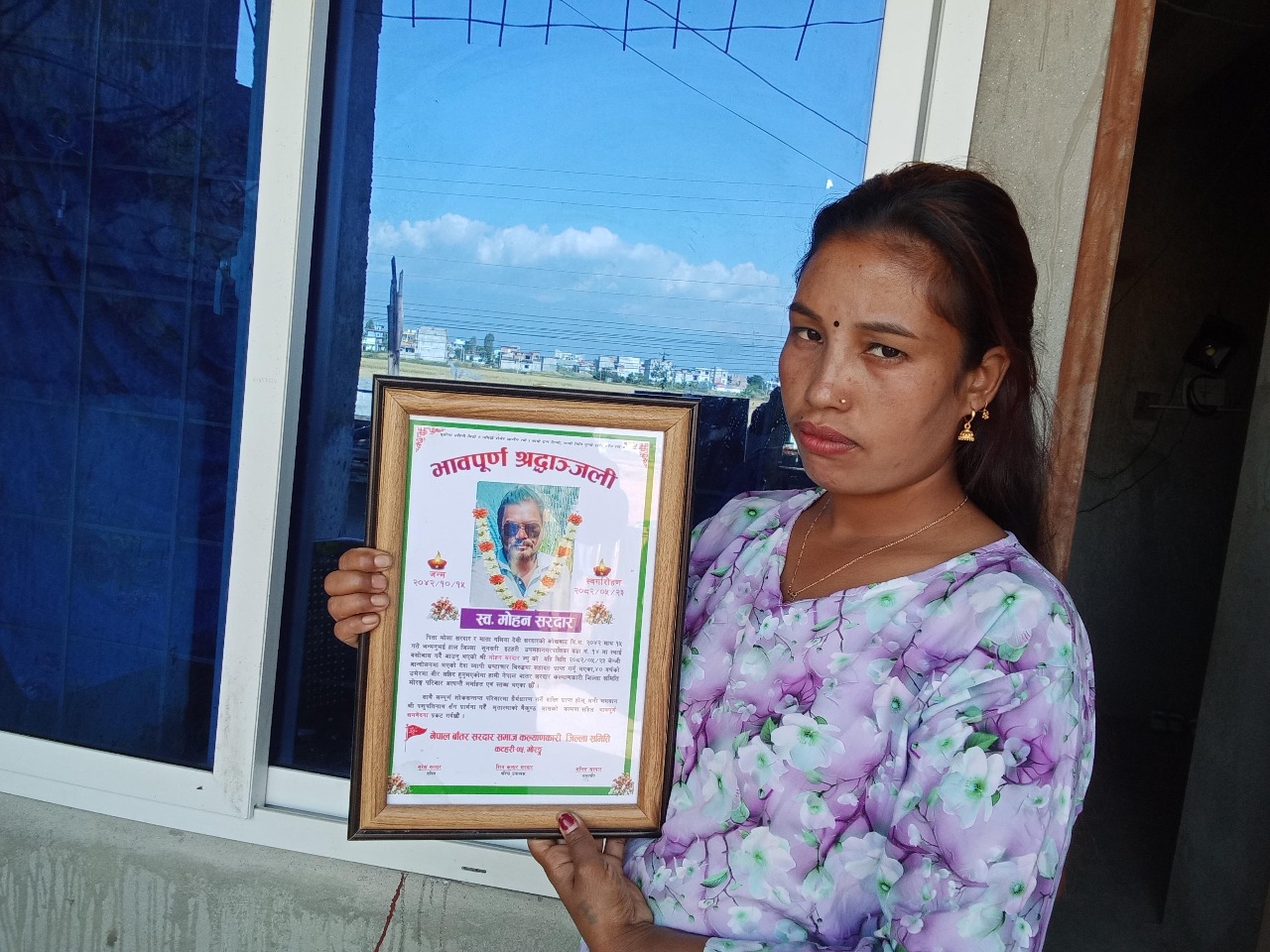
Itahari, Nov 24: Mohan Sardar of Itahari–14, who became a martyr during September 8 Gen-Z protest, used to work as a mason. On September 8, the day he died during the Gen-Z protest, he actually had little idea about what the movement was about. He had planned to go to the market with fellow villager Shrawan Sardar. As he was recovering at home from a leg injury he got while working, he thought he would visit the community health center after a short trip to the market.
He told his wife, Manju Sardar, “I’ll just go to the market for a while and also have my leg checked.” He left home — but never returned.
When he did not come back even late in the evening, Manju asked Shrawan. Shrawan replied that they had separated earlier that day amid a crowd during the protest in the marketplace, and he couldn’t find Mohan afterwards. “I don’t know where Mohan went. I couldn’t contact him,” he said. Hearing this, Manju felt a chill in her heart.
She began calling Mohan repeatedly, but his phone was switched off. She pleaded with relatives and villagers for help, but everyone gave the same uncertain response: “We haven’t seen him.” She hoped he would come back by nightfall, but her heart remained uneasy. She checked Facebook again and again.
Then she saw a video on Facebook — her own husband lying on the ground after being shot. She remembers regaining consciousness after family members tried to console her. Villagers then began searching everywhere for Mohan. Later, they received notice that his body had been kept at the BP Koirala Institute of Health Sciences morgue in Dharan, some 12 kilometer from Itahari. Manju went to see him the next day.
Mohan and Manju were married eight years ago. Losing her husband left Manju devastated. Even now, she bursts into tears at the mention of Mohan’s name. Mohan was 40 and the two had a love marriage. They have two daughters — one five years old and the other seven. “We had vowed to live and die together, but his untimely death has made my life unbearably difficult,” said 27-year-old Manju. “Our little daughter Akriti constantly asks about her father. It breaks my heart.”
They have told their younger daughter that her father has gone abroad for work. “But for how long can we lie to her?” Manju asks. “Akriti believes it for now, but when she learns the truth someday, how much pain will she feel?” Manju herself had returned from Kuwait after two years of hardship. “The children believe their mother came back, and their father went abroad,” she said. The elder daughter, seven-year-old Arbi, knows her father has passed away.
With the money Manju earned in Kuwait and Mohan earned as a mason, they had managed to build a small home on public land. Their family life was going on in a simple but stable way — until tragedy struck. “Now how will I raise my daughters? This worry haunts me all the time,” Manju says.
She has been holding onto hope because Prime Minister Sushila Karki promised her a job. Before Tihar, Gen-Z youth had gathered in Kathmandu, and Anju Rai, a Gen-Z leader from Jhapa, had brought Manju along to the event. During the meeting, PM Karki assured them of employment according to their qualifications, Manju recalls.
“The Prime Minister said she would manage a job, so I have been waiting,” says Manju. “I haven’t even gone out to look for work yet, because I am hoping for the Prime Minister’s promise to be fulfilled.” She adds that without work, it is becoming difficult to manage daily expenses. “I have been working since childhood. I worked hard in Kuwait too. I can do any work,” she says, appealing to industrialists and business owners: “Please give me some kind of work for the sake of my daughters.”
The government has already provided her Rs 1.5 million in compensation — Rs 1 million through the Home Ministry as compensation and Rs 500,000 for funeral and related expenses. The Koshi Provincial Government and Itahari Sub-Metropolitan City have also decided to provide support, though the relief has not been distributed yet.
Manju says she has saved the remaining money for her daughters’ future after spending what was needed for funeral rituals. “No matter how much hardship I face, I will not let my daughters suffer,” she says. Due to her poor financial condition, her daughters are currently studying at Maryland Boarding School in Itahari with support from donors.
On the first day of the Gen-Z protest itself, two people were killed in Itahari. Along with Mohan, 16-year-old Abhishek Shrestha — originally from Inaruwa–6 and living with relatives in Itahari — was also killed by police gunfire. #genz #martyr #nepal rss