


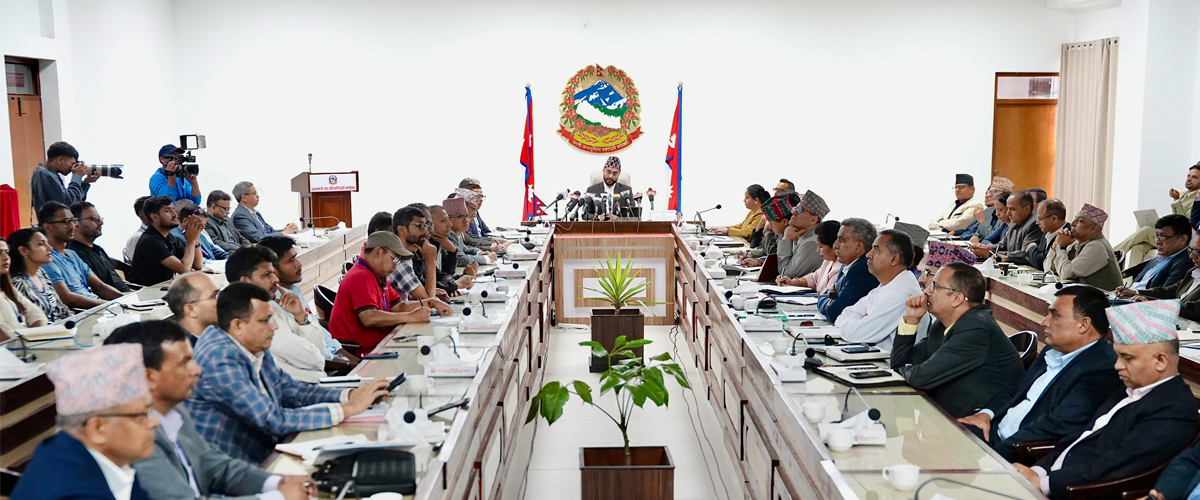
Kathmandu, July 4: The government has given high priority to policy reforms and legal provisions for the improvement of the country’s economy.
As per the details of the government’s achievements released today on the occasion of the 100th day of the formation of the current government, 15 irrelevant laws have been repealed in line with the recommendations of the High-Level Economic Reforms Advisory Commission.
Similarly, the Department of Revenue Investigation has been abolished and managed.
The Alternative Development Finance Act 2083 BS has been passed by the federal parliament and has entered the implementation phase, with the objective of attracting private sector and foreign investment in public infrastructure development. This has created an environment where innovative tools can be used to mobilize investment in the state’s priority areas.
Similarly, the Financial Procedures and Financial Responsibility Regulations have been amended to delegate the authority to transfer capital budget funds to the Secretary (Accounting Responsible Officer) of the concerned ministry.
The government believes that this will significantly reduce the process of transferring funds and increase capital expenditure.
Arrangements have been made so that taxpayers can get permanent account numbers from the Company Registrar’s office and 120 local levels.
In order to reduce the burden on the people due to the disruption in the supply of petroleum products and the rise in prices in the world market due to the conflict in West Asia, a 50 percent discount was given on customs duties and infrastructure development fees.
The ‘E-Pension Verification’ system has been implemented and through this arrangements made to verify the pension from any place or home. A large number of pensioners have been benefitted from this.
Similarly, all the work including submission of tax return, payment of tax from the Inland Revenue Office has been provided through the ‘online’ system. It is mentioned in the details made public today that support has been given to reduce the cost of business, facilitate business and develop ‘faceless and contactless’ revenue administration.
Since February 21, 2025, Nepal has been included in the ‘Grey List’ of the Financial Action Task Force. The country is moving ahead towards meaningful improvement in that realm for the first time since then. It has been made clear that Nepal is moving forward with the positive steps taken by the incumbent government.
The meeting of the FATF held in the month of June 2026 evaluated the progress made up to April 2026 and it is mentioned that out of the 15 tasks determined to get out of the gray list, three tasks have been completed and partial progress has been made in four tasks.
The final report has been prepared after conducting the Due Diligence Audit (DDA) of Gorakhkali Rubber Industry, Hetauda Cement Industry, Janakpur Cigarette Factory and Nepal Metal Company Limited.
Similarly, the final draft report of the DDA for Udayapur Cement Industry has also been received while study is ongoing regarding the Butwal Yarn and Nepal Orient Magnesite.
A study of 970 large and important projects under the Investment Board Nepal has been completed.
Similarly, the process has been set in motion to amend the Banking and Financial Institutions Act, 2073 BS for implementing a provision to mobilise funds from bank and finances’ accounts that that have remained inactive for 10 years or more.
According to details unveiled at the programme, a working group was formed to propose a draft in this regard. The group comprises representatives from the Ministry of Finance and the Ministry of Law, Justice, and Parliamentary Affairs, has already submitted a report to the Board of Directors.
The Office of the Comptroller and Auditor General has prepared a study report on consolidating funds of a similar nature and submitted it to the Ministry of Finance within the government’s first 100 days at Office.
According to the report, above 196 funds hold a combined balance of Rs 84.84 million. To ensure their more effective mobilization, the government has initiated the process of amending the relevant laws.
To strengthen efforts to curb revenue leakage, the Revenue Investigation Department has been dissolved, with its functions integrated into the Inland Revenue Department and the Customs Department. Besides, a dedicated operations teams has been formed and deployed to enhance the effectiveness of revenue leakage control.
More, 841 taxpayers with annual transactions of over Rs 200 million have been connected to the ‘Central Invoice Monitoring System’. This initiative aims to control revenue leakage, making tax administration more transparent.
Similarly, a circular has been issued to connect taxpayers with annual transactions of over Rs 100 million into this system from July 15, while 253 monitoring teams have been mobilized to ensure mandatory implementation of MRP in the market. Under this, 1,692 companies and firms have been monitored and 102 have been fined Rs 7.11 million.
Vehicles that had remained stranded at customs checkpoints for years were handed to the Nepal Police and other government agencies, while the process of auctioning the remaining vehicles has been initiated.
According to the government’s accomplishment report, those people suspected of involvement in revenue leakage at the customs checkpoints have been suspended and are under investigation.
Similarly, as part of a detailed feasibility study of the Dhaubadi and Rate Khola (stream) iron ore mining areas, core drilling has been completed at 12 locations.
In addition, the environmental impact assessment work has been initiated through a consultancy system. Similarly, a policy reform has been implemented to limit the multiple-level approval process in the government decision-making to a maximum of three levels.
The government has tightened the regulation of mining and mineral resources across various parts of the country. As part of this effort, clarifications have been sought from 27 inactive license holders, while three mining and 12 exploration permissions have been rescinded.
Likewise, the government informed that a preliminary study has confirmed an estimated 112.1 billion cubic metres of natural gas reserves in the Jaljale area of Dailekh district.
Based on the findings, a conceptual framework has been prepared to assess the feasibility of generating 200 megawatts of electricity, producing 2,200 tonnes of urea fertilizer per day, and supplying compressed and piped natural gas (CNG/PNG) for transport and other uses.
The government deems that the biggest challenges for this project are the development of essential infrastructure including roads, electricity and drinking water facilities-and mobilizing the large-scale investments required for commercial extraction.
The government has prioritize establishment of a subsidiary under the Nepal under the Nepal Oil Corporation to determine an investment modality, formulate national standards for the sector as well as to collaborate with universities to develop technical manpower to advance the project.
It was also shared that a phased implementation plan has also been formulated to take forward the project while accelerating detailed technical and economic feasibility studies.
While unveiling the key accomplishments, the government highlighted that the ‘One-Stop Approval System’ has been in operation under the Investment Board Nepal in a bid to improve investment climate and provide integrated services to investors.
To achieve the agenda of economic prosperity, the incumbent government also devised a strategy to protect and promote the private sector and boost business confidence.
The government shared that bilateral discussions are underway with the UK on a Double Taxation Avoidance Agreement (DTAA), while negotiations with the United Arab Emirates (UAE) are in progress.
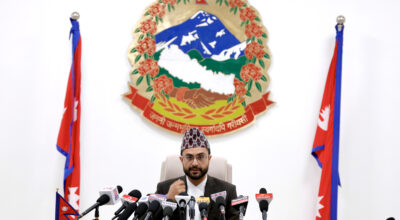
Efforts are underway to enforce international standards on tax and financial transparency, the Minister appraised the gathering of journalists.
Among the key achievements includes issuance of a transfer-pricing directive and the incorporation of related legal provisions in the ‘Economic Bill, 2083 BS’.
Furthermore, the government during this period delegated an additional authority to representatives of 14 agencies stationed at the Department of Industry’s One-Stop Service Centre, it was informed.
Similarly, employees assigned to such Centres have also been authorized to issue tax registration certificates on behalf of tax officials, it was stated.
The Minister also reminded that the government has approved a concept paper for a rapid response mechanism to strengthen industrial and commercial security.
It has kept 15,439 personnel of the Armed Police Force on standby across all 77 districts to respond to emergencies. The government has also introduced a provision for establishing District Industrial and Commercial Security Coordination Committees.
Additionally, an integrated business recovery plan has also been put in place to support industries, businesses and commercial establishments affected by the Gen-Z movement during September 8 and 9 last year.
Providing tax relief, concessions, incentives and other monetary support among others are also part of the plan rolled out by the incumbent government for such affected enterprises.
It was also mentioned that the affected businesses and other borrowers have also been allowed to reschedule and restructure their loans through Nepal Rastra Bank.
To ensure food security in remote areas, the government has prioritized the storage and distribution of food grains and salt, maintaining minimum national reserves of 8,000 metric tonnes of food grains and 25,000 metric tonnes of salt. #nepal #rss