


Biratnagar, June 19: Koshi Province has emerged as one of Nepal’s leading electricity-producing regions, with the total installed capacity of its operational energy projects reaching 901 MW, according to the semi-annual report on economic activities published by Nepal Rastra Bank (NRB).
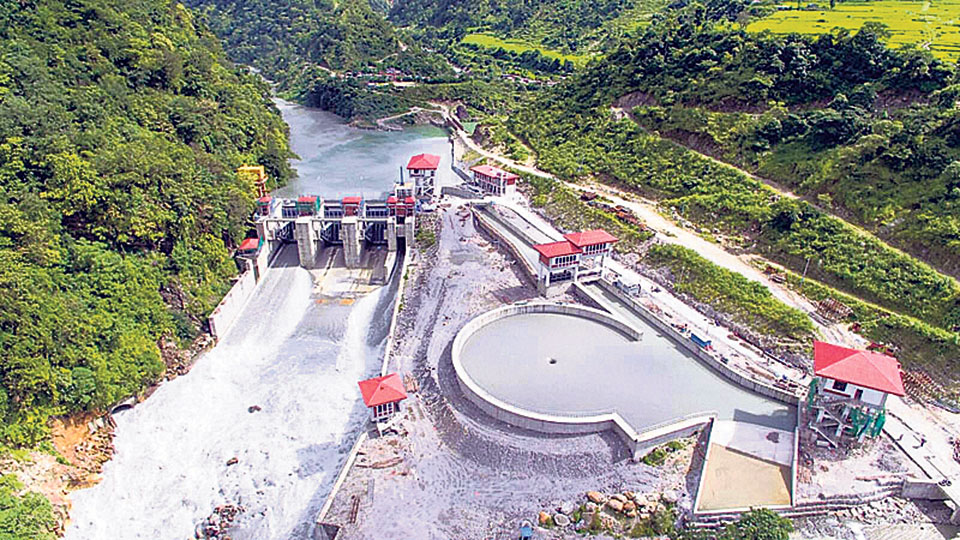
As of mid-January 2026, 63 hydropower projects operating across the province have a combined installed capacity of 884.8 MW. In addition, two grid-connected solar power plants contribute another 16.8 MW, with a 6.8 MW solar project in Morang and the 10 MW Jhapa Energy Limited project in Jhapa, bringing the province’s total electricity generation capacity to 901 MW.
During the first six months of the current fiscal year, four hydropower projects with a combined capacity of 113.9 MW were completed and brought into commercial operation.
The report states that Koshi Province accounts for 21 percent of Nepal’s total installed hydropower capacity of 4,300 MW, underscoring its growing role in the country’s energy sector.
Among the districts, Solukhumbu has the highest installed hydropower capacity at 339.4 MW, followed by Taplejung (150.8 MW), Ilam (126.7 MW), Okhaldhunga (92.5 MW), Panchthar (72.9 MW), Sankhuwasabha (66.1 MW), Bhojpur (17.7 MW), Khotang (11.1 MW), Jhapa (10 MW), Tehrathum (7.5 MW) and Morang (6.8 MW).
In terms of project numbers, Ilam hosts the highest number of hydropower plants with 17 projects, followed by 11 in Sankhuwasabha, nine in Solukhumbu, eight in Taplejung, five in Panchthar, four in Okhaldhunga, three each in Bhojpur and Khotang, and one in Tehrathum. The province also has one operational solar project each in Jhapa and Morang.
The NRB report also highlights the steady progress of the 900 MW Arun III Hydropower Project and its associated 400 kV transmission line, which together represent an estimated investment of Rs. 145 billion.
Construction of the Arun III Hydropower Project began in April 2018 and is scheduled for completion by January 2028. By mid-January 2026, the project had achieved 74 percent physical progress and 78 percent financial progress. It has created direct employment for 2,931 workers, including 1,682 Nepali and 1,249 foreign nationals.
Likewise, the 217-kilometre Arun III 400 kV Transmission Line Project, which commenced in February 2020, is also targeted for completion by January 2028. The transmission corridor passes through Sankhuwasabha, Bhojpur, Khotang, Udayapur, Siraha, Dhanusha and Mahottari districts.
According to the report, the transmission line project has achieved 57 percent physical progress and 60 percent financial progress. It has provided direct employment to 234 workers, comprising 100 Nepali and 134 foreign workers.
The continued expansion of hydropower generation and transmission infrastructure is expected to strengthen Nepal’s electricity supply, enhance export potential and support long-term economic growth. #nepal