


Mata Bhoomiḥ Putro’ham Prithivyāḥ. The Earth is my mother; I am her child.
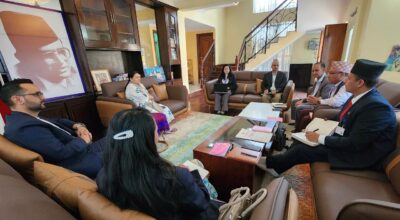
This Sanskrit verse, which inaugurated the Sagarmatha Sambaad earlier this year, continued to reverberate around the Soaltee Hotel in Kathmandu as lawmakers from all across the Hindu Kush Himalaya gathered. It served as reminder that climate change is not just a scientific fact or a policy dilemma. It is a shared duty that is beyond borders, beliefs, and generations.
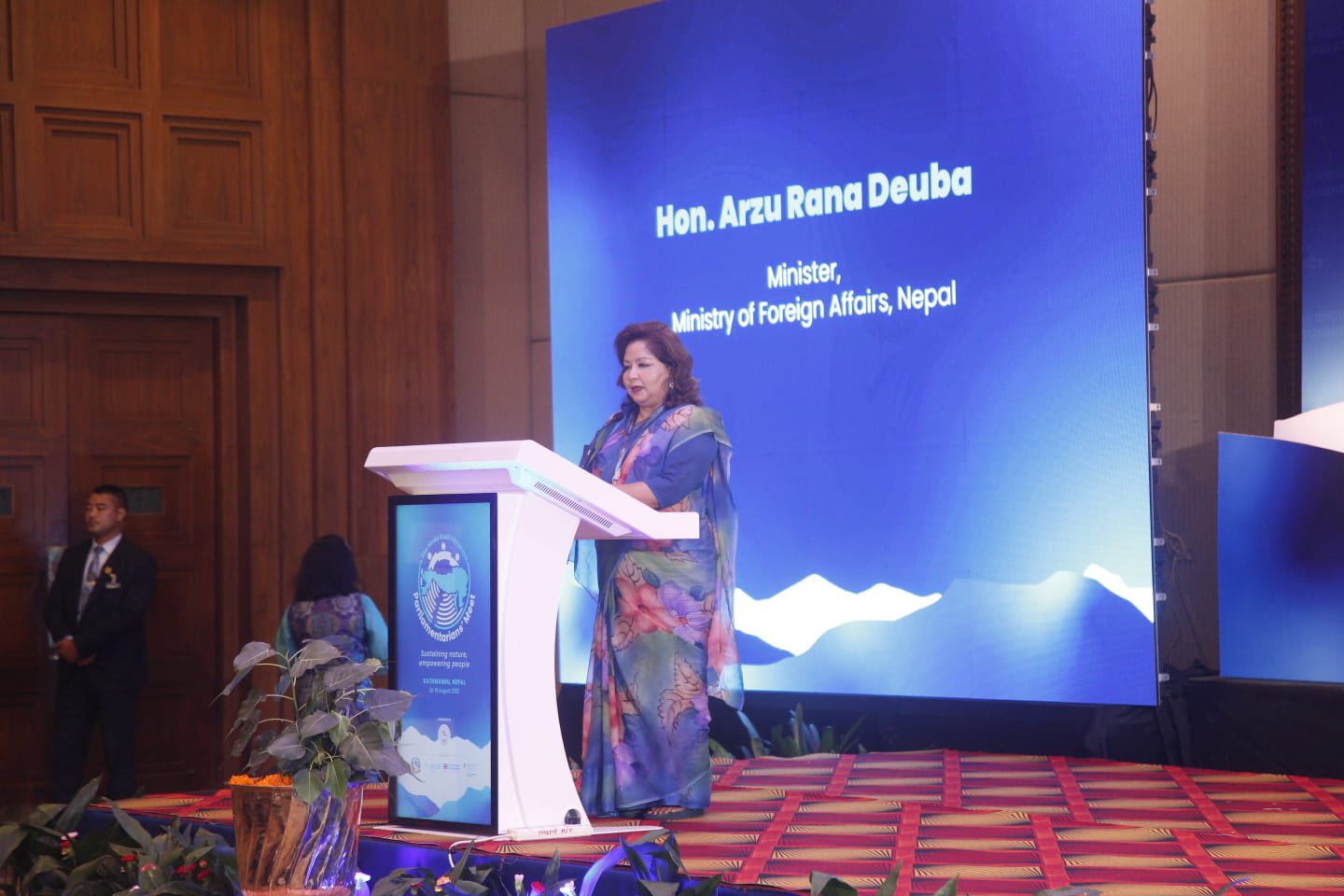
In the light of this, Foreign Minister Dr. Arzu Rana Deuba served more than a formal welcome. Combining her roles as a parliamentarian and the current minister, she redefined the meeting as a space for accountability. She stated, “Parliamentarians are not just lawmakers, but guardians of the future.” Her comments highlighted Nepal’s climate challenges in relation to international law.
She referred to the recent Advisory Opinion of the International Court of Justice for the first time from Nepal and emphasized that protecting the climate is now a binding legal, ethical, and political duty hence, it is no longer just a moral concern. This shift from a moral perspective to a legal one was not merely rhetoric; it firmly placed climate justice within enforceable responsibilities.
Dr. Deuba made another important point by framing Nepal’s vulnerability as a strength rather than a weakness. Despite Nepal’s small carbon footprint, she noted that the country’s delicate alpine ecosystems are warming at a rate that is almost twice as high as the global average. She referred to this disproportionate burden of pain and accountability as “enduring climate injustice.” Instead of portraying Nepal as a helpless victim, she cited the country’s bold pledges, such as its strong NDCs, net-zero by 2045, and successful national climate policy, as proof that small governments can take decisive action.
What argument do large emitters have if Nepal can handle disproportionate burdens? That was the obvious difficulty she hinted at.
Using instances from their own experiences, several lawmakers reaffirmed this importance. On a quick trip to Kathmandu, Bhutan’s parliamentarian Phuntsho Rapten detailed the obvious shifts in snowlines, proving that glacial retreat is an unavoidable fact. As 40% of Bangladesh’s oxygen comes from trees that have been damaged by deforestation, Supradip Chakma of Bangladesh voiced concerns about diminishing oxygen supply. Dr. Thaung Naing Oo of Myanmar presented species-specific restoration and community forestry as workable conservation techniques. “If we legislate in bits, we get fragments; if we legislate in whole, we get force that can revolutionize climate protection for the world,” said Munaza Hassan, who spoke from Pakistan. Her country’s experience as both a “victim and laboratory of solutions” strengthened her ideas on carbon levies, electric vehicle transitions, and renewable energy scaling as issues of survival and sovereignty.
Lawmakers from Nepal brought a gender perspective to the discussion. Women in the Himalayan region are compelled to be confronted with droughts, floods, and fragile eco-tourism businesses with little resources as a result of men moving overseas. They acknowledged that present measures are sometimes ineffectual and asked for gender-responsive climate finance, eco-tourism support, and entrepreneurship aid. Despite the fact that climate concerns transcend national boundaries, President Ramchandra Paudel emphasized the need of parliament in ensuring that resources are allocated and laws are enforced.
These voices converge on one conclusion: the region cannot afford fragmented action. Instead, there is a need for a Model Climate Law, developed through the Climate Parliament framework, which can align regional strategies while respecting national contexts. This law could introduce green taxes on polluting industries, establish gender-sensitive finance, enhance cross-border water security, and make climate justice a parliamentary commitment.
Ultimately, the success of such a model hinges on whether parliamentarians can move from speeches to actual laws. The Himalaya does not need another declaration; it needs enforceable plans that last beyond election cycles. The Sagarmatha Sambaad offered a moral guide, this Parliamentarians’ Meet marked the start of creating legal structures. The real question now is whether the lawmakers of the Hindu Kush can use their collective legislative power not in fragments, but as a united force to transform the mountains from a frontline for climate disasters into a frontline for solutions.
(Siddika Pathak is studying BALLB at Kathmandu School of Law.)