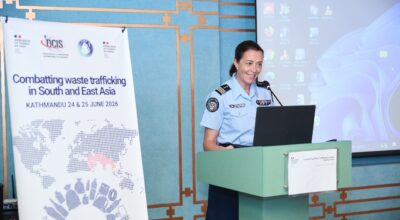



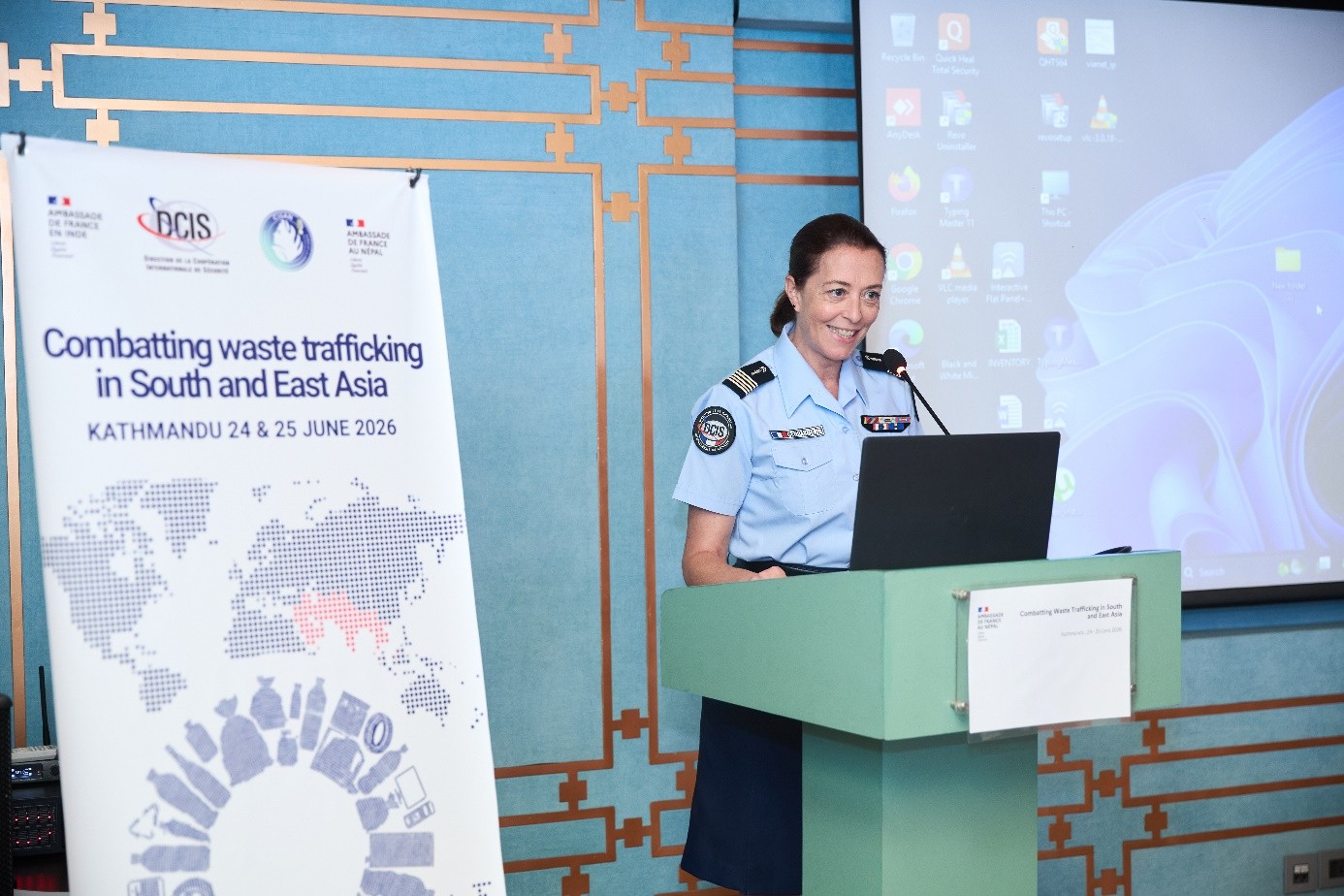
Kathmandu, June 27 A regional seminar bringing together law enforcement agencies, customs officials and international organizations has called for stronger cross-border cooperation to combat waste trafficking in South and Southeast Asia.
The two-day seminar, held in Kathmandu on June 24-25, was jointly organized by the Embassy of France in Nepal and the French Homeland Security Service of the Embassy of France in India, following the success of a 2024 regional seminar in Nepal on combating poaching and wildlife trafficking.
The event brought together officials from Nepal’s Department of Customs, Nepal Police, Armed Police Force, the Ministry of Forests and Environment and the Ministry of Home Affairs, along with representatives from Bangladesh, Sri Lanka, Cambodia, India, Indonesia, Singapore and Vietnam. Experts from the French National Gendarmerie’s Law Enforcement Directorate for Environment and Public Health (CESAN), INTERPOL, the United Nations Office on Drugs and Crime (UNODC) and the private sector also participated.
The seminar provided a platform for participants to exchange practical experiences, share best practices and discuss strategies to strengthen regional cooperation against waste trafficking.
Speaking at the opening session, Chargé d’Affaires of the Embassy of France in Nepal Elsa Calley thanked the Government of Nepal for facilitating the event, saying the initiative reflected the commitment of both France and Nepal to tackling environmental crime through closer cooperation among law enforcement agencies.
Deputy Homeland Security Attaché at the Embassy of France in India Christel Fontaine highlighted the growing scale of environmental crime, noting that waste trafficking has become the world’s fourth most profitable criminal activity, generating an estimated US$70 billion to US$213 billion annually.
Colonel Sébastien Nochez of CESAN outlined France’s integrated approach to preventing and investigating environmental crime.
He also presented the European “UNITE” programme implemented in 2023-2024 with partners from Europe, Asia and Africa to combat waste trafficking, particularly in South and Southeast Asia, and stressed the need to further strengthen international cooperation.
UNODC representative Muendao Suandee presented the regional WasteNet project, emphasizing stronger inter-agency collaboration and faster mutual legal assistance to trace illegal waste shipments and the financial networks behind them.
INTERPOL’s Environmental Security Sub-Directorate Operations Coordinator Michele Viale said illicit waste trafficking enriches organized criminal groups while harming the environment and public health, calling for a coordinated global response.
Guillaume Dourdin, Chief Executive Officer of Veolia India, highlighted the importance of recycling value chains and circular economy approaches in addressing waste management challenges.
Case studies from Sri Lanka and Bangladesh highlighted the growing pressure on ports, shipping routes and maritime security posed by illegal waste trafficking in the region.
The seminar concluded with a visit to Kathmandu-based Moware Lab, a Nepali social enterprise that transforms plastic and glass waste collected from Sagarmatha National Park into artworks and household products.
The event was organized under the Nepal-France Green Roadmap, adopted in 2023 to strengthen bilateral cooperation on environmental issues, with financial support from France’s Directorate for Security and Defence Cooperation (DCSD) and the International Security Cooperation Directorate (DCIS).