

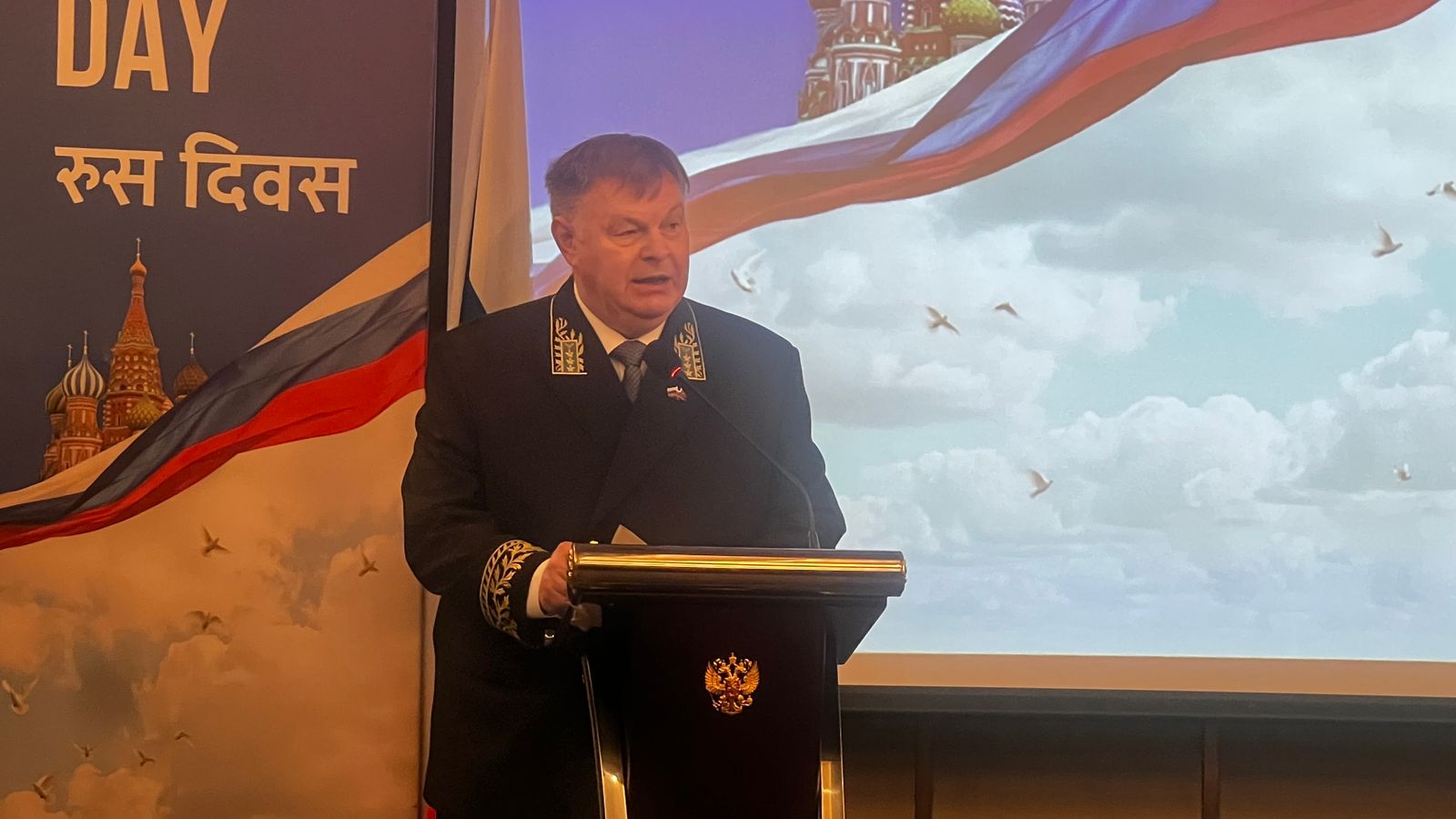
I am glad and thankful to welcome you all at the reception on the occasion of the National Day of Russia!
This day manifests the continuity of the Russian statehood spanning more than thousand years, the patriotism and cohesion of our nation, its rich and heroic history.
Our heritage includes centuries of achievements in science and art. Mendeleev built the periodic table. Lobachevsky rewrote geometry. Pavlov figured out how reflexes work and received a Nobel Prize for it. Korolev put the first satellite into orbit, then the first man – Yuri Gagarin, a name the world still recognizes on sight. Civil nuclear energy, television, radio, aviation, modern physics and healthcare cannot be imagined without the achievements of Russian scientists.
Our writers Tolstoy, Gorky, Dostoevsky, Chekhov and many others influenced millions of intellectuals all over the world. Composers Tchaikovsky, Stravinsky, Prokofiev are performed in the concert programs almost everywhere. And Russian ballet, of course, needs no introduction.
The respect for traditional values and cultural diversity enables
the unity and harmony between hundreds of ethnic and religious groups living in Russia. In this respect, as in many others, our country has a lot of common with Nepal – hundreds of flowers, the one garland.
This experience of coexistence and mutual respect helps Russia to maintain cordial relations with other peace-loving nations and shapes our vision of international relations.
We consistently advocate the establishment of a just multipolar world order based on equal and indivisible security, respect for the cultural and civilizational identity of nations, and the sovereign right of every state to determine its own path of development.
Nowadays, the transformation towards multipolarity is undeniable. Many centers of rapid economic growth have emerged, and the world is being reshaped amid competitive rivalry. The previous hegemons are reluctant to accept the reality and give up their privileges, that’s why they in fact resort to the neocolonial methods: unilateral restrictions and sanctions, portraying themselves as garden and the rest of the world as jungles, sure to invade this garden, as the them EU High Representative for Foreign Affairs said. Obviously, such disdain for Global South and Global Majority leads to gunboat diplomacy and proxy wars.
At the same time, when the world faces many challenges – from climate change and melting glaciers to economic crises and disruption in the supply of fertilizers, grain and oil, Russia is firm in its belief in the importance of the multilateralism and equal dialogue. We are happy to see that most countries, including Nepal with its long tradition of diplomacy, share this approach.
One of the important pillars of such multilateral engagement is the initiative of the Greater Eurasian Partnership put forward by President Vladimir Putin. It is supposed to link regional organizations like the Eurasian Economic Union, ASEAN, and, why not SAARC and BIMSTEC, to ensure better transport connectivity in Eurasia and to lay the foundation for equal and indivisible security architecture in the region. Another promising initiative on the such scale is the Eurasian Charter of Diversity and Multipolarity in the 21st Century, jointly promoted by Belarus and Russia and open to participation by all Eurasian states without exception.
Of course, BRICS and SCO are equally crucial to develop the architecture of political, economic, financial, development, social and security cooperation of the Asian countries and the Global South in general. Indeed, the interaction with these platforms could bring multiple benefits for Nepal in particular. Many constructive initiatives are also arising now within the Asia Cooperation Dialogue.
We are deeply grateful to our partners among the international community who support such collaboration and to our friends in Nepal who see it as an opportunity.
As for bilateral ties between Russia and Nepal, this year is very special to us as on the upcoming 20th of July we will mark the 70th anniversary not merely of diplomatic relations, but of traditional and time-tested friendship, based on goodwill, mutual respect and people-to-people contacts. Nepal’s sovereign foreign policy, rooted in non-alignment and principles of Panchsheel, is something that Russia has always valued.
Now we look optimistically at the prospects of mutual partnership. Economic cooperation, in particular in hydropower, IT, agro-industry, pharma and biotechnology, transport infrastructure, including railways, tourism, as well as humanitarian contacts should be the backbone of it.
At this point my remarks come to an end. Our friendship, I trust, does not.
Neither does this event as we have a special cultural programme for our valuable guests. Here I would like to especially praise the contribution of Mr. Vladislav Dmitriev, Representative of the Russian Chamber of Commerce and Industry in Nepal and in Mumbai, who spared no efforts to make this performance happen, while tirelessly promoting the economic collaboration between our countries.
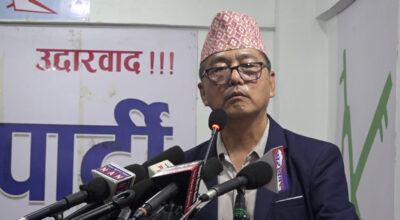
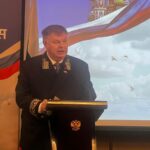
[Russian Ambassador to Nepal, Aleksei Vladimirovich Surovtsev, was delivering a keynote speech during the National Day of Russia in Kathmandu on June 24, 2026.]