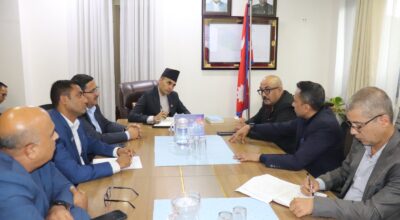



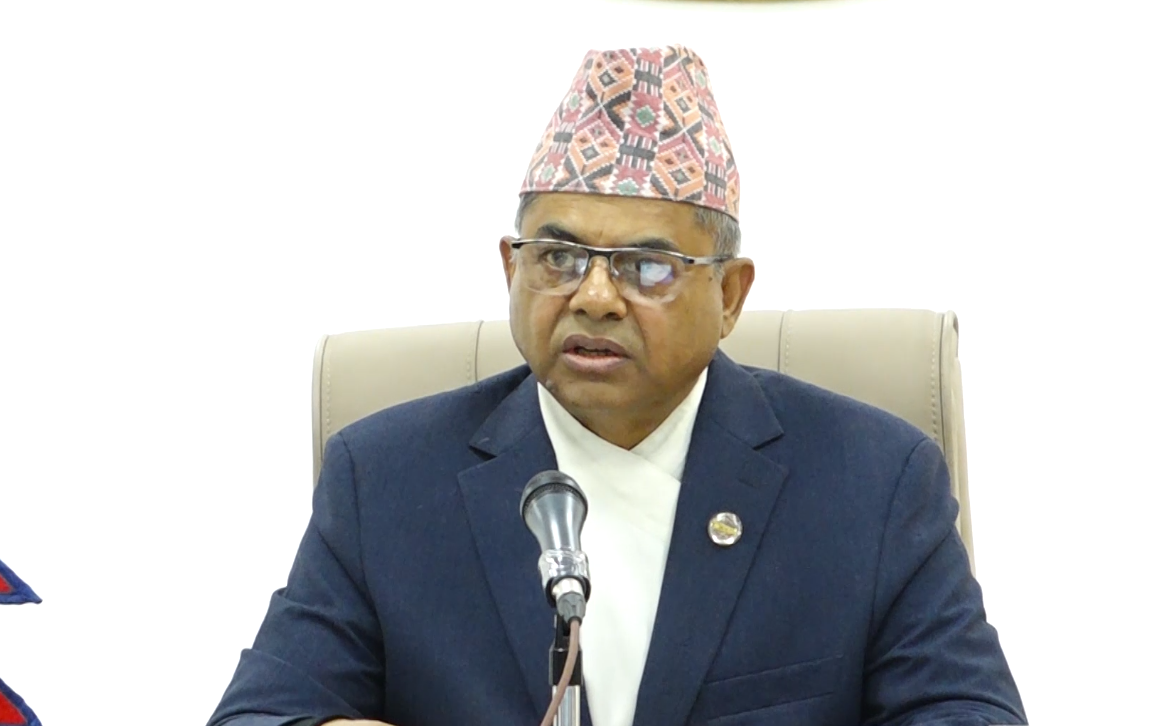
Kathmandu, Dec 19: Minister for Industry, Commerce and Supplies Anil Kumar Sinha has said that public trust in the state is weakening due to the persistent trend of spending public funds without adequate assessment of planning, priorities, and outcomes.
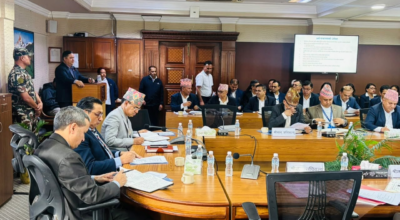
Speaking at the Policy Dialogue on Improving the Effectiveness of Public Expenditure and Service Delivery, organized by the Society of Economic Journalists Nepal (SEJON) in Kathmandu on Thursday, Minister Sinha stated that public dissatisfaction has been growing as a result of the failure to ensure the prudent and accountable use of taxes collected from citizens.
“Public dissatisfaction naturally increases when public resources are not properly utilized and economic good governance is not upheld. The Gen Z protests of September 8 and 9 are a recent manifestation of this dissatisfaction,” he said.
The Minister noted that the government remains committed to ending black marketing, monopolistic practices, and artificial shortages in the market. Although the government formed after the Gen Z protests is committed to good governance, transparency, and fiscal discipline, he acknowledged that progress has been slower than expected due to structural and implementation-related constraints.
“Creating a positive environment by making visible improvements in governance and service delivery before the upcoming elections, while responsibly handing over state authority, is our obligation,” Minister Sinha added.
He further clarified that the incumbent government has curtailed projects and programmes that were included in the budget based on power and access rather than genuine necessity. Emphasizing reform measures, he highlighted the importance of digital technology, effective human resource management, spending prioritization, and result-oriented budget allocation to improve public service delivery.
Also speaking at the programme, Financial Comptroller General Shobakant Poudel attributed inefficiencies in public expenditure to structural problems, expressing concern that a significant portion of spending is being directed toward unproductive sectors. He cited political instability and the lack of review of the social security expenditure framework as major challenges.
Referring to the private sector, Comptroller General Poudel criticized the tendency to retain project licenses without implementation. “Despite the adoption of privatization and economic liberalization policies, economic power remains concentrated among a few individuals and business houses, with resources confined to limited institutions,” he said.
According to him, the interim government formed after the Gen Z protests of September 8 and 9 has reduced unnecessary expenditures. He urged political leaders and bureaucrats to work with high morale and a strong sense of responsibility, stressing that economic growth cannot be achieved without investment in productive sectors and effective mobilization of available resources.
Similarly, Suresh Pradhan, a member of the Public Expenditure Review Commission, expressed concern over the absence of clear criteria for public spending. He said the budget formulation process lacks transparency, with undefined standards for allocation and expenditure emerging as one of the most pressing challenges.
Pradhan further noted that regulatory agencies have repeatedly raised concerns over delays in project completion, unclear division of responsibilities among government agencies and civil servants, and problems arising from ad hoc decision-making.
Youth entrepreneur Vedika Murarka highlighted the need for transformative changes in public service delivery, stating that economic transformation is not possible without investments that foster innovation and new ideas.
Economist Dr Dilli Raj Khanal also observed that the effectiveness of public expenditure remains weak, with no significant improvement in service delivery. He called for the dissolution of boards, committees, and institutions that have failed to produce tangible outcomes.
Dr Khanal pointed out that although social security obligations have increased rapidly in recent years, the results have not been commensurate. He further noted that despite the provision of concessions and incentives in the manufacturing sector, the expected outcomes have not been achieved.
“Nepal ranks among the weakest countries in South Asia in terms of poverty levels, per capita consumption, and living standards. Efforts to improve public expenditure administration have been insufficient, and persistent shortcomings in service delivery continue to surface,” Dr Khanal added.
Other speakers at the dialogue unanimously emphasized the need to make public spending more result-oriented, transparent, and accountable, describing it as both a major challenge and a critical opportunity at the present juncture. #sejon #nepal #policy