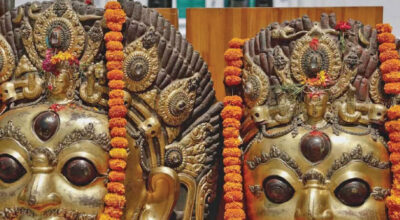



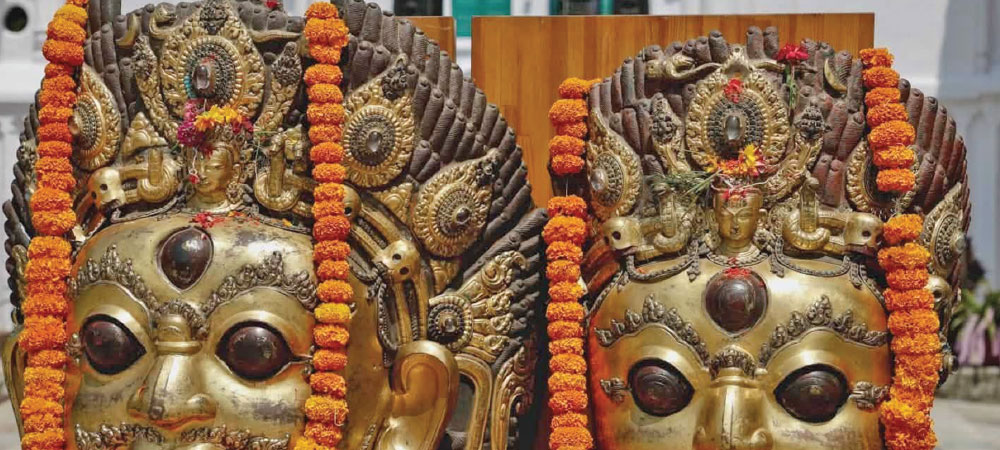
Kathmandu, June 20: Two historic masks (mukhundos) of Akash Bhairav, stolen from Dolakha more than three decades ago and later discovered in museums in the United States, were formally handed over to the Nakchhe Pradhan family on Thursday.
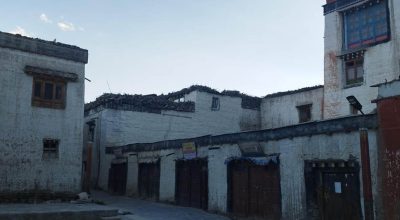
The culturally and archaeologically significant masks, stolen from Gurukot Tol in the historic town of Dolakha about 33 years ago, have finally returned to their sacred homeland.
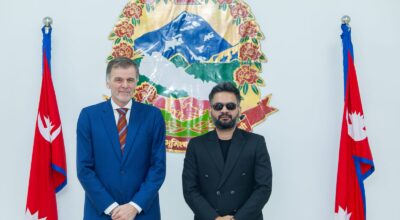
Aruna Nakarmi, Chief of the National Museum in Chhauni, handed over the masks to the concerned custodians after the completion of all legal procedures.
The priceless artefacts were repatriated from the United States in 2024 through diplomatic and legal efforts. On January 31, 2024, the Department of Archaeology announced their return during a press conference. The masks were then transferred to the National Museum on February 1, 2024, where they remained on public display until their return to Dolakha.
Upon arrival in Dolakha, the masks were taken in a ceremonial procession through the town, accompanied by traditional music, cultural performances, and religious rituals before being carried to the ancestral residence of the Nakchhe Pradhan family in Gurukot Tol.
Local residents, public representatives, security officials, and representatives of various organisations from the district headquarters, Charikot, welcomed the artefacts with great enthusiasm.
The masks were brought to Dolakha under the leadership of Yagya Kumar Pradhan, the senior priest of the Nakchhe Pradhan community.
The sacred masks, known locally as Akash Bhairav, were stolen from the ancestral home of the Nakchhe Pradhan family around 1993–94 (2050–51 B.S.). Their disappearance significantly affected the religious and cultural traditions associated with the deity, which is worshipped as the family’s ancestral god.
The search for the missing masks was initiated by the Lost Arts of Nepal campaign, an organisation dedicated to digitally documenting and tracing stolen cultural heritage from Nepal. During the investigation, one mask was located at the Dallas Museum of Art in Texas and the other at the Rubin Museum of Art in New York.
According to historical records, the masks date back to the 16th century during the Malla period. Local tradition holds that the masks were divided among the five children of King Govindadev of Dolakha, with the Nakchhe family receiving custody of these particular masks. Since then, they have been worshipped as the family’s clan deity.
Traditionally, the masks are kept in a secure chamber within the ancestral home throughout the year and are displayed to the public only during the annual Indra Jatra festival in Dolakha.