


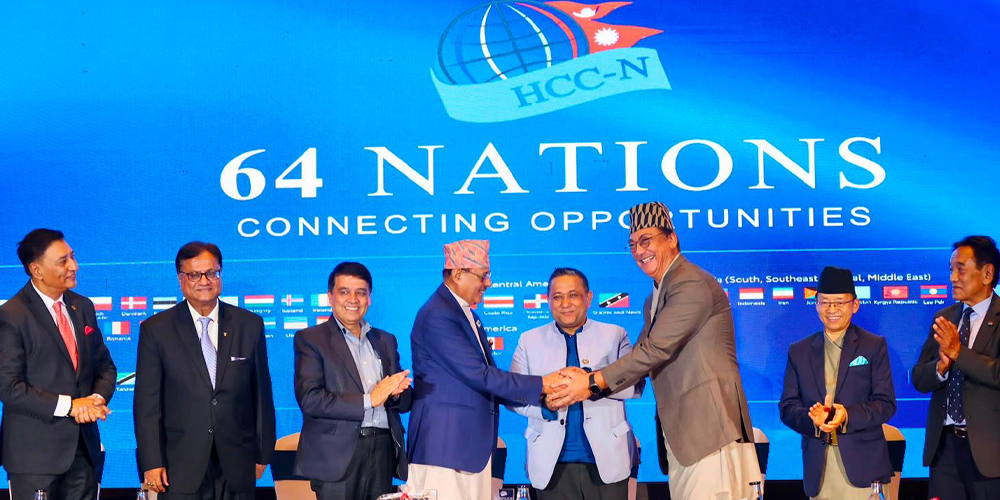
Kathmandu, July 24: Suraj Vaidya, the Honorary Consul General of the Philippines to Nepal, has been elected to the Dean of the Honorary Consular Corps of Nepal.
Vaidya, the former president of the Federation of Nepalese Chambers of Commerce and Industry, was unanimously chosen as the new dean at HCCN’s general assembly held here on Thursday.
Previously, Bhola Thapa, the Consular General of Bulgaria to Nepal, was the HCCN Dean. The conference has selected Pasang Dawa Sherpa as the Vice Dean of HCCN.
The newly appointed Dean, Vaidya, said that during his tenure, he will make bringing foreign direct investment to Nepal, promoting tourism, and strengthening economic diplomacy his main priorities.
He said that he will actively work to make the relationship between Nepal and the international community more effective and expand economic cooperation.
On the occasion, Dean Vaidya mentioned that HCCN currently represents more than 64 countries around the world and pointed out that these nations are making significant contributions to the global economy, international trade, technology, innovation, tourism, and investment.
He stated that expanding Nepal’s ties with those countries, which have a population of over five billion and a combined economic size of more than 100 trillion US dollars, is an important opportunity for economic development.
Vaidya mentioned that the importance of economic diplomacy has become even greater in the current situation where Nepal aims to attract investment, create jobs, expand tourism, and increase international trade.
He mentioned that honorary consuls play the role of a bridge not only between governments but also in expanding collaboration between the private sector, investors, entrepreneurs, educational institutions, and communities.
The main speaker of the programme, foreign affairs analyst and former Major General of the Nepali Army, Binoj Basnyat, emphasized that Nepal should take advantage of the changing global political landscape to promote national interests through economic diplomacy, institutional reforms, and strategic foreign policy.
He expressed the view that amid the world power balance, the growing importance of the Indo-Pacific, and geopolitical competition, Nepal needs to adopt a clear strategy, national confidence, and active diplomacy.
Basnyat stated that Nepal’s foreign policy should be based on active engagement, balanced relations with neighbours, regional cooperation, and ‘smart diplomacy’, and that diplomacy should be made an effective means to bring in investment, technology, knowledge, and development.
He emphasized that Nepal’s network of 41 embassies, three permanent missions, 10 consulate generals, and 64 honorary consulates and trade representatives should be effectively utilized to expand foreign investment, innovation, knowledge exchange, and development partnerships.
Outgoing HCCN Dean Bhola Bikram Thapa said that a draft Memorandum of Understanding (MoU) was submitted to the Ministry of Foreign Affairs with the aim of making HCCN a strategic partner of the government in economic diplomacy.
He said that through a network of 64 countries, HCCN can play the role of a ‘force multiplier’ in promoting foreign investment, technology transfer, trade, tourism, and connectivity in Nepal. Thapa also mentioned that a proposal has been submitted to the Passport Department to improve the queue management system for service users and expressed confidence that it will be implemented after the necessary formal approvals. #nepal #rss