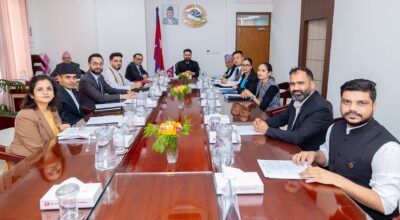



Kathmandu, July 2: As the formation of government nears completion of 100 days, various ministries have shared the activities they launched and executed in line with the ‘100 agendas of governance reform’.
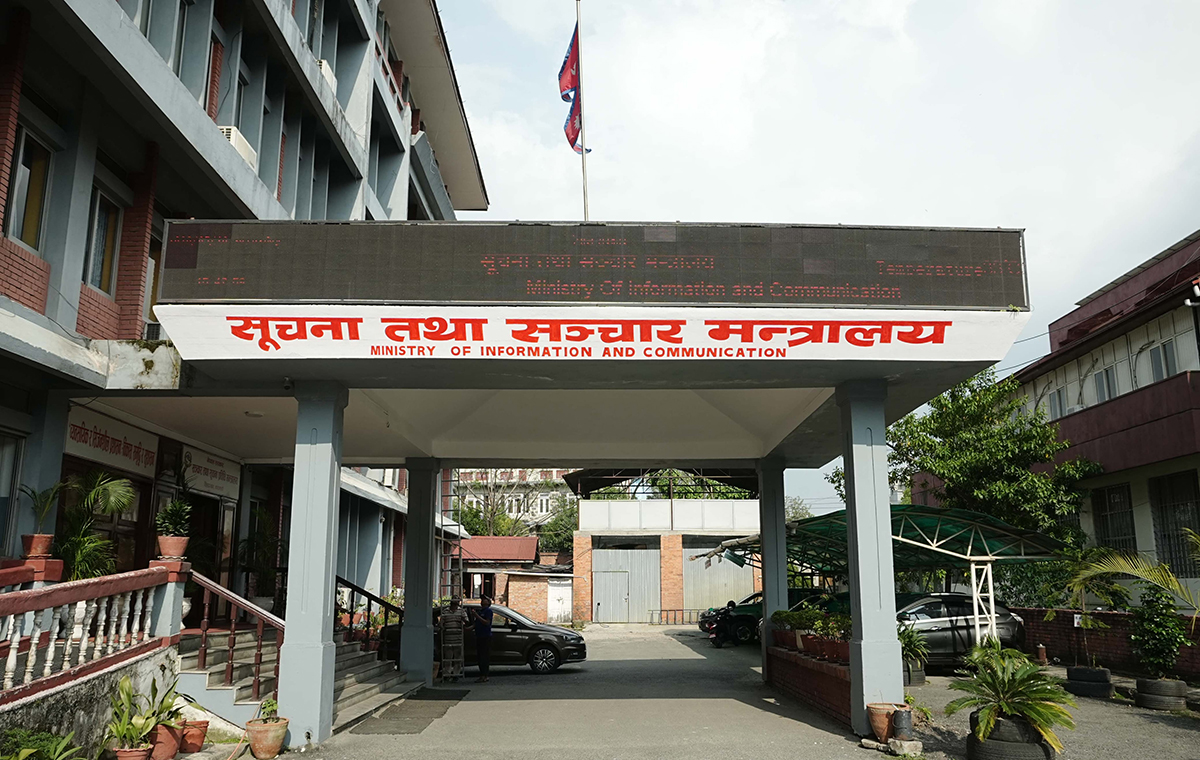
As part of the enforcement of 100 agendas of reform, the Ministry of Information and Communications has advanced programmes relating to simplification of service delivery, digital administration and expansion of citizen-friendly services via postal office.
The Ministry shared that it accomplished the activities including the prompt administrative procedures, expansion of Nagarik App, launch of ‘Government Courier Service’ to deliver official documents to people’s doorsteps, disabled-friendly government websites, curb on illegal online betting and intensification of process to draft laws related to artificial intelligence (AI).
Business Process Re-engineering (BPR) has been in place to end the citizens’ compulsion to go through multiple levels of approval and wait for a long time. It also unburdens officials and service seekers of unnecessary paperwork for the same service. The Ministry and its subordinate bodies have been written with guideline to limit the layers of multiple approvals at maximum three.
A ‘front desk’ has been come into operation at the Ministry to make service delivery more effective. It has ensured direct submission of letters to various sections at the Ministry. The Ministry argued it has enabled service seekers to receive immediate service, with an end to delays in works.
Change in employees’ behaviour
Changing the behaviour of employees has been accorded a top priority, for which a code of conduct and a commitment letter was prepared and put in practice for employees at the Ministry and the bodies working under it. All employees have made commitment, which is directly linked to the aim of making the bureaucracy accountable, service-oriented and people-centred. It also terminates plodding and uncomfortable behaviour towards service seekers.
A draft of the Organization and Management Survey (O&M) has been prepared and sent to the Office of the Prime Minister and the Council of Ministers, while the process of preparing objective performance indicators for each position was advanced. Employee’s evaluation will be directly linked to performance in coming days, the Ministry argued.
Time to receive services down by over 50 percent
The Ministry has been successful to significantly reduce the time for some major services, such as recommendation in foreign currency exchange, film censor and classification, and permission for film and documentary filming. Such tasks used to take three to seven days, while these are done within one to three days at present. Similarly, frequency management in areas with low frequency used to take five to seven days, which is now feasible within two to four days; while of seven to 10 days in areas with high frequency is now done in seven to 10 days.
Arrangements are in place to register complaints through phone, email and social media so that seeking service and lodging complaints are made hassle-free. Addressing problem and complaints received through the ‘Hello Government’ at the Office of the Prime Minister and Council of Ministers is in equal priority. As many as 620 complaints were received through ‘Hello Sarkar’ during this period. Out of these, 347 complaints were addressed, while the rest ones forwarded to the related sections and subordinate bodies to initiate actions accordingly, according to the Ministry.
Govt service at people’s doorsteps
The Ministry has advanced the ‘Government Courier Service’ as its most ambitious scheme. Through this, the Ministry has aimed at delivering official documents to the citizens’ doorsteps. So far, more than 204,000 passports have been ferried to the District Administration Offices. The work began for distributing passports to the concerned houses of service recipients in 75 districts. Until Wednesday, 5,728 passports have been delivered to citizen’s doorsteps through postal offices.
More than 810,000 driving licenses have reached the concerned offices, while nearly 1,100 licenses are delivered at the citizen’s doorsteps in various districts. An agreement has been made with the Nepal Open University to ensure delivery of certificates to students’ homes. Transporting reports from the National Public Health Laboratory, distributing health education documents, and ferrying materials from the Health Insurance Board are also going on via postal system.
The concept of ‘smart postal services’ is launched by the government to modernize the postal system, which for some years had been losing relevance especially in the wake of digital/internet age. The Ministry of Information and Communications informed that it had selected 50 post offices across the country to develop them as smart postal services by leveraging information technology. A seven-digit postal code has been enforced for it and activities forwarded to update the system in line with the standards of international postal services. Budget allocation is ensured for purchasing new vehicles to equip postal transportation, agreements with international airlines and management of the international transportation system.
License printing in final stage
Another important task is the printing of smart driving license. The government has speeded up the printing of smart driving licenses with completion of 82 percent of the total target so far. As per the agreement signed with the Department of Transport Management, setting the target of printing 2.9 million smart driving licenses by end of June, 2,375,181 copies or 82 percent of the smart licenses were printed. The printing of remaining units is underway to complete on time and hand over to the Department.
The printing is going on for 24 hours. It will soon end the long-pending distribution of smart driving licenses.
Improvement in Telecom
The Ministry has further featured the reform in telecommunications service as the activities executed in line with 100 agendas of good governance. Data management, e-SIM, online complaint hearing, automated renewal package, one-stop service are some of the salient features launched by Nepal Telecom. Enhanced data pack is another in the reform list.
Nepal Telecom has informed that the 4G internet speed has augmented by 59.7 percent with the addition of 5-Mhz frequency in its existing capacity. It has also resulted in increase of data traffic by 24.2 percent.
Digital Nepal campaign picks a pace
With the internet and digital activities given much priority by the government, the drive for Digital Nepal has also taken a significant pace. Whether it is making public service hassle-free or the interoperability in the government system, the prompt and smooth operation undoubtedly contributes to digital transformation.
The concept of Information Technology Bill has been approved by the Ministry and forwarded to the Prime Minister’s Office. The Council of Ministers has given approval in principle for drafting AI Bill.
In view of rapid expansion of AI in Nepal, the government is making efforts to create a legal basis for its regulation. The Ministry of Information and Communications has shared that it has intensified the creation of a legal framework relating to the Nagrik App, Government Information Management System (GIOMS), automatic data filling system, disable-friendly government website and artificial intelligence (AI) so that government services would be made fully digital, transparent and citizen-friendly as stated in the 100 agenda of governance reform.
More and more government services are being featured in the Nagrik App. Discussions are held to incorporate university-related services in the App.
Provision is in place to avoid practice of submitting same documents in multiple government agencies. For it, technical arrangements have been made at the Passport Department, the Department of Transport Management and the Armed Police Force. The private banks and financial institutions have begun demanding the application programming interface (API) for similar test.
As part of the paperless administration, the government launched a campaign to strengthen the Government Integrated Office Management System (GIOMS). The Ministry shared that a total of 704 government agencies, including 354 at the federal level, 284 at the provincial level, 62 at the local level, and four corporations, have been integrated to this system. Even the employees have been trained to operate the system, and the database integrated accordingly.
The Ministry is collaborating with the United Nations Development Programme (UNDP) to develop a separate system for the provincial and local levels.
Strict action against illegal online betting is another noticeable activity of the Ministry to deter digital fraud and crimes.#nepal #rss