


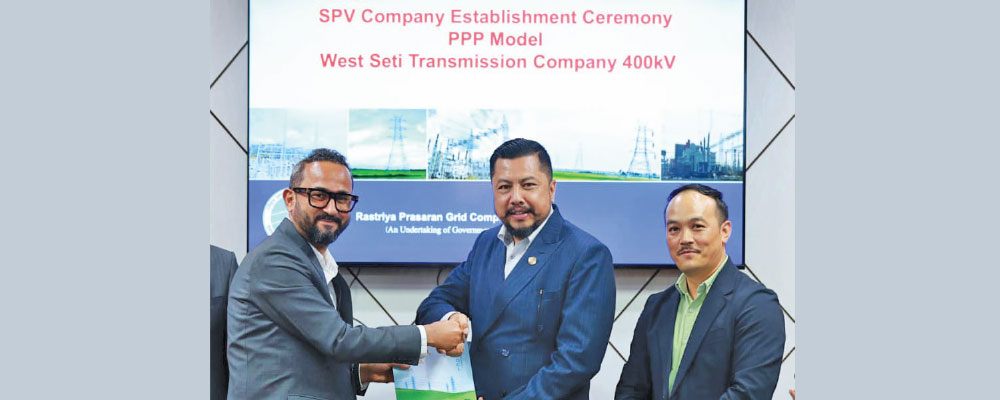
Kathmandu, June 2: Construction of a major 400 kV transmission line in western Nepal has moved forward under a public-private partnership (PPP) model, paving the way for the evacuation of electricity generated by large hydropower projects in the Seti River basin into the national grid.
A special purpose vehicle, West Seti Transmission Company Limited, has been established to implement the project. The company was officially registered on May 27 after the Board of Directors of the Rastriya Prasaran Grid Company Limited (RPGCL) approved its investment structure.
The project, estimated to cost around Rs 20 billion, will be financed through a mix of 30 percent equity and 70 percent debt.
Addressing the founding partners of the company on Monday, Minister for Energy, Water Resources and Irrigation Biraj Bhakta Shrestha said the private sector’s contribution, which has played a significant role in electricity generation, is now expanding into transmission infrastructure development.
Describing transmission lines as the “lifeline” of the energy sector, Minister Shrestha expressed confidence that such partnerships would usher in a new era of energy development in Nepal.
“Participatory development is also an exercise of democracy. As collaboration with the private sector in transmission lines is a new practice for Nepal, the government will encourage it,” he said.
The minister noted that the review process of Power Purchase Agreements (PPAs) is ongoing and that future decisions will be made based on the findings of the review. He added that ensuring a reliable and sustainable energy supply would provide fresh momentum to the national economy while significantly contributing to the development of the far-western region.
Reiterating the government’s commitment to the project, Shrestha said authorities are prepared to resolve any obstacles that may arise during implementation.
“The private sector has taken risks to move this project forward. The government will not step back from its responsibility to ensure its successful completion,” he said.
The transmission line is designed to carry up to 2,500 MW of electricity, strengthening the reliability of the national power system while supporting cross-border electricity trade, energy security, and Nepal’s long-term energy development strategy.
Regarded as one of Nepal’s most significant transmission infrastructure projects under the PPP model, it is expected to become a milestone in the development of 400 kV transmission networks in the country.
RPGCL Chief Executive Officer Sagar Shrestha said construction activities will accelerate once land acquisition, right-of-way clearance, and forest approvals are completed. Necessary preparatory work has already begun, he added.
Chairman of partner company Samriddhi Energy Limited, Shailendra Guragain, described the project as a “game changer” for Nepal’s energy sector, saying its long-term significance has encouraged private-sector investment.
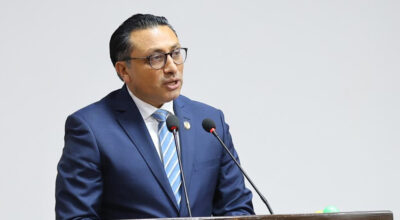
Similarly, Acting Managing Director of the Nepal Electricity Authority (NEA), Dirghayu Kumar Shrestha, emphasized the strategic importance of the project.
Under the company’s share structure, the government side will hold a 51 percent stake, including 26 percent by RPGCL, 12.5 percent by Chilime Hydropower Company Limited, and 12.5 percent by Chainpur Seti Hydropower Company Limited.
Among private investors, Samriddhi Energy Limited will hold 25.1 percent ownership, Ngadi Group Power Limited 7 percent, and Siuri Nyadi Power Limited 6.9 percent. The remaining 10 percent will be offered to the general public.
The project includes the construction of a 145-kilometre-long 400 kV double-circuit transmission line stretching from the Chainpur Substation in Jayaprithvi Municipality-1, Bajhang, through Banlek in Doti, to the Dodhara Substation in Bardagoriya Rural Municipality-2, Kailali.
It also includes the construction of substations with capacities of 160 MVA in Chainpur and 315 MVA in Banlek.
According to project officials, preliminary surveys and required land acquisition work have already been completed, and the project is scheduled to be finished within five years.
Once completed, the transmission line will evacuate electricity generated by the 750 MW West Seti Hydropower Project, 450 MW Seti River-6 Project, 170 MW Upper Seti Project, and several other hydropower projects within the Seti River basin and its tributaries to the national grid. #nepal