

JOHANNESBURG—In this, its semiquincentennial year, let’s give America its due. By the turn of the 20th century, it was a leading industrial power and achieved global primacy after the two world wars. It built the post-1945 global governance system—the United Nations, the World Bank, the International Monetary Fund, and the General Agreement on Tariffs and Trade (which became the World Trade Organization)—that helped prevent a third world war and advanced decolonization across Africa and Asia.
Despite representing only 4% of the global population, the US leads much of the world’s technological innovation and has been generous in supporting UN-led humanitarian causes. Even George W. Bush, who invaded Iraq and Afghanistan, launched the President’s Emergency Plan for AIDS Relief, which has provided $100 billion to fight HIV/AIDS in Africa and the Caribbean, saving an estimated 25 million lives.
America’s “soft power” is further evidence of the country’s dynamism, producing music, movies, literature, sports, food, and more that the world has embraced. One could easily argue that the United States has done more than any other country to shape the current global order we inhabit.
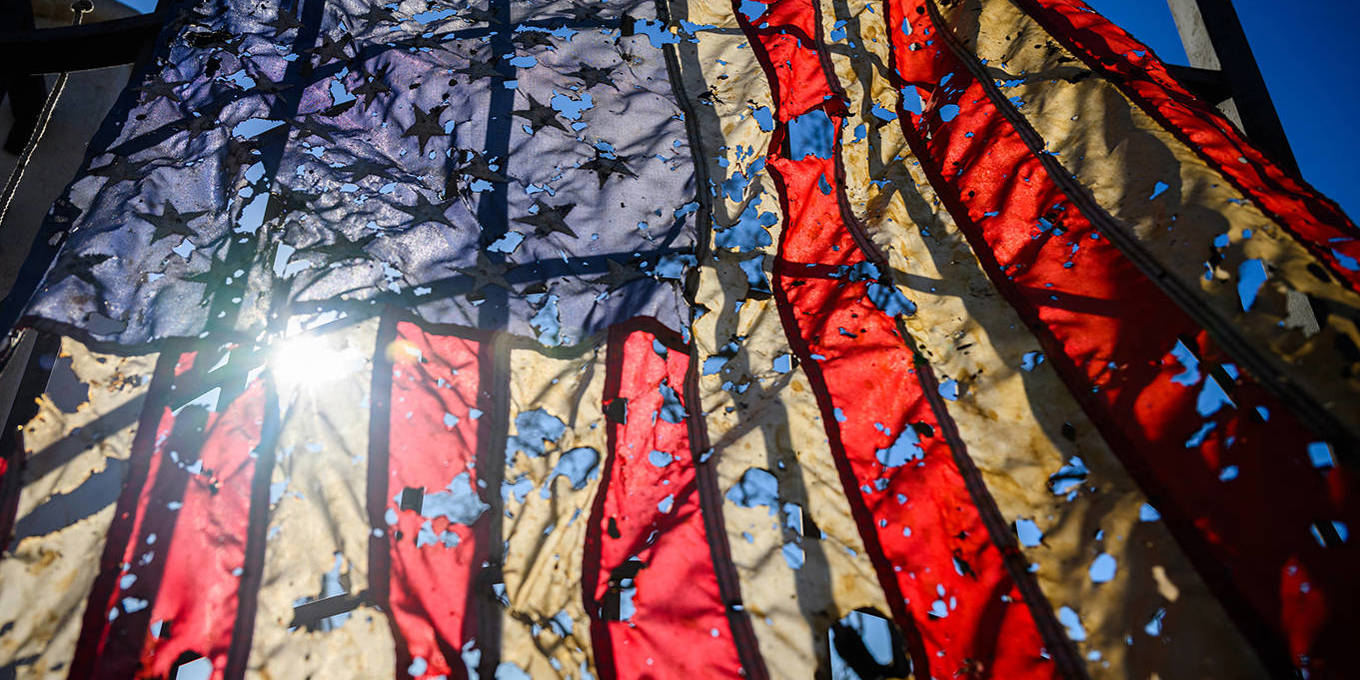
But, across much of the Global South, the recent celebrations of the semiquincentennial have served as bitter reminders of how the country has often failed to live up to its lofty founding principles. The Declaration of Independence may proclaim that “all men are created equal,” but the many sins committed by the US since then make it hard not to view this promise with a cynical eye.
The US’ two great “original sins” were genocide and slavery. An estimated 15 million Native American people inhabited North America in 1492. By 1900, fewer than 300,000 remained. The annihilation of the continent’s Indigenous population mostly occurred after 1776, with the bloody expansion westward in the name of “Manifest Destiny.” The US stole land from Indigenous nations like the Sioux, Cherokee, and Creek, and starved and spread disease among them. After finally being granted citizenship in 1924, Native Americans were shunted to desolate, impoverished reservations.
Moreover, the US was built on African slavery, weaving a virulent form of racism into its social fabric. Five of the first seven presidents, including George Washington and Thomas Jefferson, were slave owners. Even US President Abraham Lincoln, the Great Emancipator, sought federal funds to repatriate African Americans to other countries. As Lincoln told a Black delegation visiting the White House in 1862: “Your race suffer very greatly, many of them, by living among us, while ours suffer from your presence…. If this is admitted, it affords a reason, at least, why we should be separated.”
To be sure, Lincoln denounced the US Supreme Court’s 1857 Dred Scott decision, which ruled that Black men were not citizens and that the Fifth Amendment protected the rights of slaveowners because the enslaved were property. But support for slavery was deep-seated and difficult to dislodge because it was the foundational institution of American capitalism. By 1860, cotton exports produced on slave plantations accounted for nearly 60% of US exports.
Perhaps unsurprisingly, America’s Black population taught the country how to live up to its founding ideals. Following centuries of revolts, about 500,000 slaves risked their lives to escape from Southern plantations to the North during the Civil War (1861–65). An estimated 179,000 Black men joined the Union army to fight for their own liberation, with around 40,000 dying over the course of the war. Black women also contributed to the war effort. African-American abolitionist Harriet Tubman, who escaped slavery in 1849, led an all-Black battalion to liberate over 700 slaves in South Carolina.
Even after the Union’s victory, it would take another century for African-Americans to win their basic legal rights. The civil rights movement of the 1960s, led by Martin Luther King, Jr., Hosea Williams, Fannie Lou Hamer, and many others, resulted in the 1965 Voting Rights Act and the 1968 Fair Housing Act, although massive structural inequalities remain.
The idea that some groups are entitled to the land and labor of others has also underpinned US imperialism. America’s 1846–48 war of aggression against Mexico resulted in the latter ceding 55% of its territory, including the present-day US states of California, Nevada, New Mexico, and Utah, as well as most of Arizona and Colorado. This expansionist project grew to include “gunboat diplomacy” in 1898, with the US eventually seizing Hawaii, Guam, Samoa, and Puerto Rico, and occupying Cuba, the Philippines, the Dominican Republic, and Haiti.
The dark underbelly of the 20th-century Pax Americana was that the US backed often vicious military caudillos in Brazil, Argentina, Chile, Uruguay, Paraguay, and Bolivia, and supported death squads in El Salvador and Nicaragua in the fight against communism. In 1953, the CIA helped topple Iran’s elected Prime Minister Mohammad Mossadegh; less than a decade later, in 1961, the agency was involved in the assassination of Congolese leader Patrice Lumumba, one of the Cold War’s greatest crimes.
The US eventually exposed its imperial hubris after the 9/11 attacks by waging war against Afghanistan and Iraq, which resulted in roughly 171,000 Afghan and 500,000 Iraqi deaths, and together cost between $4–6 trillion.
Despite the immense resources committed to these wars, the world’s largest military power failed to achieve its goals in Iraq, and was defeated by Afghan jihadis it had overthrown 20 years earlier.
President Donald Trump, however, seems hell-bent on destroying the international aid system and the multilateral institutions that underpinned US global leadership and soft power, while his spiteful actions at home have left the country more divided than ever. The one consolation is that Trump’s nativist measures are doomed to fail: the country’s non-Hispanic white population is projected to fall from 199 million in 2020 to 179 million by 2060.
America’s aspirational motto, e pluribus unum (“out of many, one”), will be put to the test. Its sentiment offers the only glimmer of hope for narrowing the gap between America’s noble ideals and its uglier realities.
Adekeye Adebajo, a professor and a senior research fellow at the University of Pretoria’s Centre for the Advancement of Scholarship, is the editor of The Black Atlantic’s Triple Burden: Slavery, Colonialism, and Reparations (Manchester University Press, 2025).
Copyright: Project Syndicate, 2026.
www.project-syndicate.org