



NewsPolar AI

- Climate Risk Must Be a Central Political Agenda
- Strong Institutional Structure and Climate Law Needed
- Access to Climate Finance with Clear Implementation Plans
- Risk-Informed Development and Climate-Resilient Economy
- Manifestos as Accountability Tools for Climate Justice
Political parties’ election manifestos are formal written documents outlining their official policies, future plans, and commitments. They are also taken as a “roadmap” or pledge of what they intend to accomplish within five years if elected to form a government.
Almost all party manifestos are filled with ambitious visions for economic growth, foreign policy, education, health, employment, and social security. But do parties place climate risk-capable of undermining the very achievements and existence of these sectors-at the center of their priorities? This has become a growing concern for those engaged in development, environmental protection, and climate action. The focus should be on risk-informed development that addresses a changing ecosystem and growing administrative complexity.
Climate risk is not only Nepal’s problem but a shared planetary crisis. If we fail to act today against the uncertainty of the future, floods, landslides, glacial lake outburst floods (GLOFs), extreme rainfall, drought, and dry spells will severely damage the economy.
A 2020 report by UNDP and ICIMOD identified 25 glacial lakes in China, 21 in Nepal, and one in India, which, they warned, need to be closely monitored to reduce the vulnerability of mountain people and settlements downstream in the three river basins. Accordign to the report, of the 47 identified potentially dangerous glacial lakes, 42 are within the Koshi basin making it the river basin with the highest risk and the Gandaki and Karnali basins have three and two such lakes, respectively.
According to the World Bank, climate change could reduce the global economy by 10 to 18 percent by 2050. Floods, droughts, and sea-level rise are forcing millions to become “climate refugees,” intensifying border tensions and social conflict. Rising temperatures are affecting agricultural production, increasing the risk of inflation and hunger worldwide.
Although climate risk is global, poorer countries suffer disproportionately, deepening diplomatic tensions between developed and developing nations. Climate risk is a problem no single country can solve alone and no country can escape its impacts. Recent snowstorm in United States illustrate intensifying climate crisis.
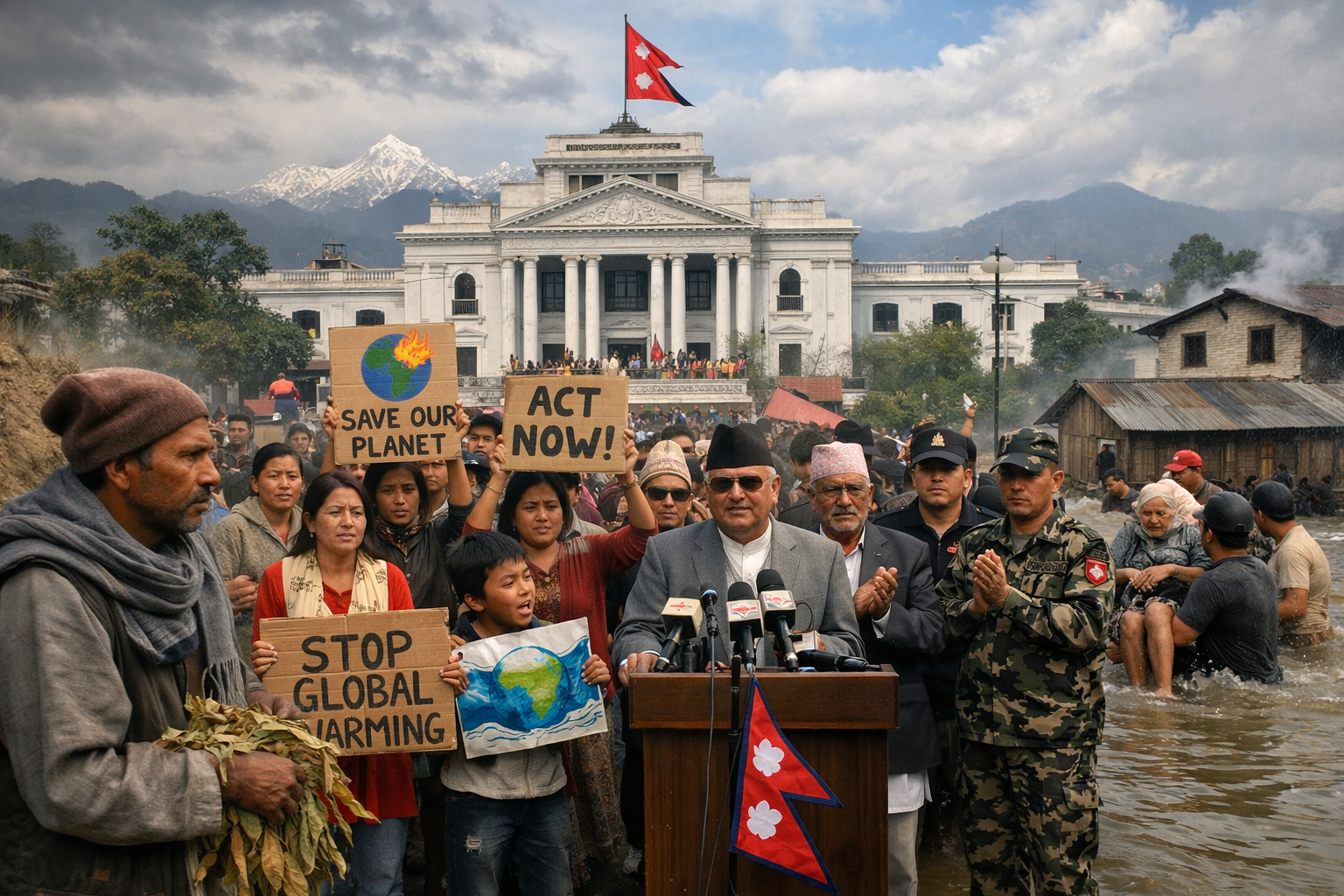
Devastating floods in Europe in late 2024, severe drought in Brazil and Africa, the glacial lake outburst in Thame, floods in Rasuwa, drought in Madhesh, and heavy rainfall in Ilam and Kanchanpur in Nepal reveal the deepening impacts of climate change. Looking at Nepal’s recent disaster record raises a serious question: have our political parties truly recognized the climate crisis? Or is it still confined to the “last page agenda” or donor-pleasing rhetoric?
Access to Climate Finance
Global political tensions, conflicts, and denial of climate science have narrowed international climate funds. Nevertheless, if Nepal can present strong, evidence-based arguments in international forums, it still has a solid chance of securing funds from the Climate Funds. As a Himalayan country directly experiencing rising temperatures, Nepal commands global sympathy. Political parties must go beyond vague promises of “increasing international climate funding.” They must commit to concrete adaptation and resilience plans, systematic documentation of loss and damage, project bank development, and transparent mechanisms to channel grants to vulnerable communities.
As a member of the United Nations Framework Convention on Climate Change (UNFCCC), Nepal must implement its National Adaptation Plan in line with the Paris Agreement. A clear roadmap and budget allocation reaching local governments and communities is essential for implementing the third Nationally Determined Contribution (NDC).
Specialized Institutional Structure and Umbrella Acts
It is not enough for parties to write abstract promises such as “we will reduce climate impacts.” A strong commitment to structural reform is necessary. Manifestoes should clearly state that an empowered, specialized structure or a separate ministry under the direct authority of the Prime Minister will be established to handle climate change and disaster management. Many climate-vulnerable countries have successfully adopted such high-level mechanisms.
Without a powerful coordination body chaired or overseen directly by the Prime Minister, inter-ministerial fragmentation will persist. Currently, ministries operate in silos; coordination gaps undermine effective climate action. The proposed structure should also strengthen vertical coordination among federal, provincial, and local governments. Policies formulated at the federal level often lose clarity or create conflict at the local level.
A specialized body should act as a bridge facilitating planning and budget allocation based on local geography and needs, empowering local governments through technical and financial support rather than top-down directives. It should also have the authority to review infrastructure projects for climate compliance and halt those that violate risk standards.
This specialized body must make climate change a regular agenda item of elected institutions. A mandatory provision should be introduced requiring the submission of an annual report to the Federal Parliament that includes the country’s climate status, risk profile, and climate-related expenditures.
This would compel Members of Parliament to understand climate science and its impacts. Only when floods, landslides, and carbon trading begin to be debated from the parliamentary rostrum as policy matters will climate change truly enter the mainstream of national politics. Party manifestos must clearly outline a powerful structure-based on successful international practices that can ensure intergovernmental coordination and remain accountable to Parliament.
The biggest problem observed at the administrative level is “conceptual ambiguity.” In the absence of a clear vision among policymakers, implementation at the lower levels has stalled.
The Ministry of Federal Affairs and General Administration has instructed the implementation of local disaster and climate resilience frameworks. This has created confusion regarding the implementation of the Local Adaptation Plan of Action initiated under the leadership of the Ministry of Forests and Environment.
Which ministry’s directive should local governments follow? Through their manifestos, political parties must present a roadmap to enact an umbrella law that integrates conflicting policies and empowers local governments. If vague terminology such as “to coordinate” continues to be used, and local governments are left merely preparing frameworks, when will actual plans be implemented? At a time when climate risk has yet to become a political agenda, merely imagining legislation is not enough. Climate risk must become a central agenda of political parties, accompanied by a clear commitment to address these challenges through law.
Key Indicators to Evaluate Manifestos
Party manifestos must not remain mere “wish lists”; they must become roadmaps for resolving the climate crisis. The seriousness with which political parties address climate change in their manifestos is itself a litmus test of their vision toward modern development. To assess how realistic and implementable their commitments are, we can use ten key indicators of “climate-friendly economic prosperity” as benchmarks. Saying “we will ensure climate justice” is an assurance.
Integrating it into the budget and concrete action plans is implementation backed by commitment. In this election, the climate agenda will serve as a litmus test for political parties: do they genuinely intend to protect citizens from climate risks and guarantee climate justice, or are they merely seeking power?
The first and most important indicator is a clear plan for energy transition and reduction of the trade deficit. While parties distribute dreams of exporting electricity, we must examine whether they present a concrete roadmap specifying by what percentage petroleum imports will be reduced annually. Only a time-bound plan to mandate electric stoves in kitchens and electric vehicles on roads can safeguard both the economy and the environment.
The second indicator should be the assessment of commitment to climate-friendly infrastructure development. Do party manifestos include legal provisions to curb the reckless use of bulldozers and mandate disaster-resilient standards, climate risk assessments, and bioengineering measures in all infrastructure projects? There must be numerical clarity regarding which river basins suffer annual flood losses, where exactly interventions are needed, and what types of structures will be built.
The third indicator relates to climate-smart agriculture and food security. Do the manifestos guarantee irrigation support for rain-fed farming, drought- and flood-tolerant seeds, and climate insurance with the state paying the premium?
The fourth indicator concerns domestic climate finance. Instead of constantly relying on foreign aid, parties should commit to allocating a fixed portion of the national budget through a “climate budget code” and ensuring that revenues collected from pollution taxes are directly deposited into a climate fund. The issue of Loss and Damage that Nepal raises in international forums must also be reflected in domestic policy.
The fifth indicator is localization and fiscal transfer. There must be a mechanism to ensure that funds received from the Green Climate Fund and other sources reach affected communities directly. Plans made from Singha Durbar cannot stop floods in villages. At least 80 percent of climate finance should be directly transferred to local governments under a decentralized framework that equips them with adequate resources.
The sixth indicator is the early warning system. There must be a budgeted and time-bound commitment to expand effective and reliable early warning systems that ensure universal access to pre-disaster information. Risk mapping based on geographical vulnerability should be accompanied by concrete plans and budgets. Localization of early warning systems, public awareness, and direct financial support at the implementation level are urgent needs. All infrastructure development must prioritize climate and risk pre-assessment and adopt a risk-informed approach.
The seventh indicator is green jobs and entrepreneurship. To reduce youth outmigration, manifestos must set numerical targets for creating green employment in sectors such as waste management, forest-based enterprises, and renewable energy.
The eighth indicator is an issue related to Loss and Damage Fund and climate justice. Manifestos should commit to establishing a nationally financed Loss and Damage Fund to provide immediate relief and rehabilitation for disaster-affected and poor households.
Another crucial indicator is the enactment of a Climate Act supported by a specialized institutional structure. Through such legislation, political parties must commit to protecting the constitutional right to live with dignity (Article 16) and the right to property (Article 25).
Without a powerful institution and an umbrella act, the plans outlined above cannot be effectively implemented. Party manifestos must be evaluated by citizens against these ten indicators. Issues that may seem ordinary at first glance have long-term significance in improving everyday life. A party manifesto is also a social contract. Voters must look for action-oriented plans within it. Political parties must acknowledge the gravity of the climate crisis. The next manifesto should not be a mere piece of paper, but a plan for survival. #Nepal
photo- AI