



Bigyan Adhikari
Kathmandu, Dec 28: After a meeting held on Saturday at Baluwatar between Prime Minister Sushila Karki and leaders of three major political parties—the Nepali Congress, CPN-UML, and the Nepali Communist Party—an understanding was reached to move forward with elections. This development was described in political circles as an “ice-breaker.”
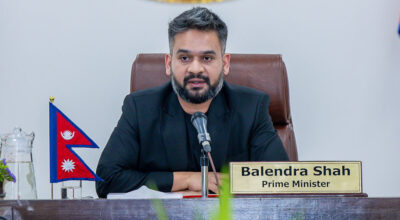
By the same logic, today can also be seen as witnessing another such “ice-breaker.” Early this morning, Kathmandu Metropolitan City Mayor Balen Shah joined the Rastriya Swatantra Party (RSP) and signed a seven-point agreement, an event that has dominated mainstream media and social media discussions throughout the day.
Despite these two “ice-breakers,” uncertainty still remains over whether a conducive environment for elections has truly been established. Nepali Congress President Sher Bahadur Deuba, while speaking to the media after the Baluwatar meeting, stated that although both the Nepali Congress and CPN-UML would participate in the elections, the overall electoral environment was still not fully in place.
In fact, following the Gen Z movement of last September 8 and 9, this was the first time Prime Minister Sushila Karki held talks with the leaders of the then ruling coalition partners—the Nepali Congress and CPN-UML—and the then main opposition party, which has since transformed into the Nepali Communist Party. That meeting marked a significant political thaw.
Following that development, today (Sunday) another new political message has emerged from a new political force. After the Rabi Lamichhane (RSP President) – Balen Shah agreement, several media outlets have reported that Nepali politics has entered a new chapter.
Meanwhile, Kulman Ghising, who was not accommodated in this agreement, has turned toward cooperation with another political party. He was unable to be part of the Rabi–Balen understanding after his demand to be appointed party chair was not met. As a result, he has initiated talks with the Progressive Democratic Party, which was formed after splitting from the former Maoist party.
Talks between Janardan Sharma, the coordinator of the Progressive Democratic Party, and Kulman Ghising have been ongoing since this morning and continued into Sunday evening. The negotiations appear likely to reach an agreement, as Ghising has chosen the Progressive Democratic Party as an alternative after being excluded from the Rabi–Balen political equation.
These developments largely concern party unifications. Whether these alliances are merely electoral arrangements or represent long-term political mergers remains to be seen. The outcome will largely depend on the number of seats these parties secure in the upcoming elections, as any agreement on the prime ministership ultimately depends on parliamentary strength.
Another critical dimension, however, involves the Supreme Court. Notably, the two major ruling parties—the Nepali Congress and CPN-UML—have institutionally filed writ petitions seeking the restoration of Parliament, and hearings on these cases are currently underway.
At the same time, these parties are actively preparing for elections. Today and tomorrow, they are in the final stages of submitting their proportional representation (PR) candidate lists to the Election Commission. This indicates that election preparations are moving forward.
Nevertheless, alongside electoral preparations, their attention remains firmly fixed on the Supreme Court. What course the court will take and what kind of verdict it will issue continues to be a matter of serious concern for political parties—leaving Nepali politics simultaneously focused on the courtroom and the ballot box. #nepal #genz #election