


Purushottam Ojha
Kathmandu, April 30: Mechanization of industries was started during the second half of eighteenth century which was the fall out of rapid urbanization, invention of steam engines, and the faster pace of population growth. Thus, a shift from handmade to machinebased production also gave rise to the emergence of industrial cities. Mass transportation of goods and people were enabled by the newly developed railways-based transport system. This phase of industrialization was succeeded by next phase of industrial expansion since 1870 that was based on use of electrical power, giving rise to efficiency in production, large corporations, with consequential expansion of global trade.
The third industrial revolution started during the latter half of twentieth century on the backbone of information technology and computerization while the current phase of industrialization, also called its fourth phase, started in the first decade of this millennium. In this phase, not only trade and industries are being supported by the use and application of advanced forms of information technology, but the overall aspects of human activities are connected with the virtual world, such as big data, block chain, robotics, and artificial intelligence. Countries are contesting on adoption of these modern technologies in facilitating the trade and investment decisions, and become competitive in the market.
Invariably, trade is considered as the engine for higher economic growth. Countries, thus, aspire for enhancing the export of goods and services by optimizing the use of available resources in harnessing the trade potentials. Increasing production at a competitive price is the necessary condition to generate and build the export capacity of any economy. Moving up the higher value chain in production and processing makes the terms of trade more favorable, and countries are vying for such remunerative transactions.
Traditionally, agriculture was the main sources of employment and income to a large number of people while mechanization induced the workforce shift toward industry, and manufacturing, creating more job opportunities surpassing the agricultural sector. The anecdotal history of emerging and the developed economies suggests that a gradual shift from agriculture to manufacturing and services sector was the ladder of moving from low income to higher income, greater employment opportunities, and achieving prosperity.
Investment, production, and productivity Production of goods, and services at a competitive price depends upon efficient use of inputs and processes backed by improved technology. In a competitive market, the producers need to reflect the choices of the consumers in terms of design, quality, and prices to retain its share in the market. We have seen that big companies like Apple, Samsung, and Huawei focus on bringing new version of the mobile phone periodically in order to outpace their competitors. Similarly, multinationals dealing with leather goods, apparel and garments focus on designing newer versions and produce high end fashions to cater the need of the well-off consumers. These efforts cannot bear fruition without adequate investment in human capital, technology, and infrastructures.
Availability of raw materials, and intermediary goods is essential for supporting the industrial establishments in production of finished goods. Such materials are either produced within the domestic markets or could be sourced from outside the country. Whatever may be the source, the value-added segment is the deciding factor in reckoning importance, and competitiveness of the products. This needs to be further supported by the favorable market access conditions to harness the benefit of trade.
Land, labor, capital, and technologies are the primary requisites for increasing production which is closely associated with the proper level of investment. Efficient use of these factors entails to increasing productivity and competitiveness. Other enabling parameters could be the provisions such as improved physical and digital infrastructures, availability of human resources, transparent rules, and regulations, and existence of open, and competitive market for a level playing field to the economic players.
Where do we stand?
Nepal embarked on mechanization of industries in a limited scale, with the establishment of Biratnagar Jute Mill in 1935. The decrees of New Company Act, and Banking Act were issued by the Rana Prime Minister Juddha Shumsher in 1937. This triggered the establishment of other industries like, mining company, paper mills, herbal companies, soap, and oil manufacturing companies, plywood, and furniture companies by the private investors. Industrial Council was made operational to provide license and regulate those industries while the establishment of Nepal Bank Limited in 1938 facilitated the credit services to such industries (Pandey-2026). Taken by the size of production, those were the small and medium scale industries, and the focus of the government was on promotion of cottage and small industries, mainly based on the domestic resources and raw materials. In the process of advancing industry sector in the economy, the first periodic plan (1956-61) envisaged the creation of an Industrial Research Bureau for the purpose of research, training, and market analysis, and piloting of the projects. But this institution could not come into existence due to changes in the priority of the succeeding governments. Rather, an industrial financing corporation by the name of Nepal Industrial Development Corporation was established during the period to provide consulting and financial support to the industries.
The next thirty-year period (1961-1990) was the phase of government led industrialization. Several industries such as shoes and leather factories, cement, paper, cigarettes, rosin and turpentine, textile and yarn, pharmaceuticals, handicraft, and mining industries were established by the government and run as public enterprises.
Carpet, pashmina and garment were the major manufacturing export from the industries, run by the private sector during the period. The process of liberalizing the economy started during the second half of 1980s, which was intensified after the restoration of the multiparty democracy in the country in 1990.
The policy measures were focused on open general licensingabolition of compulsory licensing system in industries, and trade, full convertibility of Nepalese currency in current account, and privatization of public enterprises, among others. The reform measures also included the enactment of several legislations, and amendment in the existing legislations to facilitate the private sectors to make investment in industries, transport, tourism, health and education sectors. Regulatory regimes were relaxed to encourage the private investors in setting up and running the business ventures.
There have been no major departures in those policies despite the frequent changes of the government over the last three decades. But, the Nepalese economy is not reckoning a satisfactory outcome in respect of increasing industrial growth, outputs, and employment. The share of agriculture and the industry sector in the GDP has been declining, and the service sector contribution is on the rise over the past thirty years. The share of agriculture, industry, and service sector in 2024-25 remained 24.71, 12.91, and 62.38 percent respectively (MOF-2025). Among the clusters of industry, the manufacturing sub-sector contributed slightly less than 5 percent in the GDP. The persistent low performance of industry sector, continuing over the last two decades, was detrimental in increasing employment opportunities and export income.
Status of industries
The Department of Industry (DOI), and the Investment Board Nepal (IBN) are the two government agencies responsible for approval of industrial investment in Nepal. Out of the approved investment of NRs. 4,766 billion till mid-July 2024, approval from DOI comprised 68 percent, and the rest 32 percent from IBN. The DOI is the industry registration authority at the federal level while the provincial industry offices are responsible for registration of micro, cottage and small industries. The number of industries registered with DOI by mid-February 2025 were 9963; of these 1461 were big industries, 2164 medium, and 6338 small industries.
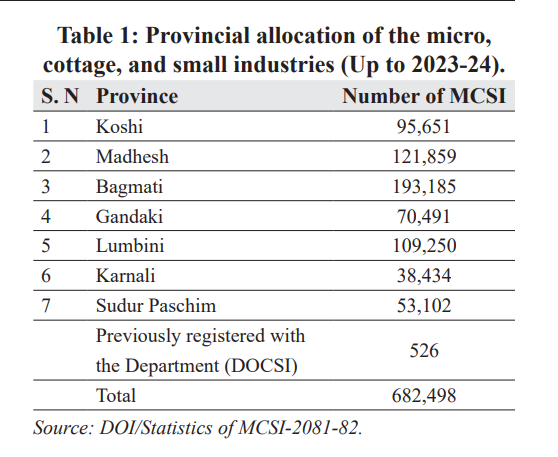
Total investment in these industries were NRs. 3,248 billion, with the estimated employment of 732 thousand people. Similarly, the micro-cottage and small industries (MCSI) registered with the erstwhile Department of Cottage, and Small Industries (DCSI), and the Cottage and Small Industry Board (CSIDB), and the district offices of the Provincial Governments till 2023-24 were 648,500. Of these, highest number includes service industries 208,927 (32%), followed by agriculture and forest-based industries 202,733 (31%), and manufacturing industries 160,054 (25%). Tourism falls fourth in the series (58,611), and construction (14,611) in the fifth position. The energy-based industries, mine based, and ICT account less than 1 percent. Altogether, 3.8 million people are said to be employed in those industries (DOI-2025).
Micro, cottage, and small industries are the backbone of the industrial sector, as they conspicuously represent the vibes of traditional knowledge, skill, craftmanship, and culture.
Several cities around the country such as Lalitpur, Palpa, Dhankuta, Bhojpur, Pokhara, Doti, and Illam, were taking the lead in producing the handcrafted items since centuries. Those industries formed the sources of employment and income to the people engaged in the enterprises. The provincial allocation of the registered MCS industries shows that the highest number is found in Bagmati Province followed by Madhesh and Lumbini.
Foreign Direct Investment
Investment from the alien countries is crucially important to bridge the resource gap for industries, particularly in complementing the domestic resources and financing of the projects. Besides the availability of finance, FDI helps in bringing new technologies, skills, and managerial competence, and also help in expanding market access, benefitting the host country. With the globalization of economy, fragmentation of production and trade in parts emerged as a new concept in a bid to become more competitive in production with optimum use of skills, and resources. This steered countries to become a segment of cross-border value chain.
The provisions of long-term contract, and direct trade measures were introduced in various trade and economic cooperation agreements enabling the multiple cross-border flow of raw materials and intermediary goods before they are finally produced. This has also facilitated the variegated cross-border investment, such as the greenfield and brownfield investment, portfolio investment and easing commercial presence of the companies in the host countries. In view of the need for creating greater employment opportunities, increasing industrial output, and export, and increasing revenue, governments around the world are competing to entertain the foreign direct investment in their countries. This encouraged the governments to make the investment regimes more favorable to the comfort of foreign investors.
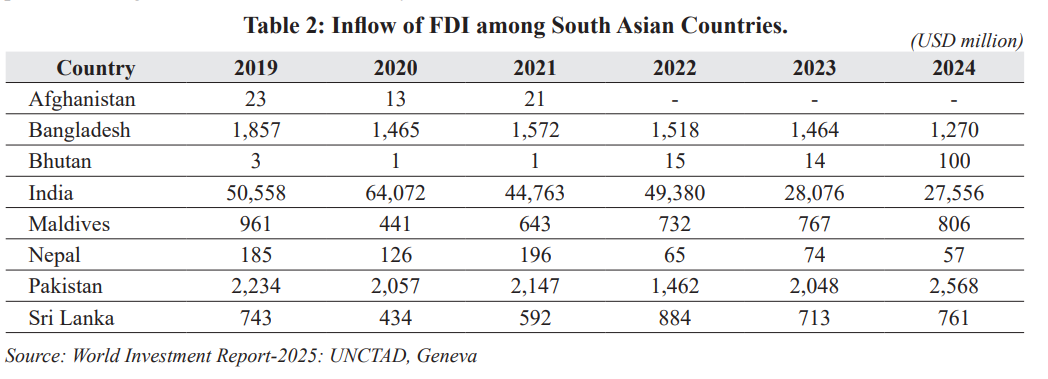
The global trend of foreign direct investment is on constant rise over the last seven years with the exception in 2020, which was the fall out of pandemic. According to the World Investment Report-2025, published by UNCTAD, there was increment in the volume of FDI in 2024 by 3.7 percent at the global level, and this is mostly skewed in favor of developed economies accounting to 8.8 percent rise in the year. Meanwhile, FDI in South Asia experienced slight decline (by 0.03 percent) during the year. The highest recipient country is India, followed by Pakistan, and Bangladesh, as given below. Nepal is on the low rung as recipient of FDI in South Asia.
The total FDI stock in Nepal has reached NRs. 333 billion as of mid-July 2024. Of these, highest stock (29.5 percent) belongs to electricity, gas, steam, and air conditioning, followed by manufacturing (29.3 percent), financial, and insurance services (24.4 percent), accommodation, and food services (8.1 percent), and information, and communication services (6.5 percent). Among the foreign investors, India ranks first with a share of 32.3 percent of the total stock, followed by China (10.2 percent), Singapore (8.3 percent), and Ireland (7 percent). One of the underlying issues is the increasing gap between commitment, and realization of the foreign direct investment, as it has been found that only 31.9 percent of the approved FDI over the last 30 years has been realized (NRB-2025).
Table 2 illustrates that, Nepal is on the low ebb from the perspectives of attracting investment in the industrial establishments. Complex legal regimes, policy instability, inadequate physical and IT infrastructures, unstable market access conditions, lack of skilled human resources, poor governance backed by corruption, lack of accountability, and enforcement are the reasons behind the unfavorable business environment. Frequent changes in the seat of government at the federal and provincial level, and the corresponding changes in the policy, also send negative signals to the potential investors.
Issues, prospects, and the way forward The current arrangement for industry registration is scattered over a number of agencies. Those includes; Department of Industry, District Cottage Industry Offices under the provincial government, and municipality of industry to be located. These entities have their own mechanisms, and processes on renewal of registration, use of government services, and reporting by the industries. Services available to the industries are not consistent and coordinated.
For example, various pieces of legislations related to industries have made provisions of constituting one stop services centers (OSSC), and one such entity has been established in the Department of Industry. But its effectiveness in providing relevant services to the industries is being constantly questioned by the industrial establishments. Similarly, the legal arrangements in obtaining environmental clearances, particularly the EIA, and land with forest cover is cumbersome, and time consuming. Simplification of the government regulations and effective functioning of the OSSC would be of utmost importance to remove several impediments faced by the industries.
Inadequacy of infrastructures is another impeding factor in growth of industry, and corresponding investment. Nepal has made a good progress in development of road infrastructures over the last thirty years, with the construction of 100,339 kms of road by 2022-23. However, the quality of road does not support the safety of passengers and vehicles. A large part of the roads is dirt, windy, and the road accident has become frequent over these years. The electrical power has reached to almost 97 percent of the household and the installed capacity of power from hydro and alternative energy reached 3200 MW (NPC-2024).
But, the quality of supply has been questionable. Digital infrastructures are also in the offing. There are good prospects of promoting industries and industrialization with the proper utilization of these infrastructures.
Another issue faced by the investors is the difficulty in getting credit from the banks, and finance institutions. The government has started providing concessional loans to the startup industries through the commercial banks with effect from 2024. However, rest of the industries, particularly the big and medium industries, have to take the burden of higher interest rate, and offer land, and houses as collateral for the credit.
Banks and financial institutions feel comfortable to finance the housing, and vehicular loan, rather than industries which has relatively a long gestation period for realization. Paradox lies in mobilization of credit facilities, as commercial Banks are now sitting with large amount of liquid assets on one side while the demand for borrowing in the industrial sector is plummeting due to slowing economy on the other. Government need to make a review of the current state of affairs, financing mechanism and make necessary adjustment in the policy to encourage investment in the industries. The country is confronted with the contradiction of supplying skilled human resources to the industrial establishment in the country.
On one side, a large number of workforce (skilled or unskilled) are leaving the country for employment abroad while the industries within the country, albeit in limited numbers, are facing the acute shortage of workers. According to the immigration desk of the international airport of Kathmandu, migrant workers between 2000 and 2500 in numbers, are leaving the country on a daily basis. This shows the seriousness of the problems relating to employment, job opportunities, and industrial establishment in the country. Government of Nepal need to devise the practical policies to prepare the skilled human resources to meet the national requirement, and implement measures with incentives to retain them for productive jobs within the country.
Land prices are soaring up day by day, and the acquisition of land has become a herculean task for the industries. Land owners normally jack up the prices of their land by several times once they know that investors chose a particular location for setting up the industries. Sometimes, the land price goes much higher than the investment to be made in rest of facilities, including plant, machinery, and equipment. The available option is the creation of more Special Economic Zones, and Industrial Estate by the government and providing space for locating industries in those premises. In the realm of the resources crunch, and technological insufficiency, foreign direct investment will be crucially important for enhancing industrial production and productivity.
Hence, focus should be in taking measures to bring large amount of foreign direct investment into the country; they may be in the area of high value agriculture, manufacturing or tradable services. This requires implementation of measures that are associated with promotion of good governance, transparency, accountability, and rule of law. Nepalese diplomatic missions abroad and the organization of Nepalese diaspora, should be mobilized in promoting and marketing Nepal as the potential investment destination.
As part of this, Road Show may be organized in the countries and cities having large number of potential investors. Furthermore, this requires an overall review of investment ecosystem and the adjustment in the legislation, policy, institutions, and processes to settle the current dilemma and realign the country in higher growth trajectory.
Conclusion
Nepalese economy is making an advancement to a structural shift toward services with the gradual shrinkages of the agriculture and industry sector over the last three decades. Growth of industries, particularly manufacturing sector, has got a setback during the period giving a sense of premature deindustrialization. Migration of large number of youths every year for employment has created short supply of human resources in the productive activities within the country. On the other side, the amount of remittance is increasing and this reached NRs. 1.72 trillion in 2024-25. This has eased in maintaining the balance of payment, but at the same time fueled the import of goods, and services to meet the domestic demand. Government revenue is thus largely driven by import duties.
Investment in industries, particularly in the manufacturing sector is considered crucial from the perspectives of creating employment opportunities, increasing value added production, substituting import, enhancing export, and ultimately supporting the economic growth. This requires substantial amount of private investment which require mobilization of domestic investors, and bringing more foreign investment for financing, and technology upgradation.
There are prospects of funneling investment from the two big neighboring countries in the North and South, that will require proper marketing strategies. In the meantime, focus should be in creating an investment friendly environment in the country with policy, and regulatory reform, and promotion of good governance. Adoption of digital technology in provision of support services, promotion of healthy competition, quick redressal mechanism for industrial disputes, and entering bilateral investment agreement with the partnering countries are the necessary conditions for promoting foreign investment. Government should not lose sight of this.
Government of Nepal may take a two-pronged approach in development of industrial sector. In the first case, focus should be in promoting micro, cottage and small industries that can generate large number of employments, and self-employment at the grassroot level. This can largely benefit the disadvantaged section of the society including women, promoting inclusivity in production, and increasing income of the vulnerable groups.
Secondly, it should focus on- in bringing investment in large industries and big projects which would be highly supportive to unleashing economic prosperity and drive economic growth in higher trajectory.
The parliamentary election held in March this year, following the Gen-Z movement in September 2025, has generated a single party bagging almost two-third seats in the House of Representative. This has enabled the formation of a stable government for five years for the first time after the promulgation of the Constitution of Nepal in 2015. The onus lies in the newly formed government to bring job and employment opportunity at home with increased investment both from abroad and within country.
( Mr Ojha was a former secretary at the government of Nepal)
Courtesy: Nepal Rastra Bank Annual Journal