


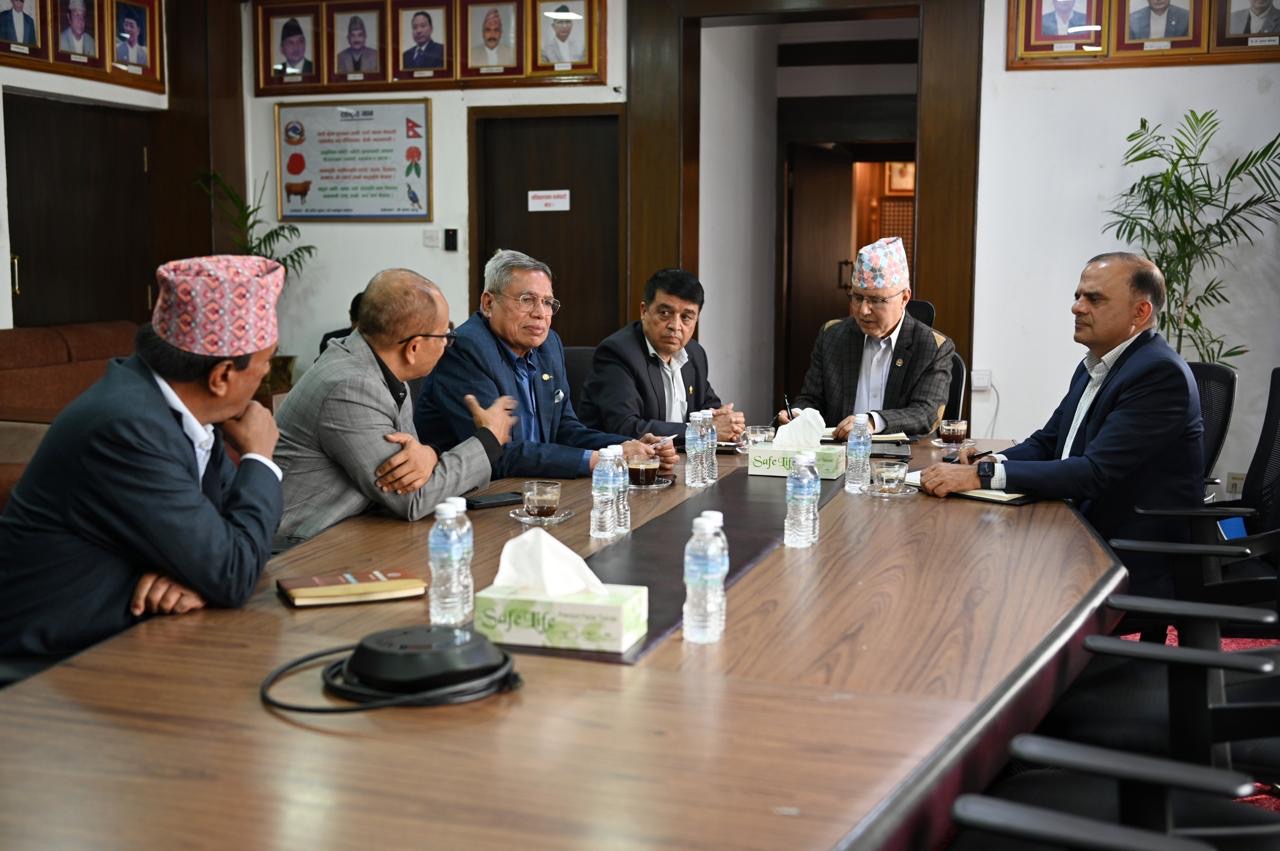
Kathmandu, March 12: Finance Minister Rameshwar Prasad Khanal held a meeting with leaders of private sector organizations at the Ministry of Finance on Thursday to discuss current economic issues and the business environment.
The meeting was attended by Chandra Prasad Dhakal, President of the Federation of Nepalese Chambers of Commerce and Industry, Kamlesh Kumar Agrawal, President of the Nepal Chamber of Commerce, Birendra Raj Pandey, President of the Confederation of Nepalese Industries, and Khem Raj Bhandari, President of the Nepal Industry and Traders Federation.
During the meeting, Finance Minister Khanal expressed his sincere gratitude to the private sector for their cooperation and support during his tenure.
He noted that restoring the business environment and boosting the morale of the private sector had been a major challenge at the beginning of his term, especially following the protests on September 8 and 9, 2025.
He said that through joint efforts, those issues have gradually been addressed and the business climate has improved.
The minister also stated that steps have been taken to maintain macroeconomic stability, create an investment-friendly environment, protect domestic industries while promoting exports, make the capital market more transparent and investment-friendly, and strengthen economic governance.
However, he acknowledged that due to the current circumstances and policy complexities, some tasks remain incomplete and will be handed over to the incoming finance minister.
Leaders from the private sector thanked Minister Khanal for his attention to the issues raised by businesses and for addressing several of their concerns during his tenure.
They also emphasized that political stability is essential for the country’s overall development and prosperity, expressing optimism about the results of the recently held elections.
On behalf of the private sector, they thanked the government for ensuring a fear-free environment and conducting the elections in a fair manner.
During the discussion, private sector representatives also drew the minister’s attention to several pending issues, including adopting a multi-rate system for Value Added Tax (VAT), ensuring that the tax on imported raw materials is at least two levels lower than the tax on finished goods, promoting weightless or boundaryless production and exports, evaluating the effectiveness of regulatory bodies, and reducing high excise duty rates. #nepal #finance