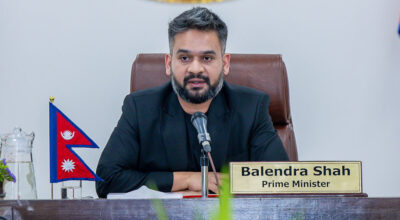



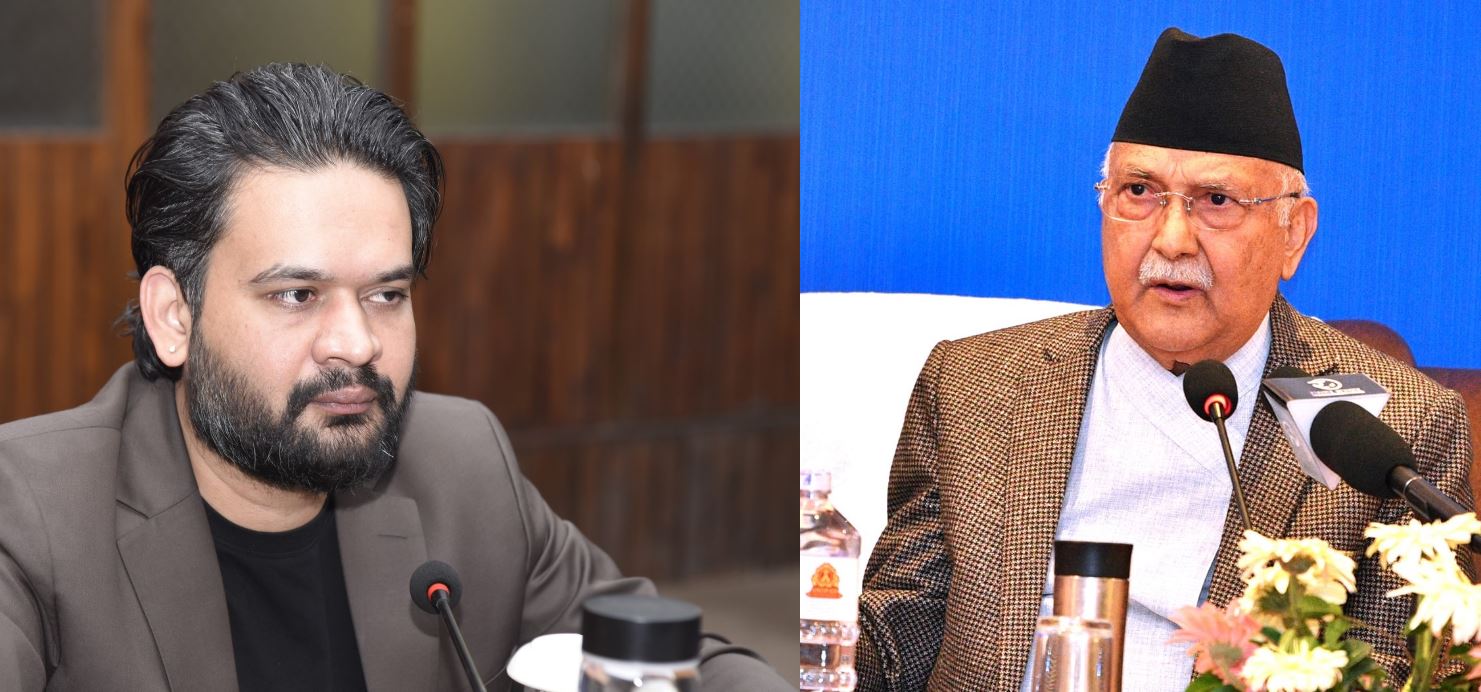
Kathmandu, Feb 2: The political contest in Jhapa constituency No. 5 has intensified, transforming a traditional CPN-UML stronghold into a centre of national attention as CPN-UML Chairman and four-time Prime Minister KP Sharma Oli faces Balen Shah, a senior leader of the Rastriya Swatantra Party (RSP) and former mayor of Kathmandu Metropolitan City.
With both candidates filing nominations for the March 5 House of Representatives election, Jhapa-5 is set for a high-stakes confrontation between a seasoned political heavyweight and a leader who enjoys strong support among younger voters.
Oli is contesting from Jhapa-5 for the eighth time. Of the seven elections he has previously contested in this constituency, he won six and lost once. He secured victories in the parliamentary elections of 1991, 1994, 1999, 2013, 2017 and 2022. His only defeat came in the 2008 Constituent Assembly election, when Maoist candidate Bishwadeep Lingden defeated him by a margin of around 1,200 votes.
This time, Oli faces Shah, who rose to national prominence after winning the Kathmandu mayoral election as an independent candidate with a significant margin. The large crowds and enthusiasm witnessed during Shah’s nomination filing have signalled a potentially tough contest in what has long been considered Oli’s safest seat.
Although Jhapa-5 has traditionally favoured the UML, past elections—particularly in 2008—demonstrate that the constituency can produce unexpected outcomes. Shah has positioned himself as a representative of a new political generation, emerging from a post–Gen Z movement, and has attracted visible support from young voters and citizens disillusioned with mainstream parties.
Since Shah’s nomination, several local leaders from both the Nepali Congress and the UML have joined the RSP. Among them is Prakash Prasai, chair of the Nepali Congress Damak Municipal Committee and a popular youth figure, who entered the RSP on the day of nomination. Likewise, the chair, vice-chair and secretary of the UML-affiliated National Youth Federation Nepal, Damak municipal committee, have switched allegiance. UML youth leader Kamal Prasad Gaire announced his resignation from the party via social media, while Mahendra Budhathoki, secretary of Nepali Congress Kamal Rural Municipality Committee, has also joined the RSP.
However, local political figures caution against drawing premature conclusions. Netra Budhathoki, former principal of Damak Multiple Campus and a Nepali Congress general convention representative, said Prasai’s departure would not significantly weaken the party’s organisational base. “Individual decisions do not cause fundamental damage to a party,” he said.
Budhathoki also warned against equating social media narratives with electoral reality. “On social media, UML supporters appear to have already declared Oli the winner, while Shah’s supporters are equally confident. But online sentiment alone cannot determine election outcomes,” he added.
Advocate Lila Udasi of Jhapa echoed similar views, noting that campaigning has only just begun. “All parties are claiming victory, but it is too early to make any concrete assessment,” he said.
Udasi also pointed out that Oli previously benefited from an electoral alliance with the Rastriya Prajatantra Party (RPP), which helped him secure comfortable victories. This time, however, the RPP has fielded Laxmi Prasad Sangraula as its candidate, potentially complicating Oli’s path.
In the 2022 election, Oli won with 52,319 votes, while Nepali Congress candidate Khagendra Adhikari secured 23,743 votes. The RSP finished third with 11,748 votes, while receiving around 18,000 votes under the proportional representation system.
The political equation has changed significantly since then. There is no formal alliance between the UML and the RPP, and the Nepali Congress has nominated Mandara Chimariya, a local resident of Damak, as its candidate. Even some UML leaders privately acknowledge that replicating the previous margin will be difficult amid growing dissatisfaction with Oli’s rhetoric and leadership style, as well as a visible shift of young voters toward Shah.
Jhapa-5 comprises Damak Municipality, Kamal Rural Municipality, wards 1–8 of Gauradaha Municipality, and wards 3, 4, 5 and 6 of Gaurigunj Rural Municipality. The constituency has 163,379 registered voters, including approximately 10,000 new voters. More than one-third of the electorate belongs to indigenous nationalities, whose votes are expected to play a decisive role.
In the last local elections, the RPP led Damak Municipality, the UML controlled Gauradaha, and the Nepali Congress led Kamal and Gaurigunj. Candidates from the Shram Sanskriti Party, led by Harka Sampang, and the Nepali Communist Party have also entered the race, raising the possibility of fragmentation of indigenous votes.
Several development projects associated with Oli are under scrutiny. The much-publicised Damak View Tower has yet to become fully operational, while work on the Nepal–China Friendship Industrial Park remains stalled. Disputes over the naming and location of the Indigenous Nationalities Stadium have also left that project incomplete—issues that opponents are highlighting during the campaign.
The RSP has stated that its campaign will focus on unfinished development projects, corruption, weak governance and institutional decay. Local party leaders believe Shah’s candidacy could send a strong message not only in Jhapa but also across national politics.
UML supporters, meanwhile, credit Oli with major infrastructure development, citing roads, buildings and public facilities. However, many young voters argue that most projects remain incomplete and say they are seeking an alternative political direction.
With multiple parties in the fray and shifting political dynamics, the outcome in Jhapa-5 remains uncertain. A constituency once regarded as Oli’s safest seat is now witnessing one of the country’s most closely watched contests, symbolising a broader contest between established power and emerging political forces. #nepal #election #balen #genz