


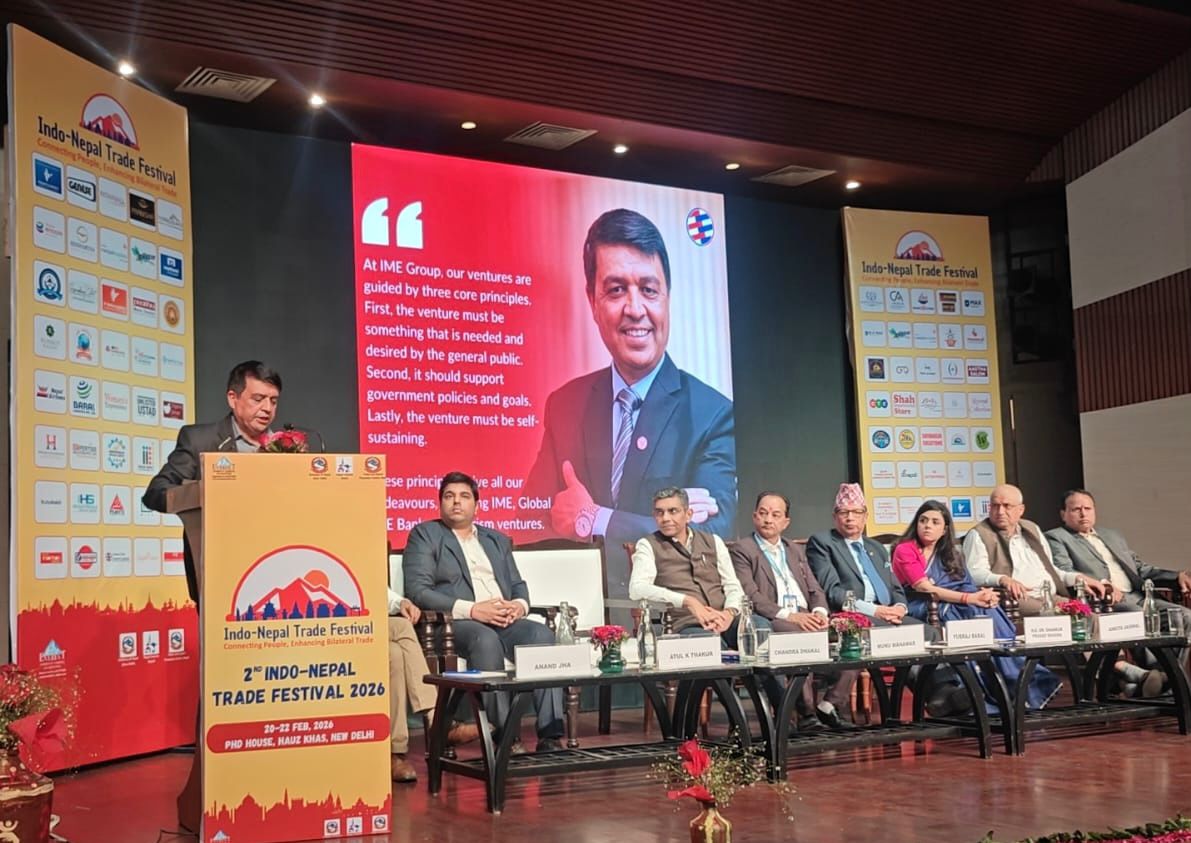
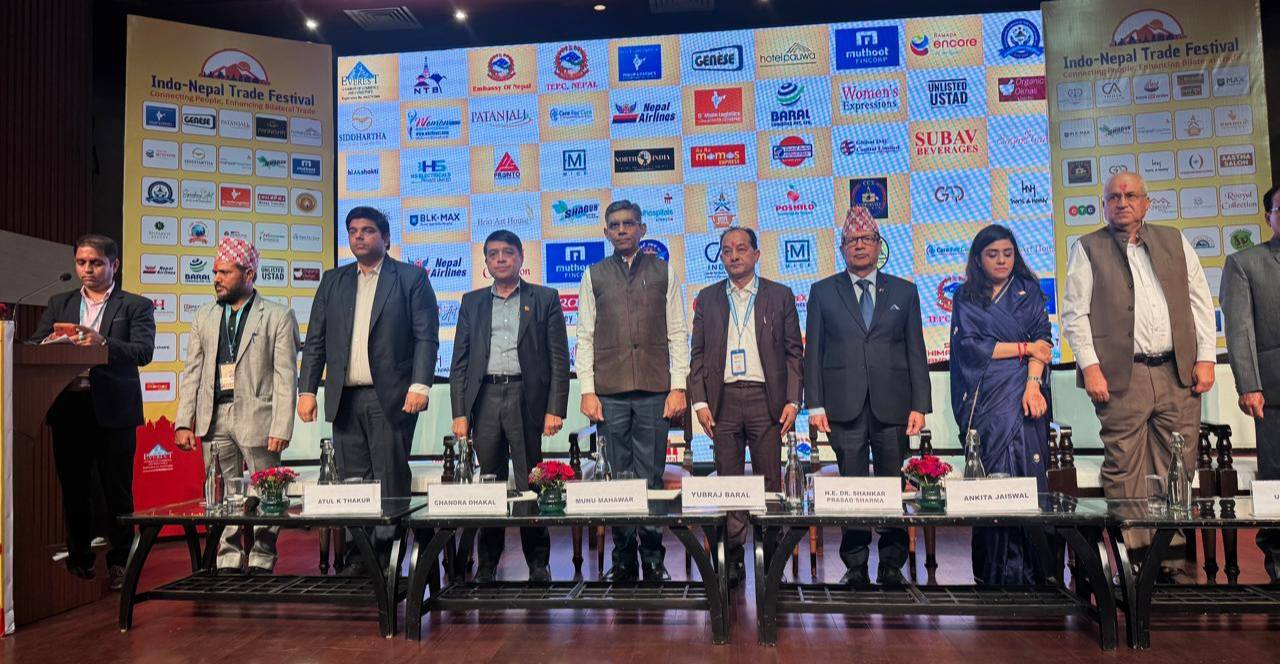
Kathmandu: It is a great pleasure for me to be here in New Delhi at the 2nd Indo-Nepal Trade Festival 2026. I would like to thank the Everest Chamber of Commerce and Industries, the Embassy of Nepal, and all partners for bringing us together on such an important platform.
Events like this remind us that the relationship between India and Nepal is not only about geography or history. It is about people, business, trust and shared growth.
India is Nepal’s largest trade partner and one of our biggest sources of investment. Our open border, cultural closeness and deep family ties make our partnership unique in the world.
Today, when the global economy is facing uncertainty, supply chain disruptions and regional tensions, it is even more important that neighbours work closely and support each other’s growth.
The recent Union Budget of India has placed strong emphasis on infrastructure, manufacturing, digital connectivity, green energy and support to MSMEs.
India’s continued investment in railways, highways, logistics parks and digital public infrastructure will not only strengthen its own economy but also create opportunities for neighbouring countries like Nepal.
When India grows faster, it creates demand, supply chains and investment flows that benefit the entire region. Nepal can connect to these initiatives through cross-border trade, energy cooperation, tourism circuits and joint ventures in manufacturing and services. Nepal must align itself strategically with India’s rapid economic growth — not as a bystander, but as an active and capable partner.
On Nepal’s side, we are also focusing on economic reforms, infrastructure development and improving the investment climate. Nepal has immense potential in hydropower, tourism, agriculture, information technology, manufacturing and services.
We are rich in water resources and have already started exporting electricity to India. With proper transmission lines and policy stability, Nepal can become a reliable green energy partner for India. We already have bankable, ready-to-invest hydropower projects that are waiting for the right partners. Cross-border transmission infrastructure is the key that unlocks this potential for both nations.
This is not only about trade. It is about long-term energy security and clean growth for both countries.
Tourism is another strong area of cooperation. Nepal offers natural beauty, adventure, spiritual heritage and warm hospitality. We are encouraging high-quality tourism infrastructure, including hotels, resorts and cable car projects in different parts of the country. Nepal sits at the heart of South Asia’s spiritual and pilgrimage economy — a market of hundreds of millions of devotees. We are actively developing a regional Cable Car Circuit connecting key religious and tourism destinations, making them accessible to visitors of all ages. This is a transformational opportunity for investors and a game-changer for mountain communities.
Cable car development is opening up remote religious and tourist destinations, creating jobs and attracting both domestic and foreign investors. Indian investors have already shown interest in hospitality and tourism projects, and we welcome more partnerships in this sector. The private sector is leading this charge — and the results are already visible on the ground.
Investment opportunities in Nepal are expanding. The government has simplified procedures in many sectors and is working to reduce bottlenecks. There are opportunities in industrial parks, special economic zones, cross-border logistics, agro-processing, pharmaceuticals, education and health services.
Nepal can also serve as a gateway between India and China, offering strategic advantages for trade and connectivity.
Nepal is entering an important democratic moment, and the private sector sees this as an opportunity — not a risk. We have consistently said that economic stability and political stability must move together, and we believe Nepal is ready to demonstrate exactly that.
Elections are a sign of a healthy democracy. What matters equally is that reforms continue, spending remains disciplined, and the investment climate stays predictable. Growth cannot wait for the political cycle to complete.
Nepal is actively building a pipeline of bankable projects and long-term partnerships. What serious investors need — and what we are committed to delivering — is consistency, confidence and continuity.
The Federation of Nepalese Chambers of Commerce and Industry has been strongly advocating for predictable policies, responsible fiscal management and private sector–led growth. We are not waiting for transformation to happen. We are driving it.
We believe that both India and Nepal should work towards deeper economic integration, smoother customs procedures, better standards alignment and stronger digital trade systems.
MSMEs on both sides need easier access to finance, technology transfer and market information.
People-to-people ties remain our biggest strength. Cinema, culture, education exchanges and tourism build understanding beyond official meetings. When our entrepreneurs meet, when our young people collaborate, when our artists perform across borders, the foundation of economic cooperation becomes stronger.
The Indo-Nepal Trade Festival is not just an event. It is a platform to convert goodwill into business deals, ideas into projects and conversations into partnerships.
Let us use this opportunity to identify concrete areas of collaboration, from green energy to digital services, from tourism to manufacturing.
India and Nepal share an open border and an open heart. Our future should also be open, ambitious and forward-looking. The private sector is ready to play its role.
With political will, policy stability and mutual trust, we can take Indo-Nepal economic cooperation to a new level.
I thank you all and wish the 2nd Indo-Nepal Trade Festival 2026 great success.
(Speech delivered by Chandra Prashad Dhakal, President of FNCCI in 2nd Indo-Nepal Trade Festival 2026, held in New Delhi on Friday)