



Kathmandu, July 12: It has been hardly a year since the devastating Khumbu flash flood occurred in a mountainous district, Solukhumbu, causing the loss of 30 million US Dollars, Nepal witnessed another flash flood, spreading alarm that span of extreme glacial events is getting shorter. The experts have underlined the need of better climate action along with cutting-edge research in this wake.
The International Centre for Integrated Mountain Development (ICIMOD) has confirmed that supraglacial lake outburst were behind the Khumbu flash flood of Solukhumbu (Aug, 2024) and Lhende flash flood of Rasuwa (last Tuesday). Dijachho Lake was burst causing Thame flash flood in Khumbu village of Solukhumbu that took a heavy toll on physical infrastructure including a hydropower.
The warning of the cases of lake breaches is however being made for long – since 1985. In addition to the projection of disasters, ICIMOD has conducted studies on Melamchi River flood, Birendra Lake of Humla and Chamoli and South Lonak of Sikkim, India.
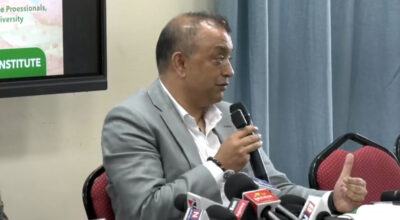
Dr Maheshwor Dhakal, Chief of Climate Management Division at Ministry of Forest and Environment, said, “Recent outburst of glacial lake has urged us to be further cautious. Information sharing and early warning system based on pattern of temperate rise have been essential.” The extreme weather events occurring in a shorter span are posing threats, he added.
ICIMOD informs that supraglacial lake is formed on the surface of glacier. These are temporary and can be formed as a pond and enlarged to big lakes. The supraglacial lakes can be sighted from satellites, especially through Landsat and Sentinel-2.
Observed in December 2024, it was a small lake in Tibetan side which began spreading much since June 2025. It ultimately caused flash flood in the Lhende stream on Nepal-China border last Tuesday.
Expert on glacial lake and glacier, Sharad Prasad Joshi, argued rise in temperature was causing incidents relating to glacial lakes. “Continuous mapping, monitoring and updating of ominous glacial lakes is mandatory. Equally important is the research,” he suggested.
As per his suggestion, the pace of snow melting and process of formation of glacial lake requires huge attention and study. The glacial outbursts increase if occurrence of rainfall is more than snowfall in mountainous region, he argued.
The weather and climate alarms are made by various other organizations and researchers. In this connection, the climate report-2024 published by the World Meteorological Organization (WMO) had finely forecasted the severe weather events in the wake of rising temperature. September 2024 recorded 1.54 more Centigrade temperature than pre-industrial era. With the base year set in 1850 to 1900, the earth has witnessed the rise of temperature by 1.4 Degree Celsius. Among this, 1.3 is caused by the anthropogenic activities.
Worryingly, the Hindukush region is further vulnerable to climate impacts, with 3 fold more than other regions in the earth. ICIMOD reports the melting of glaciers is increased by 65 percent when compared to the state of 2011 to 2020 in this region.
Sashwat Basnet, Chief of Disaster Risk Reduction at ICIMOD, expressed worry over the rising frequency of glacier-related disasters in recent years, while these used to occur in a 5 to 10 year span in the Hindukush Himalaya.
With this, he suggested an in-depth research on the patterns of glacial incidents. At a time when the recurrence of Himalayan disaster is seen in a shorter span, the early warning system must be in place to avoid further incidents, thereby saving lives and property.
But, Nepal has no such system in place except Imja and Tsho-Rolpa glacial lakes. Small glacial lakes are formed and ruptured quickly these days, to which the government needs proper attention and investments. #nepal #Supraglacial #rss