


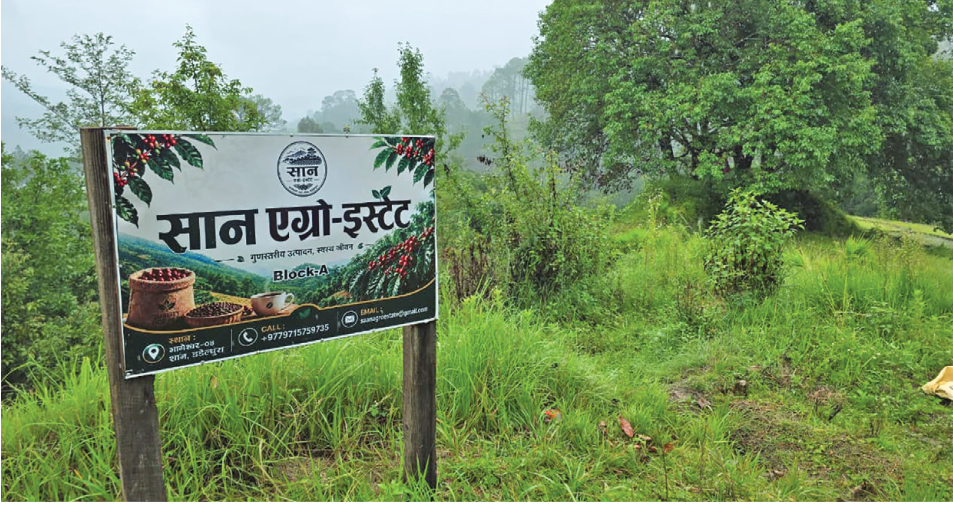
Dadeldhura, July 13: A group of three young entrepreneurs has launched the first commercial coffee farm in Dadeldhura district by planting 2,000 Arabica coffee saplings on the slopes of Golai Village in Bhageshwor Rural Municipality–4.
The hillside, which had remained covered with bushes and grass for years, is now being transformed into a well-managed agricultural estate. The initiative marks the beginning of commercial coffee cultivation in the hilly district of Sudurpaschim Province.
According to farmer Rajendra Bhandari, Saan Agro Estate has opened a new chapter in the district’s agricultural history by introducing commercial Arabica coffee farming. He described the project as more than just an agricultural venture, calling it a symbol of the three youths’ confidence in the potential of their village and its fertile land.
While many Nepali youths aspire to work or study abroad, Dixit Bhandari, Nitin Chataut and Nischal Chataut chose a different path by investing in agriculture in their hometown.
Rajendra Bhandari, father of Dixit Bhandari, said his son had saved Rs. 3 million to pursue a Master’s degree in Thailand after completing a Bachelor’s degree in Business Studies in Kathmandu. However, he later changed his plans and decided to invest the money in commercial farming instead of going abroad for further studies.
The trio established the coffee plantation on previously barren land with the goal of creating opportunities at home. They imported 2,000 high-quality Arabica coffee saplings from Gulmi, one of Nepal’s leading coffee-producing districts.
“The land was properly prepared, shade management was arranged, organic manure was applied, and irrigation facilities were ensured before planting the saplings,” Bhandari said. “Only after completing these preparations did we begin the first commercial coffee plantation in Dadeldhura.” He said the project has so far attracted an investment of around Rs. 1.5 million.
To diversify production, the farm has also planted 50 mango, 25 litchi and 30 lemon saplings alongside the coffee plantation. Appropriate shade management has been established for the coffee plants, while 20 quintals of vermicompost have been applied to improve soil fertility and ensure long-term productivity.
Nepali coffee has been gaining increasing recognition in international markets due to its high quality.
According to Narendra Paneru, Chief of the Agriculture Knowledge Centre, Dadeldhura, areas located between 1,000 and 1,600 metres above sea level provide ideal conditions for Arabica coffee cultivation. “As much of Dadeldhura falls within this altitude range, the district’s climate, temperature and soil are well suited for coffee farming,” Paneru said. He noted that coffee is a long-term investment rather than a crop that provides immediate returns.
“The saplings planted today will begin producing after around three years. However, each plant can continue yielding coffee for nearly 25 years,” he said. Paneru added that coffee farming offers sustainable income over decades, making it an investment that can benefit future generations rather than a short-term business.
The Agriculture Knowledge Centre, Dadeldhura, has supported the initiative by providing a 50 per cent subsidy of Rs. 100,000 for the purchase of coffee saplings. The centre has also assisted the farmers with irrigation pipes, organic manure and a pit-digging machine to help establish the plantation. #nepal