


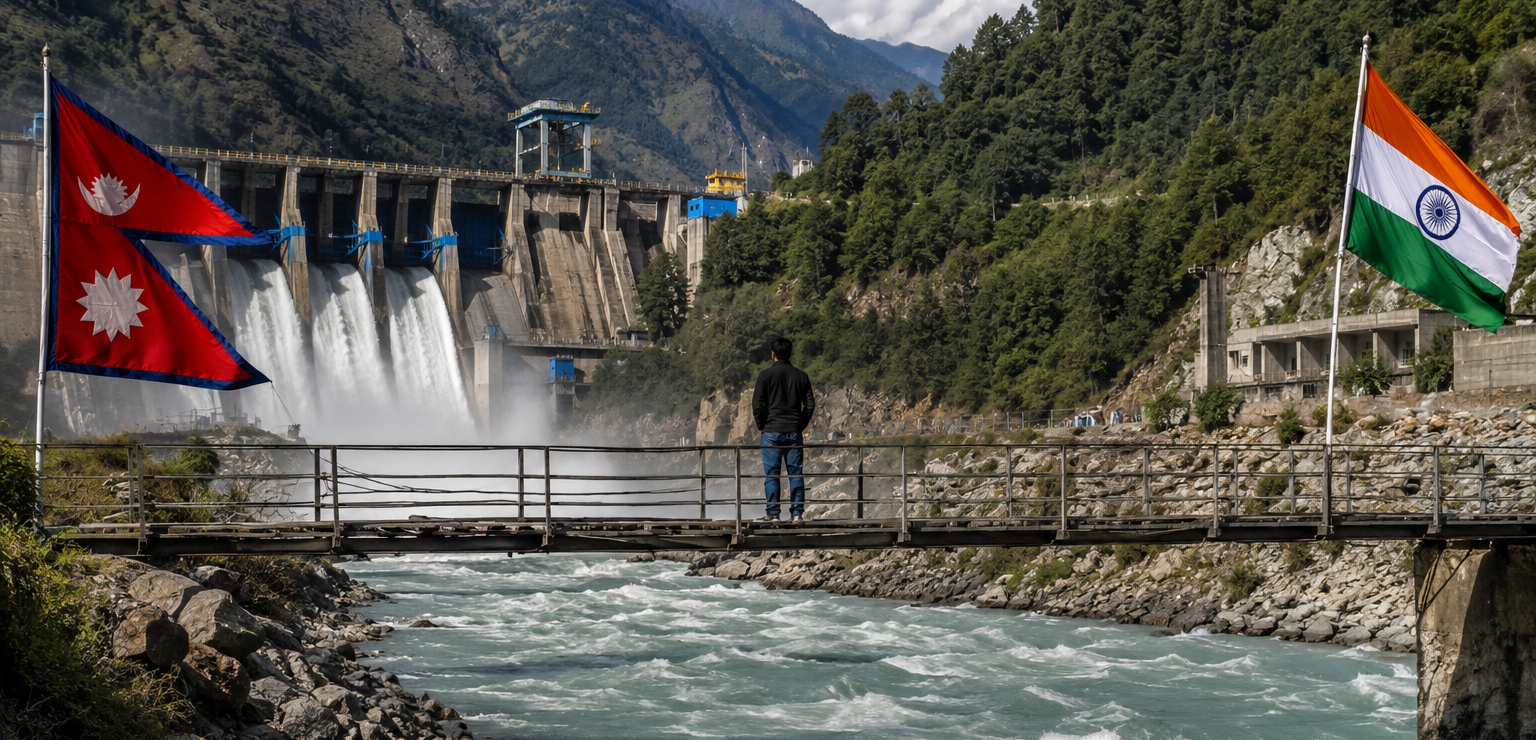
Fed by the Himalayas, Nepal’s rivers possess enormous potential for hydropower generation, irrigation, and economic development. These rivers are not only vital to Nepal’s future prosperity but are also of immense strategic and economic significance to India, where they contribute to irrigation, water security, and the generation of clean energy for one of the world’s fastest-growing economies. While such interests are natural and legitimate between neighboring countries sharing trans-boundary rivers, they have also made water resources a sensitive and often contested issue in Nepal-India relations.
Over the decades, disputes surrounding water-sharing arrangements, flood control measures, hydropower development, and the management of shared rivers have fueled concerns about sovereignty, fairness, and Nepal’s ability to pursue an independent development path. For many Nepalis, the debate is no longer merely about water; it is about ensuring that Nepal’s abundant natural resources serve the country’s own long-term developmental priorities while supporting equitable and mutually beneficial cooperation with its neighbors.
The origins of these concerns lie in a series of major water agreements concluded between Nepal and India during the twentieth century. The Kosi Agreement of 1954, later revised in 1966, was intended to control flooding, expand irrigation, and facilitate power generation. While the project has delivered substantial benefits to downstream regions in India, many Nepalis have questioned whether Nepal received a proportionate share of the gains. Similar concerns have been raised regarding the Gandak Agreement of 1959, which many believe disproportionately favored Indian agricultural interests while failing to deliver all the anticipated benefits to Nepal.
The Mahakali Treaty of 1996, built upon the principle of equal entitlement to the waters of the Mahakali River, was expected to herald a new era of cooperation. Yet decades later, the Pancheshwar Multipurpose Project remains unrealized, reinforcing doubts about whether Nepal has been able to secure equitable outcomes in major water negotiations. Collectively, these agreements continue to shape public perceptions and have become symbols of the broader challenge of managing asymmetrical relations between a small state and a much larger neighbor.
Recurring floods along the Nepal-India border have further complicated the relationship. Communities in Nepal frequently argue that embankments, barrages, and flood-control structures constructed near the border have contributed to waterlogging and inundation inside Nepali territory, while Indian authorities maintain that such infrastructure is necessary to protect vulnerable downstream populations. Every monsoon season, floods trigger renewed debates over responsibility and management. As climate change accelerates extreme weather events across the Himalayan region, the limitations of piecemeal approaches are becoming increasingly apparent. Sustainable solutions will require greater scientific cooperation, transparent data sharing, and basin-wide planning that recognizes the interconnected nature of shared river systems.
Water issues in Nepal are inseparable from questions of sovereignty. Rivers are not merely economic assets; they are strategic resources that influence food security, energy production, environmental resilience, and national development. Consequently, public debates over water agreements often reflect broader concerns about Nepal’s capacity to make independent decisions in pursuit of its national interests. Historical grievances and unresolved disputes have reinforced public sensitivity toward agreements perceived as limiting Nepal’s autonomy. This concern has become even more relevant as hydropower emerges as a cornerstone of Nepal’s economic aspirations.
Recent high-level engagements between Nepal and India have once again drawn attention to the future direction of bilateral relations. The visit of Rastriya Swatantra Party Chairperson Rabi Lamichhane to India, followed by Foreign Minister Shisir Khanal’s visit to New Delhi, attracted considerable public interest. Official discussions and public statements focused on development partnerships, connectivity, trade, and people-to-people relations. Notably, however, one of the most strategically important aspects of Nepal-India relations—water resources and the management of shared rivers—received little public attention. Given the central role that water plays in issues ranging from irrigation and flood control to hydropower development and economic cooperation, the relative absence of this subject from public discourse raises important questions about the future direction of bilateral engagement. Significantly, Foreign Minister Khanal emphasized that Nepal does not wish to carry the “old baggage” of the past and seeks to build relations with India on a forward-looking basis. Such an approach offers an opportunity not only to move beyond historical grievances but also to initiate a more transparent and balanced dialogue on issues that have long shaped the relationship, including the management and utilization of shared water resources.
For India, Nepal’s rivers are important not only as a source of clean energy but also for irrigation, flood management, water security, and agricultural productivity in downstream regions. Shared river systems naturally create interdependence between neighboring countries, and India’s interest in Nepal’s water resources is neither surprising nor inherently problematic. However, many Nepali water experts argue that this interest extends beyond electricity generation alone. Former Minister of Water Resources Deepak Gyawali has contended that India’s long-term interest lies in securing regulated water flows throughout the year for irrigation, flood control, and agricultural productivity. According to this perspective, large storage projects on Nepali rivers could provide downstream benefits that far exceed the value of the electricity generated.
Former Water Resources Secretary Dwarikanath Dhungel has similarly argued that hydropower projects should be viewed not only as energy ventures but also as instruments that shape long-term influence over river systems and water governance. Whether one fully agrees with these assessments or not, they reflect a longstanding concern among Nepali policymakers and experts that the development of water resources must be guided primarily by Nepal’s national interests rather than by external demand. The challenge for Nepal is therefore not to oppose cooperation but to avoid a situation in which its abundant water resources primarily serve external interests while the country’s own developmental priorities remain secondary.
The economic dimension of this challenge is particularly striking. Nepal is one of the most water-rich countries in the world. Fed by the Himalayas, its river systems possess enormous potential for hydropower generation, irrigation, and economic transformation. Energy development plays a significant role in the country’s prosperity, and hydropower is increasingly viewed as a cornerstone of Nepal’s long-term development strategy. Of Nepal’s estimated hydropower potential of approximately 83,000 megawatts, around 42,000 megawatts has been identified as economically and technically feasible for generation. Recognizing not only domestic consumption needs but also the potential for electricity exports, the Government of Nepal has been advancing the hydropower sector through the implementation of the Energy Development Roadmap, approved by the Cabinet. The roadmap seeks to accelerate development by promoting clear, investment-friendly, simple, and transparent policy arrangements while encouraging greater participation from the private sector. Yet despite decades of planning, policy focus, and growing investment, Nepal’s installed hydropower capacity remains only around 4,296 megawatts. This stark contrast highlights the wide gap between the country’s natural potential and its actual utilization, underscoring the urgent need for stronger domestic capacity, greater investment, and long-term strategic planning. According to national policy documents, out of more than 2.2 million hectares of irrigable land in the country, only a portion currently enjoys reliable year-round irrigation.
According to the Water and Energy Commission Secretariat, the effective utilization of water resources could significantly contribute to economic growth, reduce trade imbalances, and strengthen national prosperity. The question facing Nepal is therefore not simply how much electricity it can export, but how water resources can be mobilized to support irrigation, food security, industrialization, employment generation, and broader economic transformation at home.
The growing importance of hydropower has further elevated the strategic value of Nepal’s rivers. With immense untapped potential, hydropower offers an opportunity to transform the economy and reduce dependence on remittances. Yet current export arrangements remain heavily dependent on access to the Indian market. While India is the most logical and accessible destination for Nepali electricity exports, excessive reliance on a single buyer carries long-term risks. Changes in market conditions, regulatory policies, or political relations could affect Nepal’s bargaining position and economic prospects.
Concerns have also been raised regarding the implications of energy trade regulations and the increasing involvement of foreign companies in major hydropower projects. These developments reinforce the importance of maintaining national control over strategic resources while remaining open to foreign investment and cooperation.
The challenge before Nepal is therefore not whether to cooperate with India, but how to do so from a position of confidence and self-reliance. Strategic independence does not imply confrontation or isolation. Instead, it requires strengthening Nepal’s domestic capabilities, enhancing scientific and technical expertise, modernizing water infrastructure, improving flood forecasting and early warning systems, and ensuring that major agreements are negotiated transparently and with broad public participation.
Equally important is the diversification of energy markets. While India will remain a crucial partner for hydropower exports, Nepal should also pursue opportunities in Bangladesh and broader regional power networks to reduce dependence on a single buyer and enhance its bargaining power.
This approach is also consistent with the vision articulated in the Rastriya Swatantra Party’s “National Commitment” document, which presents a roadmap for governance reform and national development in an increasingly complex geopolitical environment. The document emphasizes safeguarding Nepal’s sovereignty, territorial integrity, and national interests while adapting to shifting regional and global dynamics. It calls for leveraging the rise of neighboring and global powers as opportunities for development through a calibrated diplomatic approach.
Significantly, it reaffirms Nepal’s commitment to strategic neutrality as a sovereign, independent, and non-aligned nation. Rejecting military alliances, geopolitical rivalry, and great-power competition, the framework advocates a policy of maintaining both equal distance and equal closeness with all countries. Its guiding principle, “Nepal First: Nepali First,” offers a useful lens through which Nepal can approach the management of its water resources—welcoming cooperation from all partners while ensuring that national interests, domestic development, and sovereign decision-making remain paramount.
Ultimately, Nepal’s vast water resources should be viewed not merely as commodities for export or instruments of regional cooperation, but as national assets capable of driving sustainable development and economic transformation. A forward-looking relationship with India, based on mutual respect, transparency, and equitable benefit-sharing, is fully compatible with Nepal’s pursuit of strategic independence.
By strengthening domestic institutions, investing in science and technology, diversifying partnerships, expanding irrigation, modernizing infrastructure, and insisting on equitable arrangements, Nepal can transform its rivers into a foundation for prosperity while preserving its sovereignty and strategic autonomy. The future of Nepal’s water diplomacy should therefore be guided by a simple principle: cooperation wherever possible, dependence nowhere. In doing so, Nepal can move beyond the limitations of the past and build a future in which its water resources serve first and foremost the interests and aspirations of the Nepali people. #nepal