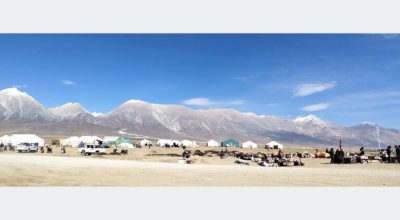




Humla, July 28: Residents of Hilsa, a border settlement along the Nepal–China frontier in Humla district, have been forced to rely on Chinese SIM cards for internet access due to the lack of reliable connectivity provided by Nepal Telecom.
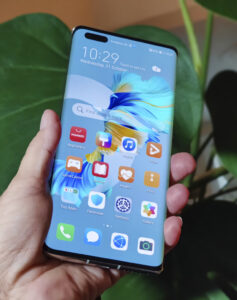
The absence of domestic internet services has left local residents, security personnel and government employees with no alternative but to use Chinese mobile networks, despite the high cost. Ram Raj Jaisi, Chief of the Yari Border Customs Office, said Nepalis living and working in the Hilsa border area have been using Chinese SIM cards because Nepal Telecom has yet to provide adequate internet services.
“Chinese SIM cards have become essential not only for personal communication but also for official work,” Jaisi said. According to local officials, more than 100 Chinese SIM cards are currently in use in Hilsa by government employees, security personnel, hotel operators and local residents.
Local trader Sonam Lama said purchasing a Chinese SIM card requires a valid passport. After obtaining the SIM card in China, users bring it back to Hilsa for use. He said the process has become increasingly complicated and expensive, making it difficult for many residents to obtain new SIM cards.
Many people continue using older Chinese SIM cards, leaving them in Hilsa during the winter months when they move elsewhere. Upon returning, they are required to pay accumulated service charges before reactivating the service, further increasing the financial burden.
Tashi Lhazom, a central committee member of the Rastriya Swatantra Party (RSP) who recently visited the area, said residents have no choice but to pay high fees for internet connectivity. She noted that the 2G tower installed by Nepal Telecom at Nara Lake to serve Hilsa does not provide reliable mobile network coverage, forcing residents to depend on Chinese mobile networks.
According to Lhazom, households in Hilsa spend between Rs. 4,000 and Rs. 5,000 per month on internet services through Chinese SIM cards. #nepal