


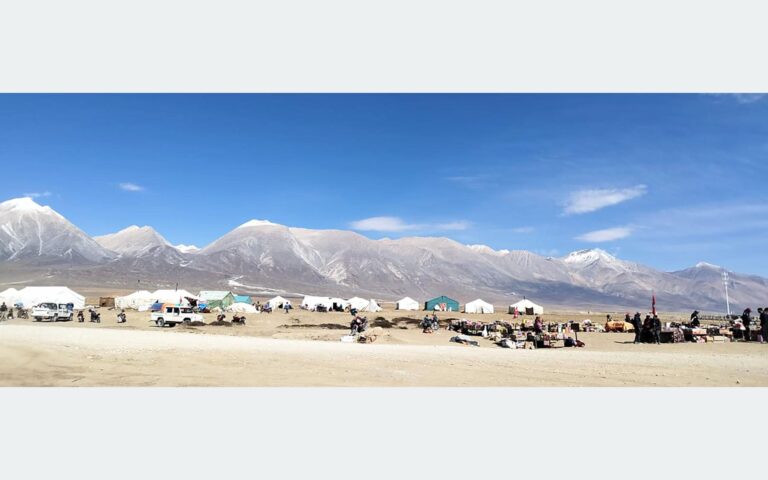
Mustang, July 27: Traders operating at the Korala border point in Upper Mustang have renewed calls for the government to construct permanent business infrastructure, saying the lack of basic facilities is hindering trade despite the border’s growing commercial importance.
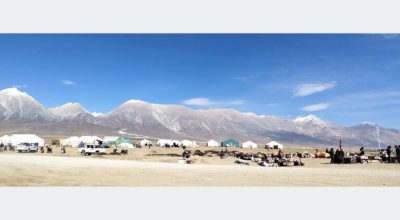
The issue was raised during a recent inspection of the Beni–Jomsom–Korala Road Project, part of the Kaligandaki Corridor, by Minister for Physical Infrastructure Development Sunil Lamsal. During the visit, local businessman Pema Chhiring Gurung urged the minister to build permanent commercial structures at the border, saying traders have been forced to operate from temporary tents for more than three years.
According to Gurung, strong winds frequently blow away the tents, while heavy snowfall damages them, making it difficult for businesses to operate year-round. Around 60 temporary tents are currently being used for commercial activities in the no-man’s-land near the border.
Traders from Chhoser have repeatedly appealed to the government through Gandaki Province Minister for Forests and Environment Namdu Gurung to develop durable business infrastructure, but say little progress has been made.
Local trader Karma Gurung said traders have consistently raised the issue with visiting federal and provincial ministers and senior government officials, requesting the development of essential infrastructure to make the border more business-friendly.
“On the Chinese side, Nepali traders have access to much better facilities. We have been operating from tents for more than three years,” he said. While China has already developed permanent structures and expanded settlements around the border area, traders say Nepal has yet to prioritize even basic infrastructure. They also expressed disappointment that the 2026/27 national budget did not allocate funding for such projects.
Khawa Tsering Gurung, a member of the Tent Business Committee, said around 150 people earn their livelihoods directly from businesses at the Korala border, while many drivers and laborers also depend on cross-border trade. However, the absence of adequate infrastructure has limited commercial expansion.
Lomanthang Rural Municipality Chairperson Tashi Nharbu Gurung said problems related to drinking water and toilet facilities have largely been addressed, but repeated efforts to secure support for permanent infrastructure have received little response from government agencies.
“Except for customs officials, employees of other government offices do not stay here. Immigration personnel are also absent. Without proper infrastructure, the border point has not become as active as expected,” he said. At present, traders cross into China each morning, conduct business during the day and return to Nepal with goods in the evening.
According to Newton Lamsal, Chief Administrative Officer of Lomanthang Rural Municipality, approximately 600 ropanis of land at the border are registered in the name of the Mustang Customs Office, creating legal obstacles to constructing permanent business facilities.
He said the municipality is coordinating with the relevant authorities to resolve the issue. Until a few years ago, local residents mainly organized periodic markets at Korala to import household goods. However, after cross-border trade expanded significantly following the reopening of the border, traders requested permanent business stalls.
Many local residents have also shifted from traditional occupations to transporting goods between the Korala border point and the Mustang Customs Office in Chhoser, located about 14 kilometres away. Situated at an altitude of 4,650 metres, the Korala border crossing was closed in the 1960s after Tibetan Khampa fighters used Nepali territory during their resistance following China’s incorporation of Tibet. #nepal